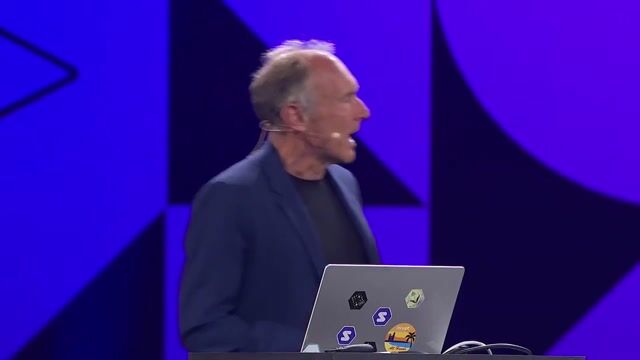
He created the web to break down silos, but big tech built them up again. Now, Sir Tim Berners-Lee reveals his plan to fix it for good.
#1about 4 minutes
The personal history and context behind the web's creation
The frustration of accessing fragmented documentation across incompatible computer systems at CERN directly inspired the invention of the World Wide Web.
#2about 2 minutes
Designing the core protocols of the early web
The web was built on three core, intentionally familiar standards: URIs for addressing, HTTP for transport, and a simple HTML for documents.
#3about 3 minutes
How blogging and open linking created early web value
The ability for anyone to publish and link to content created a virtuous circle of creation and a "long tail" of value from niche creators.
#4about 1 minute
How Web 2.0 platforms created powerful but isolated data silos
While JavaScript and APIs made web apps more powerful, they led to centralized platforms where user data is trapped and cannot be shared between services.
#5about 2 minutes
Introducing the Solid protocol for a decentralized web 3.0
Solid aims to fix data silos by providing a universal API, global single sign-on, and standardized authorization, giving users control over their data.
#6about 3 minutes
Changing the application architecture with Solid pods
The Solid architecture simplifies development by moving business logic into the browser and using a generic, application-agnostic data store called a pod.
#7about 6 minutes
Building an ecosystem of interoperable Solid applications
With a stable protocol, developers can build competing but interoperable applications that read and write to the same user-controlled data pods.
#8about 5 minutes
Analyzing the risks and architecture of current AI models
Today's large language models are controlled by large corporations, raising concerns about control, alignment, and the lack of user data privacy.
#9about 3 minutes
A new architecture for personal AI using Solid pods
By fine-tuning large language models with data from a personal Solid pod, AI can become a private, personalized tool that works for the user.
#10about 3 minutes
Empowering developers to build beneficent applications
Developers have the unique power to build a better web using protocols like Solid to create applications that truly help and empower users.
#11about 2 minutes
Reflecting on early design choices and the problem with DNS
The Domain Name System (DNS) was a design mistake because its commercialization created a messy, slow, and centralized point of failure.
#12about 2 minutes
Settling the tabs vs spaces debate and the web's growth
The definitive answer to the tabs versus spaces debate is to use spaces for Python due to semantic indentation, while also reflecting on the web's unpredictable growth.
Related jobs
Jobs that call for the skills explored in this talk.
Sir Tim Berners-Lee – the genius behind the World Wide WebWe are sure Sir Tim Berners-Lee does not need a lot of introduction. The man behind the World Wide Web and HTML is well-known not only in developer circles but amongst general masses as well. However, to show appreciation and joy for having Sir Tim a...
WWC24 Talk - Scott Hanselman - AI: Superhero or Supervillain?Join Scott Hanselman at WWC24 to explore AI's role as a superhero or supervillain. Scott shares his 32 years of experience in software engineering, discusses AI myths, ethical dilemmas, and tech advancements. Engage with his live demos and insights o...
From learning to earning
Jobs that call for the skills explored in this talk.