



.gif)
BB
Benedikt Bischof
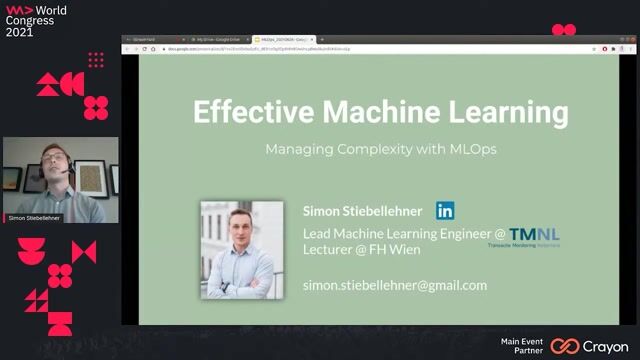
MLops – Deploying, Maintaining And Evolving Machine Learning Models in Production
almost 4 years ago
We are seeking a highly motivated postdoctoral researcher to lead the machine learning theme of this Prosperity Partnership between UCL and Lonza, working as part of a cross-disciplinary team across UCL and Lonza sites. The postholder will develop self-optimising algorithms, time-series forecasting models, and real-time feedback control loops that drive biomanufacturing optimisation. Working with high-frequency, multi-modal data streams from the bespoke PAT system integrated with continuous-flow microfluidic platforms, the postholder will design ML routines to pre-process complex spectroscopic data, predict critical process parameters and critical quality attributes concentrations. This role is funded for 2 years in the first instance, with potential for extension., You will hold (or be near completion of) a PhD in a relevant discipline such as machine learning, computer science, control engineering, biochemical engineering, chemical engineering, process systems engineering, or a related quantitative field. You will bring expertise in self-optimising / sequential model-based optimisation algorithms (e.g. Bayesian optimisation, gradient-descent variants, reinforcement or active learning), time-series forecasting, and the development of real-time feedback control. Strong programming skills in Python, with experience developing, implementing, and deploying optimisation and machine learning algorithms for real-time or data-intensive applications, are essential. Experience working with high-frequency sensor data, signal pre-processing, and integrating algorithmic workflows into experimental or industrial environments is desirable. Familiarity with bioprocessing, PAT (Raman, UV/Vis, fluorescence, scattering) or microfluidics is desirable but not essential. You will have excellent communication skills and the ability to work both independently and collaboratively across teams and institutions. A commitment to UCL’s values and to promoting equality, diversity and inclusion is essential.
The “Model-assisted, Self-optimising Unit Operations for Accelerated Bioprocess Optimisation” Prosperity Partnership is a collaborative programme between UCL Biochemical Engineering and Lonza Biologics, jointly funded by UKRI and Lonza. It will create a new bioprocess optimisation paradigm in which microfluidic platforms autonomously navigate to optimal process conditions by combining microfluidics, process analytical technologies (PAT) and machine learning (ML). The programme will appoint three Research Fellows across the technology themes (microfluidics, PAT and ML), working jointly across UCL and Lonza sites. UCL Biochemical Engineering is a global leader in bioprocess engineering research and education, with a mission to develop innovative biomanufacturing solutions for health and a sustainable bioeconomy. The department combines world-class facilities, strong industrial links, and an interdisciplinary research culture. Lonza Biologics is a leading Contract Development and Manufacturing Organisation (CDMO) with a turnover upward of £5.8bn, providing end-to-end services for biologics - from early discovery through clinical development to full-scale manufacturing of monoclonal antibodies, cell and gene therapies, and antibody-drug conjugates., As London’s Global University, we know diversity fosters creativity and innovation, and we want our community to represent the diversity of the world’s talent. We are committed to equality of opportunity, to being fair and inclusive, and to being a place where we all belong. We therefore particularly encourage applications from candidates who are likely to be underrepresented in UCL’s workforce. Our department holds an Athena Swan Gold award in recognition of our commitment and demonstrable impact in advancing gender equality. You can read more about our commitment to Equality, Diversity, and Inclusion here: https://www.ucl.ac.uk/equality-diversity-inclusion
This job is hosted externally. Click below to view the full posting and apply.
Apply on uk.indeed.comTalks and stories from around this role — technically off-topic, practically not.
3:28 min
1:50 min
 Nathaniel Okenwa · WWC 2024
2:36 min
2:14 min
2:10 min
4:25 min
.png)
.webp)
.png)

.webp)