






WeAreDevelopers LIVE • Oct 13, 2021

Geometric deep learning for drug discovery

Noah Weber

How do you search a chemical space of 10^60 to cure Alzheimer's? See how engineers leverage geometric deep learning and graph neural networks to generate protein-destroying molecules from scratch.

Pause
Mute Enter Fullscreen
#1 about 3 min

Challenges of treating diseases with undruggable proteins

Understanding why current pathogenic protein inhibition and DNA therapies often arrive too late or lack efficacy.

#2 about 4 min

Utilizing targeted protein degradation for therapeutic intervention

How connecting E3 ligase and a protein of interest with bridging molecules leads to successful degradation.

#3 about 3 min

Representing molecular interactions through non-Euclidean graph data

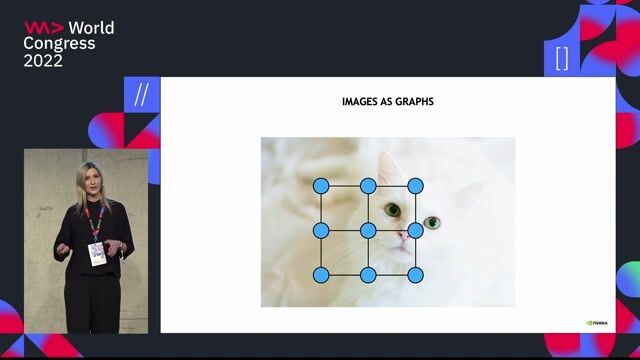
Graph architectures natively capture the complexities of inter-atomic states by using nodes and multiple edge types.

#4 about 6 min

Applying geometric deep learning to generalized graph operations

Generalized convolutional frameworks like PyTorch Geometric allow localized operations across spaces without directional Euclidean constraints.

#5 about 6 min

Structuring an end-to-end predictive pipeline for molecule pairing

Incorporating biological constraint calculations into predictions of how proteins and ligands establish initial bonding pairs.

#6 about 3 min

Exploring multidimensional spatial poses via Bayesian optimization

Smart parsing through complex molecule rotations limits excessive force-computation while discovering optimal relative spatial orientations.

#7 about 5 min

Validating probabilistic linker suggestions with chemoinformatics simulations

Using density functional theory tests to guarantee high dimensional probability rankings map to authentic physics constraints.

#8 about 3 min

Generating novel bridging molecules with constrained property models

Creating de novo linkers that satisfy strict graph metrics for acceptable toxicity limits and minimized positional energy.

#9 about 4 min

Orchestrating an AWS cloud architecture for spot instances

Serializing neural network architectures on EBS volumes guarantees resilient processing when running high-computation active learning batches.

#10 about 3 min

Building interdisciplinarity for viable biophysics machine learning

Why unifying biochemists, mathematicians, and engineers ensures predictive models represent accurate reality rather than isolated computational artifacts.

#11 about 9 min

Addressing technical strategies and interdisciplinary computing dynamics

Exploring questions on cloud provider deployment logistics, interaction energy formulation, and applying deep learning toward specific disease metrics.

Matching moments

3:00 min

Leveraging large quantitative models for intermediate quantum advantage

Yuval Dvir Yuval Dvir +1 · World Congress 2026 Europe

3:29 min

Solving optimization and simulation problems with nature's efficiency

John Fletcher John Fletcher +1 · World Congress 2026 Europe

11:07 min

Designing an automated and orchestrated machine learning target process

Simon Stiebellehner · World Congress 2021

2:03 min

Solving complex engineering challenges in artificial intelligence deployment

Nico Axtmann · World Congress 2022

2:14 min

Advancing biocatalyst research through quantum machine learning algorithms

Alexandra Waldherr · LIVE

7:10 min

Exploring pathways into the machine learning engineering field

Jose Luis Latorre Millas · LIVE