




Postdoctoral Fellows - Computational Biology & Machine Learning

The Henry M. Jackson Foundation for the Advancement of Military Medicine, Inc.
Bethesda, MD, United States
about 1 month ago

Role details

Contract type
Permanent contract
Employment type
Full-time (> 32 hours)
Experience required
0 years minimum
Compensation
$52,800.0 - $78,000.0
Working hours
Regular working hours
Languages
English

Tech stack

Artificial Intelligence Amazon Web Services Data Analysis Bioinformatics C++ (Programming Language) Cloud Computing Computational Biology Computer Simulation Python (Programming Language) Machine Learning NumPy Scientific Computating
+9 more
SciPy Workflow Management Systems Google Cloud Bioconductor Deep Learning Pandas Scikit Learn Information Technology Slurm

Job description

HJF is seeking Postdoctoral Fellow - Computational Biology & Machine Learning who will be responsible for initiating and carrying out research projects in collaboration with a research team consisting of scientific and clinical investigators. Candidates should have a strong working knowledge of computational biology and machine learning preferably in the area of single-cell and spatial omics, epigenomics, or liquid biopsy fragmentomics.

This position will be in support of Dr. Raunak Shrestha’s laboratory (https://sites.google.com/usuhs.edu/cpdr/research/labs/shrestha-lab) at the Center for Prostate Disease Research (CPDR), (https://sites.google.com/usuhs.edu/cpdr/home) at the Murtha Cancer Center Research Program (MCCRP). The Shrestha Lab is a computational cancer genomics and data science research group that focuses on elucidating the drivers of cancer progression and therapeutic resistance. We aim to advance personalized medicine and improve clinical outcomes for prostate cancer patients by understanding the complex interplay of the multi-omics information.

The Henry M. Jackson Foundation for the Advancement of Military Medicine (HJF) is a nonprofit organization dedicated to advancing military medicine. We serve military, medical, academic and government clients by administering, managing and supporting preeminent scientific programs that benefit members of the armed forces and civilians alike. Since its founding in 1983, HJF has served as a vital link between the military medical community and its federal and private partners. HJF’s support and administrative capabilities allow military medical researchers and clinicians to maintain their scientific focus and accomplish their research goals.

  • Lead Innovative research. Conceive and execute computational research projects, develop novel algorithms and analytical frameworks to interrogate large-scale, multidimensional omics datasets, and translate findings into clinically meaningful insights. Motivation to lead research projects under Principal Investigator’s supervision.
  • Build Artificial Intelligence (AI)/Machine Learning (ML) tools. Design, implement, document, and publicly release AI/ML models - including deep learning approaches - for integrative analysis of cancer genomic data, contributing resources that advance the broader scientific community.
  • Engineer scalable pipelines. Develop and maintain robust, reproducible computational pipelines for processing, integrating, and managing complex biomedical datasets across multiple data modalities.
  • Drive scientific communication. Lead and contribute to the preparation of high-impact scientific manuscripts, grant and fellowship applications, and conference presentations; represent the lab at national and international scientific meetings.
  • Collaborate across disciplines. Actively contribute to team meetings and foster a culture of scientific excellence within a diverse, interdisciplinary research environment.

Requirements

  • A PhD in Bioinformatics, Computational Biology, Systems Biology, Quantitative Genomics, Biomedical Engineering, Machine Learning, Computer Science (with a computational biology focus), or a closely related field is required.
  • Candidates at all stages of their postdoctoral career (0-5 years of postdoctoral experience) are encouraged to apply.

Required Knowledge, Skills and Abilities

  • Strong foundation in statistical and computational modeling and data analysis applied to genomics questions is required.
  • Experience with Artificial Intelligence (AI)/Machine Learning (ML) (deep learning) methods applied to cancer genomics is considered a strong asset.
  • Demonstrated experience developing or applying computational or statistical pipelines to molecular, biological, clinical, or multi-omics data.
  • Proficiency in Python, R, and/or C/C++, with hands-on experience using scientific computing libraries (e.g., pandas, NumPy, SciPy, scikit-learn, Bioconductor).
  • Demonstrated experience building or applying computational/statistical pipelines to molecular, clinical, or multi-omics datasets.
  • Proficiency with reproducible workflow management systems such as Snakemake, Nextflow, or equivalent pipeline frameworks.
  • Familiarity with cloud or high-performance computing (HPC) environments, such as Google Cloud, Amazon AWS, SLURM/SGE-based clusters, or equivalent infrastructure.
  • Experience applying AI/ML and deep learning methods to cancer genomics problems - particularly single-cell omics, spatial omics, epigenomics, or liquid biopsy fragmentomics is highly valued.
  • Prior work with large-scale biomedical datasets, including multi-omics, single-cell, spatial, clinical genomics, or treatment-response data is highly valued.
  • A track record of peer-reviewed publications commensurate with career stage in computational biology, bioinformatics, biomedical data science, or related fields is highly valued.
  • Proven ability to collaborate effectively within large, interdisciplinary teams.
  • Strong organizational skills with the ability to manage multiple priorities and meet deadlines in a fast-paced research environment.
  • Excellent written and verbal communication skills in English, including demonstrated scientific writing ability.
  • Ability to obtain and maintain a T1/Public Trust background check.

Physical Capabilities

  • Ability to stand or sit at a computer for prolonged periods.

Benefits & conditions

  • The annual salary range for this position is $52,800 - $78,000. Actual salary will be determined based on experience, education, etc., * HJF offers a comprehensive suite of benefits focused on your health and well-being, from medical, dental, and vision coverage to health savings and retirement plans, and more.

Apply for this position

This job is hosted externally. Click below to view the full posting and apply.

Apply on jobs.localjobnetwork.com

Good distractions

Talks and stories from around this role — technically off-topic, practically not.

4:54 min

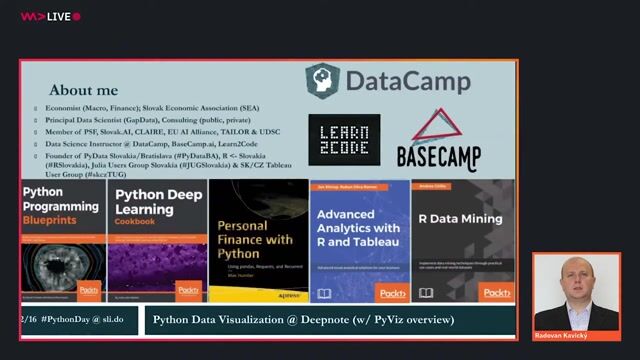
Development history of scientific computation libraries and PyViz tools

Radovan Kavický · LIVE

2:22 min

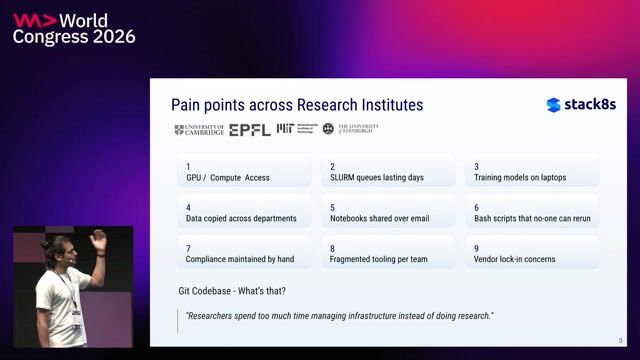
Infrastructure barriers and compliance risks in research

Jeremy Murray Jeremy Murray · WWC Europe 2026

2:34 min

Maximizing execution memory effectively via python numpy broadcasting

Jodie Burchell · LIVE

8:51 min

Addressing technical strategies and interdisciplinary computing dynamics

Noah Weber · LIVE

1:51 min

Managing GPU quotas and multi-tenancy with Kueue

Jeremy Murray Jeremy Murray · WWC Europe 2026

1:12 min

Using artificial intelligence in healthcare diagnostics and workforce surveillance

Chris Heilmann +2 · LIVE

Videos

See all

Related articles

See all