

Senior Software Engineer, AI Inference Systems

Nvidia
Würselen, Germany
1 day ago
Apply on www.xing.com
Prepare application

Role details

Contract type
Permanent contract
Employment type
Full-time (> 32 hours)
Experience level
Expert
Experience required
5 years minimum
Working hours
Regular working hours
Job source

Tech stack

Artificial Intelligence Amazon Web Services Microsoft Azure C++ (Programming Language) Computer Clusters Compilers Nvidia CUDA Computer Programming Computer Engineering Continuous Integration Software Debugging Linux
+20 more
Distributed Systems Github Python (Programming Language) Tensorflow Software Engineering Virtualization Technology Graphics Processing Unit (GPU) High Performance Computing Pytorch Large Language Models Deep Learning Multi-Cloud Parallel Computation Gpu Programming Containerization Kubernetes Information Technology Slurm Machine Learning Operations Docker

Job description

We are seeking highly skilled and motivated software engineers to join us and build AI inference systems that serve large-scale models with extreme efficiency. You’ll architect and implement high-performance inference stacks, optimize GPU kernels and compilers, drive industry benchmarks, and scale workloads across multi-GPU, multi-node, and multi-cloud environments. You’ll collaborate across inference, compiler, scheduling, and performance teams to push the frontier of accelerated computing for AI.

What you’ll be doing:

  • Contribute features to vLLM that empower the newest models with the latest NVIDIA GPU hardware features; profile and optimize the inference framework (vLLM) with methods like speculative decoding, data/tensor/expert/pipeline-parallelism, prefill-decode disaggregation.
  • Develop, optimize, and benchmark GPU kernels (hand-tuned and compiler-generated) using techniques such as fusion, autotuning, and memory/layout optimization; build and extend high-level DSLs and compiler infrastructure to boost kernel developer productivity while approaching peak hardware utilization.
  • Define and build inference benchmarking methodologies and tools; contribute both new benchmark and NVIDIA’s submissions to the industry-leading MLPerf Inference benchmarking suite.
  • Architect the scheduling and orchestration of containerized large-scale inference deployments on GPU clusters across clouds.
  • Conduct and publish original research that pushes the pareto frontier for the field of ML Systems; survey recent publications and find a way to integrate research ideas and prototypes into NVIDIA’s software products.

Requirements

  • Bachelor’s degree (or equivalent expeience) in Computer Science (CS), Computer Engineering (CE) or Software Engineering (SE) with 7+ years of experience; alternatively, Master’s degree in CS/CE/SE with 5+ years of experience; or PhD degree with the thesis and top-tier publications in ML Systems, GPU architecture, or high-performance computing.
  • Strong programming skills in Python and C/C++; experience with Go or Rust is a plus; solid CS fundamentals: algorithms & data structures, operating systems, computer architecture, parallel programming, distributed systems, deep learning theories.
  • Knowledgeable and passionate about performance engineering in ML frameworks (e.g., PyTorch) and inference engines (e.g., vLLM and SGLang).
  • Familiarity with GPU programming and performance: CUDA, memory hierarchy, streams, NCCL; proficiency with profiling/debug tools (e.g., Nsight Systems/Compute).
  • Experience with containers and orchestration (Docker, Kubernetes, Slurm); familiarity with Linux namespaces and cgroups.
  • Excellent debugging, problem-solving, and communication skills; ability to excel in a fast-paced, multi-functional setting.

Ways to stand out from the crowd

  • Experience building and optimizing LLM inference engines (e.g., vLLM, SGLang).
  • Hands-on work with ML compilers and DSLs (e.g., Triton, TorchDynamo/Inductor, MLIR/LLVM, XLA), GPU libraries (e.g., CUTLASS) and features (e.g., CUDA Graph, Tensor Cores).
  • Experience contributing to containerization/virtualization technologies such as containerd/CRI-O/CRIU.
  • Experience with cloud platforms (AWS/GCP/Azure), infrastructure as code, CI/CD, and production observability.
  • Contributions to open-source projects and/or publications; please include links to GitHub pull requests, published papers and artifacts.

Benefits & conditions

Your base salary will be determined based on your location, experience, and the pay of employees in similar positions. For Poland: The base salary range is 292,500 PLN - 507,000 PLN for Level 4, and 375,000 PLN - 650,000 PLN for Level 5.

About the company

At NVIDIA, we believe artificial intelligence (AI) will fundamentally transform how people live and work. Our mission is to advance AI research and development to create groundbreaking technologies that enable anyone to harness the power of AI and benefit from its potential. Our team consists of experts in AI, systems and performance optimization. Our leadership includes world-renowned experts in AI systems who have received multiple academic and industry research awards. If you’re excited to build systems, kernels, and tools that make large-scale AI faster, more efficient, and easier to deploy, we’d love to hear from you., NVIDIA

Apply for this position

This job is hosted externally. Click below to view the full posting and apply.

Apply on www.xing.com
Prepare application

Good distractions

Talks and stories from around this role — technically off-topic, practically not.

2:07 min

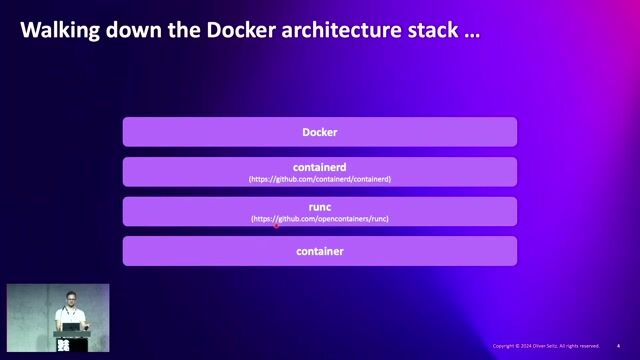
Inspecting default bridge architectures and custom Docker networks

Oliver Seitz Oliver Seitz · World Congress 2025

52 sec

Running persistent Linux environments directly on Windows

Ben Breard Ben Breard · World Congress 2025

2:22 min

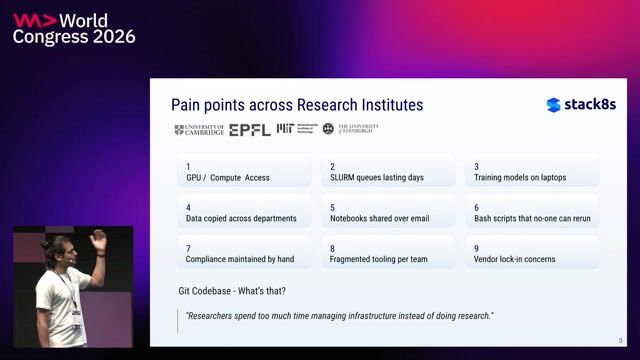
Infrastructure barriers and compliance risks in research

Jeremy Murray Jeremy Murray · World Congress 2026 Europe

2:33 min

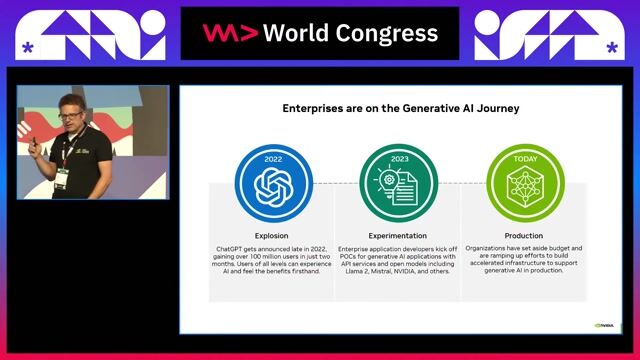
Architecting CUDA and the AI software stack

Michael Kagan Michael Kagan +1 · World Congress 2026 Europe

1:24 min

Comprehensive AI infrastructure stacks at the Linux Foundation

Matt White Matt White · World Congress 2025

2:34 min

Docker sandbox architecture and microVM environment integration

Manuel de la Peña Manuel de la Peña · World Congress 2026 Europe
Videos

See all

Related articles

See all