
Postdoctoral Research Associate, Large Foundation Models and Causal Inference for Scientific Discovery

The Rector & Visitors Of The University Of Virginia
Charlottesville, VA, United States
14 days ago
Apply on diversityjobs.com
Prepare application

Role details

Contract type
Temporary contract
Employment type
Full-time (> 32 hours)
Compensation
$60,000.0
Working hours
Regular working hours

Tech stack

Artificial Intelligence Data Analysis Big Data Computer Simulation Data Mining Desktop Computing Distributed Computing Environment General-Purpose Computing on Graphics Processing Units Information Sciences Machine Learning Natural Language Processing Electrical and Computer Engineering
+4 more
Large Language Models Deep Learning Information Technology Free and Open-Source Software

Job description

collaborate with researchers across disciplines, mentor graduate students, publish in leading venues, and develop an independent research profile. The Postdoctoral Research Associate will report to Sheng Li, PhD, and work closely with members of the RISE Lab and interdisciplinary collaborators at the University of Virginia and partner institutions., * Lead independent and collaborative research projects involving foundation models, causal inference, causal discovery, causal machine learning, and AI-enabled scientific discovery.

  • Formulate research questions, develop novel methods and algorithms, and design rigorous computational experiments.
  • Investigate how foundation models can incorporate scientific and domain knowledge to generate, refine, and evaluate causal hypotheses.
  • Develop causal methods for improving the reasoning, trustworthiness, interpretability, robustness, safety, and generalizability of foundation models.
  • Develop benchmarks, datasets, evaluation protocols, and reproducible research software.
  • Prepare high-quality manuscripts for peer-reviewed conferences and journals.
  • Mentor graduate students and provide guidance on research design, technical implementation, scientific writing, and presentations.
  • Participate actively in interdisciplinary collaborations with researchers in data science, computer science, statistics, health, education, and other scientific domains.
  • Contribute to research proposals, project reports, open-source software, and other scholarly products, as appropriate.
  • Maintain high standards for research integrity, reproducibility, responsible AI, and ethical use of data and computational models., This is primarily a sedentary job involving extensive use of desktop computing. The job may occasionally require travel to attend scientific conferences, workshops, project meetings, and other professional activities.

Requirements

  • Doctoral degree (PhD or equivalent) in Data Science, Computer Science, Machine Learning, Statistics, Electrical and Computer Engineering, Information Science, or a closely related quantitative field. All doctoral requirements must be completed at the time of hire.
  • Strong publication record commensurate with experience, demonstrating original research contributions.
  • Demonstrated research expertise in at least one of the following areas:
  • Foundation models, large language models, multimodal learning, natural language processing, generative AI, or deep learning; or
  • Causal inference, causal discovery, causal machine learning, graphical models, experimental design, or related statistical methodology.
  • Experience designing and conducting computational research, analyzing results, and communicating research findings.
  • Ability to lead research projects with appropriate faculty guidance while working effectively as part of a collaborative team.
  • Strong written and oral communication skills.
  • Commitment to rigorous, reproducible, and ethical research practices., * A strong publication record commensurate with career stage, particularly in leading AI, machine learning, natural language processing, or data-mining venues such as NeurIPS, ICML, ICLR, ACL, EMNLP, NAACL, KDD, or comparable selective conferences and journals.
  • Demonstrated research contributions connecting foundation models with causal inference, causal discovery, or scientific reasoning.
  • Experience with one or more of the following foundation-model topics:
  • Pretraining, post-training, fine-tuning, parameter-efficient adaptation, alignment, or evaluation;
  • Model reasoning, agentic workflows, tool use, or knowledge integration;
  • Large language models, multimodal foundation models, or scientific foundation models;
  • Trustworthiness, safety, fairness, interpretability, robustness, or out-of-distribution generalization.
  • Experience with one or more causal research areas, such as causal discovery, treatment-effect estimation, counterfactual reasoning, causal representation learning, mediation analysis, transportability, invariant learning, or causal experimental design.
  • Experience working with large-scale datasets, GPU computing, or distributed training.
  • Evidence of research leadership, creativity, and the ability to identify and pursue original research directions.
  • Experience mentoring or collaborating with graduate or undergraduate researchers., Education: Doctoral degree

Benefits & conditions

$60,000 life insurance, parental leave, paid time off United States, Virginia, Charlottesville 1215 Lee Street (Show on map) Aug 21, 2026, This position will remain open until it is filled. This is a full-time in-person position at the School of Data Science at the University of Virginia in Charlottesville, VA. The initial appointment is for one year; however, the appointment may be renewed for an additional year contingent upon funding and satisfactory performance. This is an exempt level, benefited position. This is a restricted position.

Anticipated Salary: $60,000

Anticipated Start Date: September or October 2026

Health and Other Benefits (visit Health and Other Benefits for additional information)

  • UVA Health Plan: the choice between 3 different health plans
  • Vision Coverage
  • Dental Plan
  • Benefit Savings Plans
  • Life Insurance
  • Disability Benefits
  • Paid Time Off: starting with 22 days of time off per year, 12 or more holidays, 8 weeks parental leave

Education Benefits (visit Education Benefits for additional information). After six months of employment, full-time and part-time (20+ hours) employees in a benefits-eligible position are offered options of:

  • Use of up to $5250 per calendar year towards a for-credit degree program or for-credit certificate program
  • Use of up to $2000 of the total $5250 noted above per calendar year for professional development including job-related training, conferences, and initial certificate exams.

About the company

The University of Virginia School of Data Science-the first of its kind in the nation-advances discovery, innovation, and societal impact through collaborative, open, and responsible data science research and education. Founded in 2019, theSchoolbrings togetherexpertiseacross business, computation, engineering, humanities, law, mathematics, socialsciences,statistics, and law to address complex, realworld challenges. Its academic offerings include a B.S. in Data Science, an undergraduate minor, residential and online M.S. in Data Science programs, and a Ph.D. in Data Science, all designed to prepare students for a rapidly evolving datadriven world.

Apply for this position

This job is hosted externally. Click below to view the full posting and apply.

Apply on diversityjobs.com
Prepare application

Good distractions

Talks and stories from around this role — technically off-topic, practically not.

3:28 min

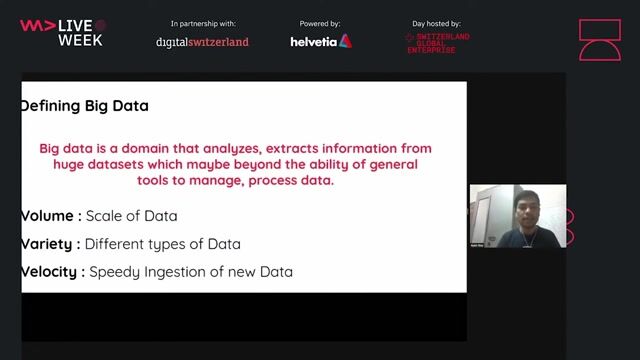
Defining big data and machine learning fundamentals

Ayon Roy · LIVE

2:31 min

Data mining literary works for language patterns

Jen Looper Jen Looper · Europe 2026 Virtual

1:48 min

Automating exploratory data analysis within training pipelines

Dora Petrella · World Congress 2023

1:01 min

Understanding foundation models and generative AI capabilities

Timo Salm Timo Salm · World Congress 2025

2:10 min

Why organizations combine big data and machine learning

Ayon Roy · LIVE

2:50 min

Transitioning from deep learning models to foundation software

Marcel Scherenberg Marcel Scherenberg · World Congress 2025

Videos

See all

Related articles

See all