
Research Informatics Software Engineer

Excelsior Sciences Inc.
New York, NY, United States
1 day ago
Apply on www.thejobnetwork.com
Prepare application

Role details

Contract type
Permanent contract
Employment type
Full-time (> 32 hours)
Compensation
$120,000.0 - $160,000.0
Working hours
Regular working hours

Tech stack

Application Programming Interfaces (APIs) Artificial Intelligence Airflow Amazon Web Services Business Analytics Applications Data Analysis C++ (Programming Language) Cloud Computing Continuous Integration Data Validation Information Engineering Data Infrastructure
+26 more
Cursor (Graphical User Interface Elements) Digital Technology Graph Database Python (Programming Language) Laboratory Information Management Systems PostgreSQL Neo4j Performance Tuning Scientific Computating Software Construction Software Engineering SQL Databases Enterprise Software Applications Feature Engineering GitHub Copilot Pytorch Large Language Models Multi-Agent Systems Apache Spark Backend Kubernetes Information Technology Virtual Agents Data Pipelines Docker Databricks

Job description

  • Integrate, extend, and support vendor Laboratory Information Management Systems (LIMS), Electronic Lab Notebooks (ELN), and analytical informatics platforms. Scope includes platforms such as Genedata, CDD Vault, Virscidian Analytical Studio, and similar systems-focusing on data models, workflows, APIs, sample/analytical data flows, and connections to instruments and enterprise systems.
  • Design, implement, and maintain scalable data pipelines and APIs that make scientific data (samples, assays, analytical results, automation streams) FAIR, high-quality, and machine-actionable for both human scientists and AI agents. Leverage modern data platforms, warehouses/lakes, and orchestration tools.
  • Build and operate cloud-native components (primarily AWS) using containers (Docker/Kubernetes), infrastructure patterns, CI/CD, and workflow orchestration to support lab informatics and AI workloads.
  • Prototype and productionize agentic AI / GenAI solutions-LLM agents, RAG and GraphRAG systems, multi-agent workflows, and prompt-engineered / retrieval-augmented pipelines-that automate or augment laboratory informatics processes, data interpretation, and closed-loop experimentation.
  • Collaborate with research scientists and cross-functional engineering teams to translate scientific needs into reliable software, data products, and AI capabilities; contribute to documentation, testing, and knowledge transfer.
  • Apply software engineering best practices (agile / AI-agile delivery, testing, schema design, performance tuning) in a scientific computing context.
  • Support continuous improvement of lab digital systems, including data quality, observability, and readiness for AI agents.

Requirements

  • Master’s degree in Computer Science (or a closely related field) with relevant coursework in cloud computing and the fundamentals of AI and ML.
  • Demonstrated experience building data pipelines, feature engineering, or scientific data workflows (e.g., Spark/Databricks-style pipelines, data quality checks, performance tuning).
  • Hands-on experience with cloud platforms (AWS), containers (Docker/Kubernetes), and modern data/backend tools (SQL, PostgreSQL, orchestration frameworks).
  • Strong proficiency with AI coding assistants and coding agents (e.g., Cursor, Claude Code, GitHub Copilot, or similar tools).
  • Familiarity with LLM concepts, RAG, retrieval, or multi-agent systems (coursework, projects, or professional exposure).
  • Willingness and aptitude to rapidly learn commercial LIMS/ELN or analytical platforms (e.g., Genedata, CDD Vault, Virscidian Analytical Studio); prior exposure is a plus.
  • Proficiency in Python and SQL; additional experience with C++/C, high-performance ML tooling, or scientific computing libraries is a plus.
  • Strong collaboration skills and ability to work at the intersection of software engineering, data, and scientific applications.

Preferred Qualifications

  • Practical, hands-on experience with LLM / agentic AI systems, including RAG, GraphRAG, multi-agent architectures, or production retrieval-augmented pipelines.
  • Experience optimizing high-performance ML or scientific models (e.g., protein structure prediction, surrogate modeling, Bayesian optimization).
  • Hands-on work with multi-agent systems, knowledge graphs (Neo4j), or agent frameworks/SDKs.
  • Familiarity with Airflow or Prefect, PyTorch, and related ML/LLM tooling.
  • Direct experience with commercial LIMS/ELN or analytical platforms such as Genedata, CDD Vault, Virscidian Analytical Studio, or similar-especially their data models, APIs, and integration points.
  • Experience with CI/CD, testing, schema design, and production-grade software practices.
  • Interest in applying agentic AI and robust data engineering to laboratory and drug-discovery workflows.

Benefits & conditions

The salary range for this position is $120,000- $160,000 per year. The actual compensation offered will be based on factors such as relevant experience, education, and skills. In addition to base salary, we offer a comprehensive benefits package, including health insurance, paid time off and other benefits.

Apply for this position

This job is hosted externally. Click below to view the full posting and apply.

Apply on www.thejobnetwork.com
Prepare application

Good distractions

Talks and stories from around this role — technically off-topic, practically not.

2:24 min

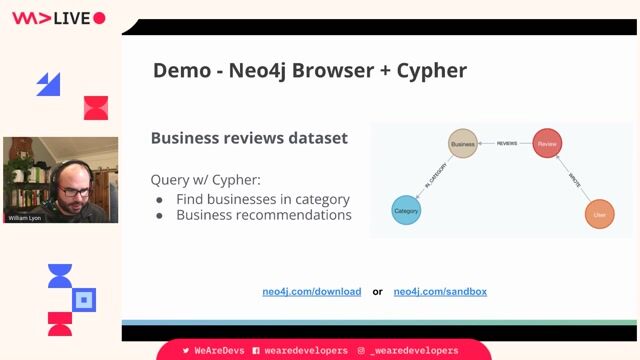
Comparing Neo4j and GraphQL conceptual models

William Lyon · LIVE

2:07 min

Inspecting default bridge architectures and custom Docker networks

Oliver Seitz Oliver Seitz · World Congress 2025

2:15 min

Empowering domain teams with an open data platform

Sandhya Menon Sandhya Menon · World Congress 2026 Europe

3:23 min

Exploring specialized career paths within the data science ecosystem

Julian Joseph · LIVE

3:30 min

Introduction to Neo4j and remote developer relations work

3:14 min

Structuring career paths and localized data architectures

Ulrich Wurstbauer +1 · LIVE

Videos

See all

Related articles

See all