World Congress 2026 Europe Jul 9, 2026 Session details

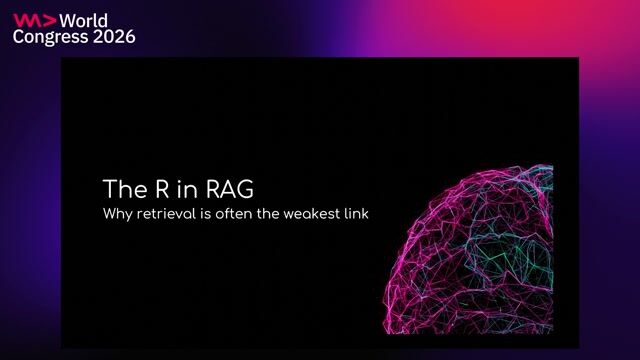
The R in RAG: Why retrieval is often the weakest link (and how to fix it)

Tomek Porożyński

Why is your RAG application failing on domain-specific queries? Discover how to fix architectural retrieval flaws and fine-tune embedding models in under a minute.

Pause
Mute Enter Fullscreen
#1 about 3 min

The weakest link in retrieval augmented generation systems

Standard large language models lack specific domain knowledge and require document retrieval mechanisms for accuracy.

#2 about 3 min

Differences between sparse and dense document retrieval methods

The choice between vocabulary-driven sparse matching and meaning-driven dense searching dictates semantic capabilities.

#3 about 2 min

Combining capabilities with hybrid and agentic retrieval strategies

Hybrid methods merge exact term catching and semantic meaning while autonomous agents iteratively refine search context.

#4 about 4 min

Using advanced retrieval methods like graph rag and raptor

Knowledge graphs map entity relationships and hierarchical clustering abstracts large documents for complex multi-hop reasoning.

#5 about 1 min

Matching specific retrieval techniques to underlying system weaknesses

Determining the optimal fix depends entirely on balancing execution speed and specific information retrieval barriers.

#6 about 4 min

Addressing domain-specific terminology via embedding model fine-tuning

Off-the-shelf embedding models fail on internal company jargon but targeted fine-tuning securely realigns vector spaces.

#7 about 2 min

Shifting vector space distributions using targeted loss functions

Triplet and multiple negative ranking loss functions strategically cluster positive matches while repelling disparate terms.

#8 about 4 min

Evaluating baseline similarity scores in python notebook environments

Python libraries load foundational elements and define benchmarking functions to measure out-of-the-box accuracy gaps.

#9 about 3 min

Preparing training datasets and executing fast model fine-tuning

Providing paired positive and negative examples accelerates deployment without requiring massive datasets or specialized infrastructure.

#10 about 5 min

Evaluating fine-tuned model performance on cross-language user queries

Custom embedding adjustments reliably propagate through semantic vectors to correctly map similar concepts across different language inputs.

#11 about 4 min

Selecting practical retrieval strategies for specific application workflows

Navigating the trade-offs between computational overhead and search relevance ensures successful real-world operational deployments.

Matching moments

2:18 min

Demystifying retrieval augmented generation and fine-tuning models

Simon Müller Simon Müller · World Congress 2024

3:20 min

Enhancing models with retrieval augmented generation and fine-tuning

Aarno Aukia · LIVE

2:05 min

Enhancing language models with retrieval-augmented generation

Mary Grygleski Mary Grygleski · LIVE

1:44 min

Understanding basic retrieval-augmented generation architectures in chatbots

Stan Girard Stan Girard · World Congress 2024

1:57 min

Understanding overarching retrieval and generation steps in RAG architectures

Csenge Szabo Csenge Szabo · Europe 2026 Virtual

3:50 min

Building local RAG architectures using the Anything LLM tool

Cedric Clyburn Cedric Clyburn +1 · World Congress 2025

Upcoming sessions on this topic

Open session

World Congress 2026 North America

September 24, 2026 · 16:10–16:40

Stage 1

Stop Blaming the Model: The Art and Science of Context Engineering and Architecture

Lena Hall, Thorsten Hans

Lena Hall
Thorsten Hans
Open session

World Congress 2026 North America

September 25, 2026 · 16:10–16:40

Stage 6

Beyond SQL Generation: How to Teach Agents What Your Database Actually Means

Kris Jenkins

Host / Developer Voices

Kris Jenkins
Open session

World Congress 2026 North America

September 25, 2026 · 14:10–14:40

Stage 4

Headroom: A Context Optimization Layer for LLM Applications

Tejas Chopra

Senior Software Engineer at Netflix

Tejas Chopra
Open session

World Congress 2026 North America

September 24, 2026 · 13:30–14:00

Stage 9

Understanding LLM Architectures: Inside the Design of Modern Models

Jofia Jose Prakash

Director - AI & Governance at Humanity + AI, Inc

Jofia Jose Prakash
Open session

World Congress 2026 North America

September 24, 2026 · 17:30–18:00

Stage 6

No Single Model to Rule Them All: Building Resilient AI Agents Across Open & Closed LLMs

Emmanuel Acheampong

Senior Manager Developer Relations at Crusoe AI

Emmanuel Acheampong
Open session

World Congress 2026 North America

September 24, 2026 · 10:20–10:50

Stage 5

Vector, Graph, or Key Value? Choosing Your Agent's Memory

Elizabeth Fuentes Leone

AWS - Developer Advocate/SDE, GenAI

Elizabeth Fuentes Leone