


World Congress 2026 Europe Jul 9, 2026 Session details

Goodbye Microservices, Hello Self-Contained Systems

Simon Martinelli

Are microservices drowning your team in synchronous API complexity? Discover how Self-Contained Systems bundle UI, logic, and data to create resilient, autonomous, AI-ready architectures.

Pause
Mute Enter Fullscreen
#1 about 2 min

Handling data integration and eventual consistency

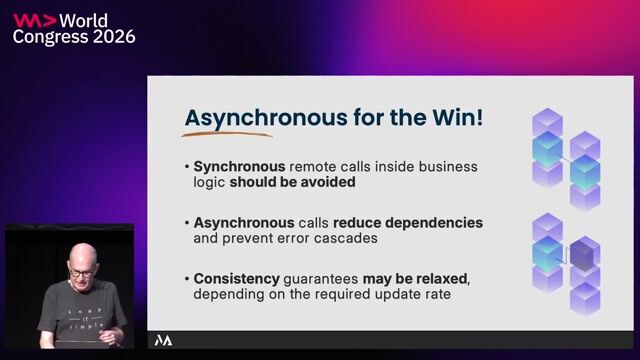
Integration between self-contained systems relies on eventual consistency, linked web interfaces, and asynchronous events rather than synchronous service calls.

#2 about 2 min

Four core advantages of self-contained architectures

Self-contained systems offer robust resilience, separate domain-specific quality requirements, independent horizontal scalability, and highly flexible vendor integrations.

#3 about 2 min

Empowering AI development with bounded contexts

Bounded contexts that group user interfaces, business logic, and databases form an ideal logical scope for AI coding assistants.

#4 about 1 min

Modernizing a legacy Java ERP monolithic architecture

A practical approach to successfully refactoring an aging monolithic application involves migrating functionality into strictly isolated processing domains.

#5 about 3 min

Strategies for database replication and intentional redundancy

Complex architectures maintain pure domain isolation by replicating read-only reference data through intentional database redundancy and specialized materialized views.

#6 about 1 min

Implementing event streams for real-time updates

Time-sensitive external domain actions demand broadcasting asynchronous events to instantly synchronize external states across various isolated databases.

#7 about 2 min

Defining macro-architecture and standard integration patterns

A deliberate macro-architecture supplies shared design systems, service locators, and concrete guidelines for toggling between broad database replication strategies and dedicated message brokers.

#8 about 2 min

Applying the strangler fig pattern for migrations

Incrementally replacing a monolithic codebase with bounded system modules mitigates severe deployment risks by allowing temporary parallel execution.

#9 about 3 min

Aligning engineering topology directly with business boundaries

Eliminating rigid synchronous dependencies allows substantially smaller, domain-focused engineering squads to fully retain functional context and release software autonomously.

Matching moments

3:18 min

Transitioning from a monolith to a microservice architecture

Aleksandr Kalikov · LIVE

5:43 min

Eliminating unnecessary layers of abstraction inside microservices

Stefan Priebsch · WWC 2021

2:14 min

Evaluating data storage limitations and monolithic architectural challenges

George Asafev · WWC 2023

5:06 min

Modernizing legacy applications through proactive leadership

Babette Wagner Babette Wagner · Coffee With Developers

2:36 min

Modern application stacks and real-time data requirements

Tim Faulkes · LIVE

2:26 min

Transitioning from a monolith to service-oriented architecture

Florian Mair Florian Mair · WWC 2024

Upcoming sessions on this topic

Open session

World Congress 2026 North America

MicroAgents: The Microservices of the Agentic Era

Ashish Shubham

Runs the show bussiness at ThoughtSpot

Ashish Shubham
Open session

World Congress 2026 North America

Microservice Cognitive Index for Deploy Diagnosis and Change Impact

Sachin Gupta

Member of Technical Staff 2 at eBay

Sachin Gupta
Open session

World Congress 2026 North America

From Legacy to Longevity – How a 17-Year-Old System stayed Modern

Alexander Arians

Empowering Engineers to drive innovation

Alexander Arians
Open session

World Congress 2026 North America

Look What Java Can Do Now: Live-Coding a GenAI MCP Server with the JAQ Stack

Suren Konathala

Senior Engineering Leader, Marketing & AdTech, AI GTM & Digital Experience Platforms, Java x AI

Suren Konathala
Open session

World Congress 2026 North America

From Cloud Native to Multi-Cloud Native: Write Once, Deploy Anywhere

Sandeep Pal

Principal Member of Technical Staff at Salesforce

Sandeep Pal
Open session

World Congress 2026 North America

Designing APIs That Survive AI Agents at Scale

Phani Pendurthi

Mastercard, Principal Software Engineer

Phani Pendurthi