World Congress 2026 Europe • Jul 9, 2026 • Session details

Ship Smarter Agents, Not Bigger Prompts

April Yoho

Bigger prompts don't mean better agents. Stop wasting tokens on overloaded context windows. Discover a structured framework to build smarter, cost-effective AI workflows with GitHub Copilot.

Pause
Mute Enter Fullscreen
#1 about 2 min

Maximizing developer time with artificial intelligence tool integrations

Integrating automated frameworks helps programmers focus exclusively on building complex logic instead of sustaining redundant operational tasks.

#2 about 1 min

Advancing development workflows from autocomplete to autonomous agents

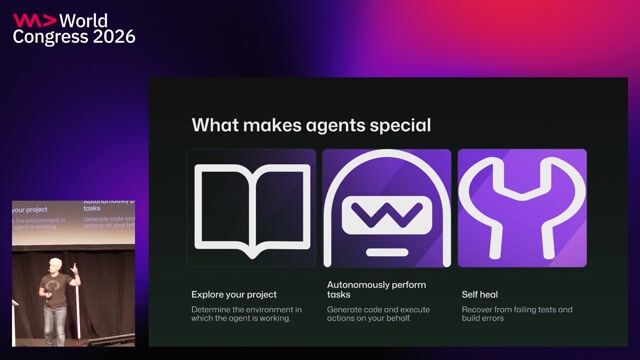
Intelligent autonomous components dynamically explore large projects and self-heal during routine code generation activities.

#3 about 1 min

Establishing strict execution boundaries and guidelines for models

Applying rigid boundaries and specialized input context guidelines ensures systems output accurate solutions without excessive guessing.

#4 about 2 min

Defining agent instructions using markdown files and servers

Structuring markdown manifests provides clear instructional context before integrating supplementary logic from external data servers.

#5 about 2 min

Developing modular contractor skills tailored for specialized tasks

Distinct skill profiles handle highly specific scenarios like safely updating internal structural dependencies and managing basic pull requests.

#6 about 2 min

Enforcing organizational code standards with targeted instruction frameworks

Creating global constraints forces autonomous workers to comply with regulatory financial frameworks and mandatory code review descriptions.

#7 about 3 min

Injecting external vendor protocols securely to manage infrastructure

Using external server connections accurately evaluates deployment architecture and securely resolves internal data residency compliance.

#8 about 3 min

Automating the complete functional software testing development lifecycle

Combining specialized testing skills with rapid quality assurance reviewing systems manages complicated pull requests autonomously.

#9 about 2 min

Rebuilding complex agent architectures to optimize token utilization

Isolating distinct processing phases into parallel chat sessions reduces total computational costs instead of triggering sprawling sequential agents.

#10 about 2 min

Customizing deployment models strictly mapped against localized complexity

Automatically routing simple maintenance logic to smaller models reduces financial overhead instead of consuming premium generation capacity.

#11 about 3 min

Imposing absolute system termination points via global documentation

Adding explicit hard stops inside repository configuration states prevents rogue generative loops and enforces meticulous internal auditing.

#12 about 2 min

Automating distributed remote communication pipelines into unified workflows

Scheduled agent operations parse lengthy digital conversations and summarize overnight internal repository adjustments seamlessly.

#13 about 2 min

Evaluating programmatic model efficiency leveraging interactive visual dashboards

Dynamic application interfaces track live consumption patterns to immediately identify redundant generation anomalies.

#14 about 2 min

Minimizing token waste by isolating explicit file fragments

Tightly formatting segmented file inputs limits background compute requests better than aggressively passing entire historical project repositories.

#15 about 2 min

Modernizing legacy code repositories for robust artificial intelligence

Modifying rigid structural files directly rapidly onboards collaborative algorithms and supports ongoing continuous developer education pipelines.

#16 about 6 min

Resolving complex configuration blockers limiting reliable algorithmic deployment

Safely segmenting functional overrides and continuously reviewing active human interaction sequences resolves unpredictable instruction conflicts.

Matching moments

1:55 min

Shifting developer workloads and realistic AI productivity gains

Chris Heilmann +2 · LIVE

2:06 min

Rethinking team structures around AI agent capabilities

Mike Mike · World Congress 2025

2:34 min

Balancing developer autonomy with the adoption of coding agents

Clemens Wasner Clemens Wasner +4 · World Congress 2026 Europe

4:56 min

Building agentic workflows using prompt engineering and language models

8:54 min

Preserving engineering fundamentals in agentic development

Chris Heilmann +1 · LIVE

2:01 min

Transitioning toward AI-first coding and managing token costs

Clemens Wasner Clemens Wasner +4 · World Congress 2026 Europe

Upcoming sessions on this topic

Open session

World Congress 2026 North America

September 24, 2026 · 10:20–10:50

Stage 6

Practices, Not Prompts: Scale GitHub Copilot with AI-Ready Repositories

Luis Pujols

Staff Customer Success Architect, GitHub

Luis Pujols
Open session

World Congress 2026 North America

September 24, 2026 · 16:10–16:40

Stage 3

Sandboxing the Swarm: Building Secure, Serverless AI Agents with Wasm

Thorsten Hans

Sr. Developer Advocate @ Akamai Technologies

Thorsten Hans
Open session

World Congress 2026 North America

September 24, 2026 · 13:30–15:30

Stage 8

The Developer's Guide to an Agentic Git Forge

Lizzie Siegle, Evis Drenova

Lizzie Siegle
Evis Drenova
Open session

World Congress 2026 North America

September 25, 2026 · 12:20–12:50

Stage 4

Give the Agent a Budget, Not a Token

Sachin Malhotra

MTS @Anthropic

Sachin Malhotra
Open session

World Congress 2026 North America

September 25, 2026 · 09:00–09:30

Stage 7

AI Agents are Only as Smart as their Context: Building a Real-Time Context Engine

Bharat Patel

Lead Software Engineer at Intuit

Bharat Patel
Open session

World Congress 2026 North America

September 24, 2026 · 16:50–17:20

Stage 5

Context Engineering Kung Fu

Carl Lapierre

Tech Lead and AI Engineer at Osedea

Carl Lapierre