


World Congress 2026 Europe • Jul 9, 2026 • Session details

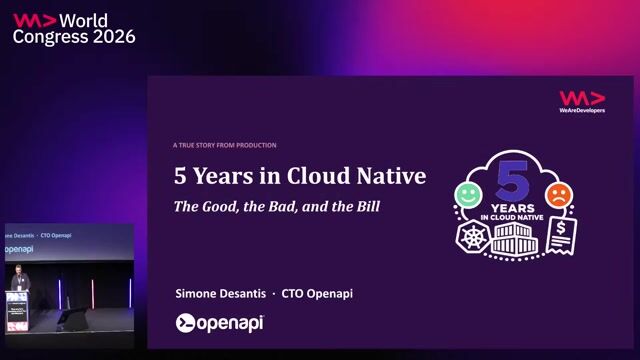
5 Years in Cloud Native: The Good, the Bad, and the Bill

Simone Desantis

A literal data center fire forced a costly lift-and-shift migration. Discover how this engineering team stopped burning money by embracing Terraform, scaling ceilings, and aggressive edge caching.

Pause
Mute Enter Fullscreen
#1 about 4 min

Losing a traditional data center to a catastrophic fire

A sudden fire destroys both physical servers and reliable backups overnight, forcing the engineering team to rebuild from zero.

#2 about 2 min

Rebuilding identical virtual machine architecture directly in the cloud

Recreating on-premises virtual machine models within a hyperscaler provides security but generates an unexpectedly massive financial burden.

#3 about 1 min

Adopting infrastructure as code through direct external mentorship

Transitioning from manual console configuration to version-controlled infrastructure definitions establishes a scalable technical foundation.

#4 about 1 min

Transforming engineering culture from system administration to devops

Shifting away from manual server mapping forces a complete reevaluation of capacity planning and resource costs.

#5 about 1 min

Evaluating cloud providers and container orchestration systems

Selecting between hyperscalers and kubernetes environments requires balancing existing team skills with realistic operational budgets.

#6 about 1 min

Managing vendor dependencies and persistent data for ephemeral containers

Adopting managed services demands conscious trade-offs between speed and determining where stateful data lives when ephemeral containers disappear.

#7 about 2 min

Optimizing application memory overhead for secure horizontal scaling

Designing for minimal memory footprints ensures cost-efficient provisioning while strict instance limits prevent unexpected bug-driven budget exhaustion.

#8 about 1 min

Aligning auto scaling infrastructure costs with real business value

Transitioning from static hardware to dynamic orchestration guarantees the company only pays for compute resources that generate tangibly useful work.

#9 about 1 min

Building internal micro frameworks for minimal memory footprint usage

Creating a standardized internal micro framework accelerates API development across engineering teams while minimizing container sizes and monthly hosting bills.

#10 about 1 min

Shielding expensive compute layers using multiple edge networks

Implementing multiple content delivery networks resolves user requests at the edge to protect core infrastructure and reduce compute processing volume.

#11 about 1 min

Aggressively caching network requests to protect sensitive database clusters

Serving requests primarily from memory caches minimizes database interactions since data partitions do not scale as gracefully as stateless containers.

#12 about 2 min

Building automated continuous deployment pipelines and final architectural insights

Replacing manual updates with automated deployments enforces stability alongside essential cloud lessons like designing infrastructure entirely to scale to zero.

Matching moments

3:19 min

Transitioning to cloud native hyperscale applications

Mario-Leander Reimer · World Congress 2023

2:27 min

Container migration and operational complexity challenges

Raphael Manke Raphael Manke · World Congress 2023

2:11 min

Executing massive cloud network migrations while maintaining live systems

Dana Lawson Dana Lawson +1 · World Congress 2026 Europe

7:33 min

Debunking common cloud-native application architecture myths

Jens Eickmeyer · LIVE

1:49 min

Transforming legacy platforms to cloud native patterns

Kai Geißelhardt +1 · World Congress 2022

8:01 min

Solving architectural challenges during rapid public cloud migrations

Liam Hurrel +1 · World Congress 2021