World Congress 2026 Europe Jul 9, 2026 Session details

AI in Your Browser: Exploring Chrome's Built-In LLM

Daniel Ostrovsky

Daniel Ostroski proves Chrome's built-in LLMs eliminate cloud API costs. Run zero-latency, privacy-first AI models directly on user devices. Build powerful agentic web apps using native browser APIs.

Pause
Mute Enter Fullscreen
#1 about 4 min

Live offline language translation demonstration in the browser

Real-time language translation logic running seamlessly on-device eliminates dependencies on external backend infrastructure or network calls.

#2 about 5 min

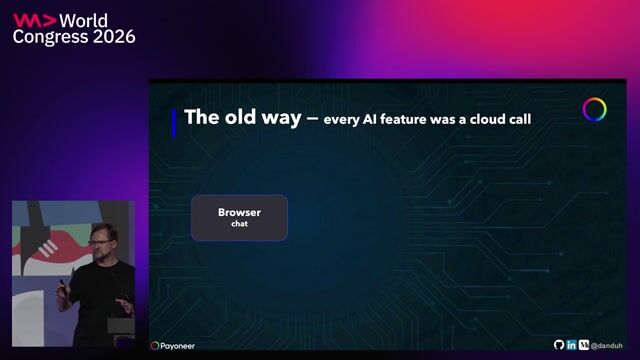
Moving language models from the cloud to client browsers

Transitioning computation workloads to local small language models significantly reduces inference latency and eliminates recurring token expenses.

#3 about 1 min

Comparing cloud infrastructure versus on-device artificial intelligence execution

Engineers must evaluate architectural tradeoffs regarding API budget, query latency limits, and stringent data privacy requirements.

#4 about 3 min

Exploring predefined task interfaces and model context protocol concepts

Dedicated browser APIs expose highly tuned generative tasks to bypass complex prompt engineering requirements entirely.

#5 about 2 min

Implementing conversational functionality with system prompt configuration settings

Adjusting parameter constants and defining rigid system bounds dictates granular control over the resulting generative model streams.

#6 about 2 min

Enforcing structured responses using native JSON schema configurations

Guiding local algorithms to output strictly typed JSON documents creates deterministic behavior necessary for immediate downstream programmatic logic.

#7 about 2 min

Executing on-device text summarization workflows using explicit context sharing

Implementing pre-configured summarization constraints accelerates local development while offering distinct variables altering final markdown formats.

#8 about 3 min

Drafting and refining content with built-in native writing toolsets

Passing strict instruction bindings directly to standard writer algorithms rapidly transforms original text scale and subjective formatting elements.

#9 about 2 min

Integrating built-in writing and summarization endpoints into frontend applications

Wiring simple application interfaces directly to local artificial intelligence hooks cleanly removes massive dependencies from typical generative pipelines.

#10 about 2 min

Managing model availability APIs and large asset download states

Checking system capability statuses lets graphical programs elegantly communicate massive file ingestion processes bound to localized machine storage bounds.

#11 about 1 min

Utilizing stable Chrome language translation APIs inside client applications

Standardized string format detection automatically redirects raw vocabulary buffers into localized translation pipelines independent of complex generative routing mechanisms.

#12 about 2 min

Implementing multimodal image processing and visual capabilities on the edge

Pushing active webcam buffers down entirely into the browser interface supports rich real-time visual interpretations running locally offline.

#13 about 2 min

Orchestrating web browser application tools via Model Context Protocol

Treating dynamic visual component commands exactly like executable functions empowers robust local loops operating without traditional event handlers.

#14 about 3 min

Demonstrating local agent workflows processing sensitive financial offline documents

Structuring offline task paths prevents sensitive consumer document elements from improperly touching external APIs during the extraction stage.

#15 about 3 min

Enforcing robust technical integration patterns for local artificial intelligence

Constraining applications to strictly solitary asynchronous flight patterns significantly reduces severe UI locking issues seen heavily inside generative applications.

Matching moments

2:54 min

Leveraging Chrome AI and nano models for web applications

Raymond Camden · Perf + AI

2:46 min

The case for native AI in web browsers

Maxim Salnikov Maxim Salnikov · WWC 2025

51 sec

Adopting hybrid approaches for browser-based AI models

Jason Mayes · Coffee With Developers

2:01 min

Utilizing built-in AI models for browser mediation

Christian Liebel Christian Liebel · WWC Europe 2026

2:46 min

Enhancing native browser experiences with on-device generative AI

Chris Heilmann +2 · LIVE

3:46 min

Integrating AI into web performance engineering workflows

Perf + AI

Upcoming sessions on this topic

Open session

World Congress 2026 North America

Small LLM in your Browser: Huge Opportunities for Web Applications

Daniel Ostrovsky

UI/UX Architect at Payoneer | AI Architect | Full Cycle Development Expert | Public Speaker | Open Source Contributor |

Daniel Ostrovsky
Open session

World Congress 2026 North America

From Software Agents to Physical Devices: Inside the Agentic Hardware Stack

Michael Yuan, Vivian Hu

Michael Yuan
Vivian Hu
Open session

World Congress 2026 North America

Building Stuff with GenAI - The Open Minded Workshop beyond OpenAI

Andreas Erben

CTO for Applied AI and Metaverse at daenet

Andreas Erben
Open session

World Congress 2026 North America

No Single Model to Rule Them All: Building Resilient AI Agents Across Open & Closed LLMs

Emmanuel Acheampong

Senior Manager Developer Relations at Crusoe AI

Emmanuel Acheampong
Open session

World Congress 2026 North America

AI Agents are Only as Smart as their Context: Building a Real-Time Context Engine at Intuit

Bharat Patel

Lead Software Engineer at Intuit

Bharat Patel
Open session

World Congress 2026 North America

Look What Java Can Do Now: Live-Coding a GenAI MCP Server with the JAQ Stack

Suren Konathala

Senior Engineering Leader, Marketing & AdTech, AI GTM & Digital Experience Platforms, Java x AI

Suren Konathala