



DC
Daniel Cranney
Truth, Lies, and Probabilities: Testing AI Hallucinations
- Discuss this with your agent
- Open in Claude
- Open in ChatGPT
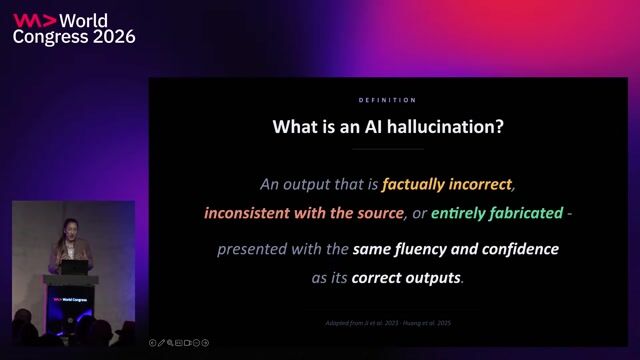
Why do conventional QA methods fail non-deterministic language models? AI hallucinations aren't bugs but inherent architectural features, demanding a radical shift toward statistical evaluation and adversarial stress testing.
Matching moments
4:08 min
Managing hallucination risks and bias in AI generation
 Léonie Watson +4 · A11y + AI
1:34 min
Mitigating the inherent challenges of generative AI tools
 Mary Grygleski · LIVE
5:03 min
Evaluating the accuracy and correctness of generated content
Cheuk Ho · World Congress 2023
10:17 min
Discussion on AI hallucinations and practical developer workflows
 Akmal Chaudhri · LIVE
4:25 min
Overcoming AI hallucinations and restrictive content guardrails
Perf + AI
1:49 min
Addressing the risks of hallucination and chat model manipulation
 Zachary Powell · World Congress 2024
More from World Congress 2026 Europe
Related videos
Related articles

CH
Chris Heilmann
AH
Aishi Huang
CH
Chris Heilmann

DC
Daniel Cranney

From learning to earning
Jobs that call for the skills explored in this talk.
1 day ago
•
Verified
AI Software Engineer (Germany)

Sunhat
Berlin, Germany
Expert
€70k–100k
Remote
REST
TypeScript
AI Frameworks
about 2 months ago
MLOps AI Engineer

TeamViewer Germany GmbH,
Austin, TX, United States
Expert
Caching
Routing
Standard Sql
23 days ago
Founding Data Scientist

Almedia
Berlin, Germany
€90k–170k
SQL Databases
Data Pipelines
Language Modeling
about 1 month ago
•
Verified
Senior AI/ML Engineer

PagerDuty
Lisbon, Portugal
Expert
Remote
AI Frameworks
AI-assisted coding tools
about 1 month ago
•
Verified
Partner Sales Director - AI Alliances - Model Providers

Dynatrace
San Francisco, United States
Expert
Remote
DevOps
AI Frameworks
Machine Learning
28 days ago
•
Verified
ML Engineer

Docker, Inc.
Seattle, United States
Expert
Remote
Go