World Congress 2026 Europe Jul 10, 2026 Session details

Refactoring in the Age of AI

Dominik Srednicki , Elena Lucarelli

Why do AI assistants create broken pull requests during refactoring? Discover how applying strict technical guardrails makes code changes safe, transforming your role from typist to director.

Pause
Mute Enter Fullscreen
#1 about 3 min

The problem of AI vibe refactoring in large codebases

Generic or hyper-specific prompts cause AI coding assistants to break application dependencies during refactoring.

#2 about 3 min

Why AI struggles with classical refactoring methodologies

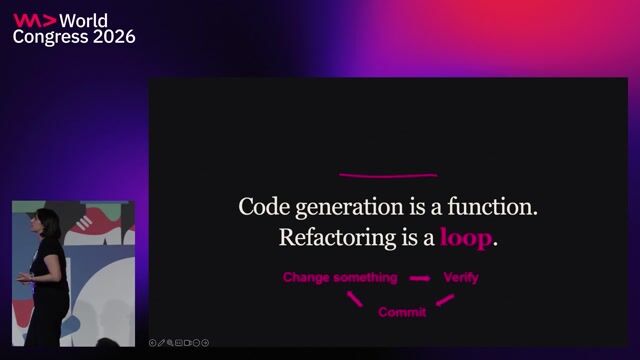
Large language models understand classical refactoring steps but fail to maintain the sequence, state, and safety nets required to execute them.

#3 about 3 min

Enforcing hard constraints through AI workflows

Establishing a rigorous workflow limits AI workarounds by analyzing the codebase, matching intents to patterns, and generating a structured execution plan.

#4 about 2 min

Designing the architecture of an AI refactoring pipeline

Static analyzers and a prompt-aware context engine combine to generate step-by-step execution plans analogous to spec-driven development.

#5 about 3 min

Designing project constitutions and structured refactoring checklists

Defining project metadata, phased execution plans, and atomic task checklists ensures AI maintains invariants and test coverage throughout the refactoring loop.

#6 about 4 min

Transitioning from code typists to refactoring workflow directors

Reviewing structured execution plans and checklists replaces manual code diff reviews while integrating up-to-date documentation directly into the repository.

#7 about 4 min

Establishing safety boundaries for AI-assisted code refactoring

Mandatory green tests, bounded blast radiuses, verifiable patterns, and incremental changes are essential prerequisites for allowing automated refactoring.

#8 about 2 min

Improving git blame log traceability with structured guardrails

Visualizing the clarity of git commits produced via strict workflows versus vague AI adjustments demonstrates the necessity of system guardrails.

#9 about 5 min

Audience Q&A on workflow formulation and spec-driven development

Audience questions address the validation of step-by-step checklists, applying automation to feature development, and injecting markdown patterns into contexts without vector search.

Matching moments

1:27 min

Addressing refactoring challenges with AI tools

Daniel Oh Daniel Oh · World Congress 2024

1:55 min

Shifting developer workloads and realistic AI productivity gains

Chris Heilmann +2 · LIVE

2:06 min

Rethinking team structures around AI agent capabilities

Mike Mike · World Congress 2025

1:19 min

Turning repetitive developer tasks into automated AI agent skills

Markus Eisele Markus Eisele · World Congress 2026 Europe

3:45 min

Balancing AI tool mandates with developer trust and productivity

Chris Heilmann +2 · LIVE

6:27 min

Using AI copilots to explain and debug legacy codebases

Chris Heilmann +2 · LIVE

Upcoming sessions on this topic

Open session

World Congress 2026 North America

September 24, 2026 · 15:30–16:00

Stage 7

Beyond Vibe Coding: Using CLI Tools as Your AI Counterpart in Pair Programming

Ron Veen

Java enthusiast and Special agent for Team Rockstars IT

Ron Veen
Open session

World Congress 2026 North America

September 24, 2026 · 11:10–11:15

Outdoor Stage

Architecting the 100X SDLC: Building Production Trust into AI-Assisted Delivery

Ranjan Parthasarathy

Founder, CPTO/CEO at AXIOMSTUDIO.AI

Ranjan Parthasarathy
Open session

World Congress 2026 North America

September 24, 2026 · 16:10–16:40

Outdoor Stage

When Humans Stop Writing Code: Rethinking Languages, Compilers, and Responsibility

Simon Auer

Organizer of flutter vienna meetup and CEO of marqably

Simon Auer
Open session

World Congress 2026 North America

September 23, 2026 · 13:40–14:10

Stage 2

Building an AI-Native Development Workflow

Vanessa Minik

Senior Service Delivery Engineer, GitHub

Vanessa Minik
Open session

World Congress 2026 North America

September 25, 2026 · 14:10–14:40

Stage 1

The Broken Rung: How AI is Rebuilding Software Development from the Ground Up

Tomislav Tipurić

Chief Technology Officer, Nephos

Tomislav Tipurić
Open session

World Congress 2026 North America

September 25, 2026 · 14:50–15:20

Tech Leaders Stage

Keeping Code Quality at AI Speed

Daksh Gupta, Arthur Hicken, Brian Mann

Daksh Gupta
Arthur Hicken
Brian Mann