
World Congress 2026 Europe Jul 10, 2026 Session details

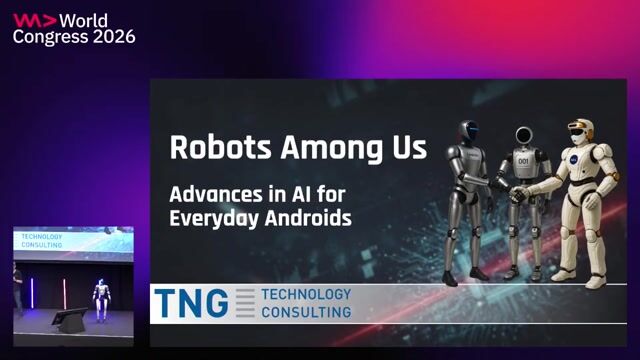
Robots Among us: Advances in AI for Everyday Androids

Florian Gather , Thomas Endres

Rigid, hardcoded hardware no longer limits robotics. Today, open-source Robotic Foundation Models let developers train affordable everyday androids using natural language and VR.

Pause
Mute Enter Fullscreen
#1 about 6 min

Evolution of humanoid robots and automated machines

The history of robotics traces the transition from ancient mechanical concepts to prompt-following machines.

#2 about 9 min

Core hardware and software components of robotics

Modern robots rely on complex actuators, lidar sensors for spatial awareness, simultaneous localization and mapping, and inverse kinematics solvers.

#3 about 4 min

Training robot locomotion using reinforcement learning methods

Reinforcement learning inside simulation environments allows robots to organically develop stable walking patterns before transitioning to physical environments.

#4 about 4 min

Understanding the architecture of robotic foundation models

Robotic foundation models combine vision-language models with diffusion transformers to translate instructions into mechanical actions across separate platforms.

#5 about 4 min

Training custom foundation models with affordable robotic arms

Collecting teleoperation data with inexpensive 3D-printed physical hardware enables foundation models to master practical tasks like sorting items and folding clothes.

#6 about 4 min

Future directions in prompt-based robotics and video imitation

Future robotic foundation models aim to execute complex plain-language prompts and learn new functional tasks directly by imitating internet videos.

Matching moments

3:46 min

Transitioning from rigid machines to autonomous AI robots

Teresa Conceicao · World Congress 2022

1:04 min

Expanding robotics beyond humanoids across diverse industries

Sergio Perez Sergio Perez · World Congress 2026 Europe

1:20 min

Shifting focus from large language models to physical AI

Sergio Perez Sergio Perez · World Congress 2026 Europe

1:36 min

Future predictions for autonomous agent environments and robotics

Philipp Schmid Philipp Schmid · World Congress 2025

2:08 min

Progressing from standard robotics to cognitive learning systems

Clemens Schwaiger · LIVE

2:27 min

Deploying inside-out foundational models onto mobile arms and humanoids

Sergio Perez Sergio Perez · World Congress 2026 Europe

Upcoming sessions on this topic

Open session

World Congress 2026 North America

September 23, 2026 · 10:00–17:00

Stage 11

Building Stuff with GenAI - The Open Minded Workshop beyond OpenAI

Andreas Erben

CTO for Applied AI and Metaverse at daenet

Andreas Erben
Open session

World Congress 2026 North America

September 25, 2026 · 12:55–13:25

Stage 1

From Simulation to Reality: Overcoming the Data Scarcity Crisis in Physical AI

Mitesh Patel

NVIDIA Corporation, Developer Advocate -- Manager

Mitesh Patel
Open session

World Congress 2026 North America

September 24, 2026 · 16:10–16:40

Stage 5

From Software Agents to Physical Devices: Inside the Agentic Hardware Stack

Michael Yuan, Vivian Hu

Michael Yuan
Vivian Hu
Open session

World Congress 2026 North America

September 25, 2026 · 11:40–12:10

Stage 9

You Can’t Re-Run Sunlight: Designing ML Data Architectures for Physical AI

An Phan

Senior Data Infrastructure Engineer @ Hippo Harvest

An Phan
Open session

World Congress 2026 North America

September 25, 2026 · 16:10–16:40

Stage 3

Building World-Aware Robots with Agent Memory and Context Graphs

Zaid Zaim

Developer Advocate EMEA at Neo4j | Microsoft AI MVP

Zaid Zaim
Open session

World Congress 2026 North America

September 25, 2026 · 10:20–10:50

Stage 5

Physical AI: 5 Things You Can Build That Aren't Another Chatbot

Vini Senger

Senior Technical Evangelist for Startups

Vini Senger