


World Congress 2026 Europe Jul 10, 2026 Session details

Confessions of a Software Archaeologist: What I Did Wrong in 10 Years of Restructuring Software

Hendrik Lösch

Refactoring legacy code is the easy part of software modernization. The true bottleneck is navigating the tangled web of human psychology and organizational politics.

Pause
Mute Enter Fullscreen
#1 about 4 min

Identifying hidden forms of debt in legacy software

Modernization efforts often fail because they ignore the implicit requirements, missing documentation, and absent test suites baked into old systems.

#2 about 5 min

Prioritizing restructuring tasks using a risk-value matrix

Mapping out system components and prioritizing low-risk, high-value tasks prevents teams from falling into the trap of poorly planned immediate fixes.

#3 about 4 min

Managing stakeholder expectations and creating delivery buffers

Committing to a conservative delivery timeline allows engineering teams to build necessary buffers and establish long-term trust with management.

#4 about 6 min

Translating technical improvements into measurable business value

Framing architectural refactoring in terms of cost reduction and strategic benefits bridges the conceptual gap between developers and corporate leadership.

#5 about 4 min

Navigating organizational politics and conflicting stakeholder agendas

Acknowledging that management, sales teams, and senior developers have competing incentives helps safeguard the technical modernization roadmap.

#6 about 3 min

Protecting restructuring projects through stakeholder influence mapping

Plotting organizational players on an influence-interest matrix ensures targeted communication and mitigates resistance from powerful internal political entities.

#7 about 2 min

Recognizing the organizational environment as part of the product

Sustainable software refactoring requires engineers to actively manage the surrounding corporate power structures alongside the actual digital architecture.

#8 about 2 min

Using three-point estimation to calculate realistic project buffers

Determining an accurate timeline buffer entails evaluating the best, worst, and most realistic completion scenarios for all remaining technical tasks.

Matching moments

2:48 min

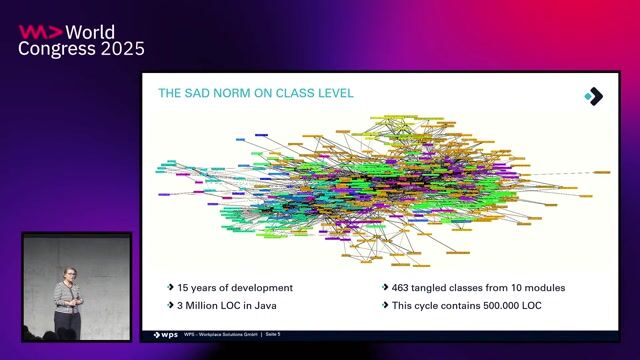
Planning multi-year restructures for legacy software systems

Hendrik Lösch Hendrik Lösch · WWC 2025

3:40 min

Identifying core challenges in modern software development

Markus Eisele Markus Eisele · WWC 2024

1:44 min

Strategies for modernizing and mitigating legacy system risks

Leszek Włodarski Leszek Włodarski · WWC Europe 2026

3:28 min

Managing technical debt in legacy web applications

Robby Russell · Coffee With Developers

2:25 min

Building engineering cultures that support long-term software architecture

Oskar Kruschitz Oskar Kruschitz · Europe 2026 Virtual

1:19 min

Key takeaways for navigating software evolution and technical debt

Luisa Rink Luisa Rink +1 · WWC Europe 2026

Upcoming sessions on this topic

Open session

World Congress 2026 North America

The Broken Rung: How AI is Rebuilding Software Development from the Ground Up

Tomislav Tipurić

Chief Technology Officer, Nephos

Tomislav Tipurić
Open session

World Congress 2026 North America

When Humans Stop Writing Code: Rethinking Languages, Compilers, and Responsibility

Simon Auer

Organizer of flutter vienna meetup and CEO of marqably

Simon Auer
Open session

World Congress 2026 North America

AI ROI: The Hard Unit Economics of AI-Native Engineering

Manu Gurudatha

Manu Gurudatha, VP of Engineering at PagerDuty

Manu Gurudatha
Open session

World Congress 2026 North America

Reinventing Testing Practices in the AI Era

Eric Deandrea

Java Champion & Senior Principal Software Engineer, IBM

Eric Deandrea
Open session

World Congress 2026 North America

Beyond the Code: Human-AI Synergies in Product Development

Ajita Kanchivakam Ananth

Staff Technical Program Manager at Google

Ajita Kanchivakam Ananth
Open session

World Congress 2026 North America

Engineering the Pivot: How Creative Strategy Solves the Hard Problems of AI Accuracy and Scale

Shruti Tiwari

AI/ML product manager, Dell

Shruti Tiwari