

World Congress 2026 Europe β€’ Jul 10, 2026 β€’ Session details

One year of the CO2-challenge – insights and lessons learned

Aydin Mir Mohammadi

Aydin reveals that idle test environments emit more carbon than production workloads. Discover how scaling non-production servers to zero instantly cuts your software emissions by half.

Pause
Mute Enter Fullscreen
#1 about 2 min

Evaluating the global digital carbon footprint

The digital sector accounts for four percent of global emissions, surpassing both the aviation and shipping industries.

#2 about 3 min

Launching a local initiative for climate-friendly software

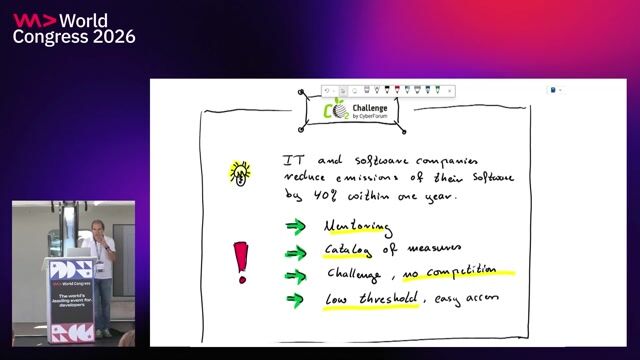
A regional network challenges software companies to reduce their operational carbon footprint by forty percent in a single year.

#3 about 2 min

Tracking company adoption and executive management commitment

Analyzing how executive backing yields a one-third successful execution rate among participating technology organizations.

#4 about 2 min

Understanding the hardware foundations of software emissions

Software indirectly generates carbon through hardware manufacturing processes and continuous electricity consumption across data centers.

#5 about 3 min

Building an implementation strategy for green software

Engineering teams utilize brainstorming and prioritization matrices to identify and act on carbon reduction hotspots.

#6 about 3 min

Overcoming resistance from senior engineering and development leads

Technical leads often block sustainability efforts because they mistakenly equate existing performance efficiency with optimized carbon consumption.

#7 about 2 min

Addressing the carbon waste of fixed hardware provisioning

Replacing static compute allocations with dynamic scaling reduces physical hardware waste and associated carbon footprints.

#8 about 4 min

Mitigating the hidden carbon costs of non-production environments

Shutting down constantly running test and staging systems presents the largest opportunity for immediate carbon savings.

#9 about 2 min

Reviewing real environmental savings from challenge participants

Participating companies significantly reduced their infrastructure footprint by implementing strict operational schedules for non-production environments.

#10 about 3 min

Navigating API limitations in sovereign local data centers

Organizations prioritizing digital sovereignty struggle to dynamically scale infrastructure without access to proprietary hyperscaler APIs.

#11 about 2 min

Reducing network payload for large digital website portfolios

Optimizing simple digital templates across thousands of deployments massively cuts down network-bound carbon emissions.

#12 about 4 min

Implementing carbon-aware computing for asynchronous background tasks

Shifting background jobs to align with high renewable grid energy minimizes the operational footprint using flexible scheduling plugins.

#13 about 3 min

Embedding sustainability advocates within product development groups

Enforcing dedicated sustainability roles within engineering teams ensures that long-term green computing practices genuinely succeed.

Matching moments

1:49 min

Coding for environmental sustainability in software engineering

Ulrich Irnich Ulrich Irnich Β· WWC 2023

4:09 min

Implementing architectural best practices for sustainable software systems

Hendrik LΓΆsch Hendrik LΓΆsch Β· WWC 2025

2:28 min

Advocating for green tech policies inside modern software companies

Lorenzo Pieri Β· LIVE

1:54 min

Analyzing the climate impact of the software industry

Pierre-Luc Noel +1 Β· WWC 2023

1:57 min

Connecting web performance optimization to ecological sustainability

Andreas Taranetz Andreas Taranetz Β· WWC 2024

2:50 min

Optimizing centralized cloud infrastructures for direct energy footprint reductions

Michael Mueller Michael Mueller Β· WWC 2024

Upcoming sessions on this topic

Open session

World Congress 2026 North America

Autonomous Infrastructure: Building AI Agents for Global-Scale Capacity Efficiency

Gregoire Colin, Tommy Tran

Gregoire Colin
Tommy Tran
Open session

World Congress 2026 North America

public void saveMoney(AI): The Developer's Guide to Unit Economics

Hrushikesh Pokala

Senior Software Engineer Lead at Equifax

Hrushikesh Pokala
Open session

World Congress 2026 North America

How to generate business value through performance optimizations

Nikolai Sidiropulo

Software Engineer at Meta

Nikolai Sidiropulo
Open session

World Congress 2026 North America

Culture Doesn't Scale Itself: Leading Engineering Teams Through Hypergrowth and the AI Transition

Thanos Baskous

VP of Engineering and Co-founder of Cogent Security

Thanos Baskous
Open session

World Congress 2026 North America

When Humans Stop Writing Code: Rethinking Languages, Compilers, and Responsibility

Simon Auer

Organizer of flutter vienna meetup and CEO of marqably

Simon Auer
Open session

World Congress 2026 North America

AI ROI: The Hard Unit Economics of AI-Native Engineering

Manu Gurudatha

Manu Gurudatha, VP of Engineering at PagerDuty

Manu Gurudatha