
EF
Elizabeth Fuentes Leone, AWS Developer Advocate, GenAI
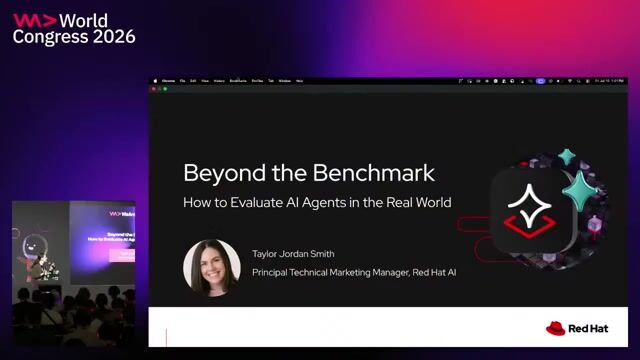
Beyond the Benchmark: How to Evaluate AI Agents in the Real World
- Discuss this with your agent
- Open in Claude
- Open in ChatGPT
Tyler Smith reveals that high benchmark scores mask fundamental AI execution failures. Ditch the happy-path demo and evaluate production agents using full-stack observability and continuous telemetry.
Matching moments
2:28 min
Introduction to building reliable AI agents in production
 Max Tkacz · World Congress 2025
2:40 min
Reviewing live performance of self-correcting AI engineering agents
 Ingo Eichhorst · World Congress 2026 Europe
2:43 min
Best practices for implementing reliable AI agent frameworks
 Marcel Scherenberg · World Congress 2025
1:00 min
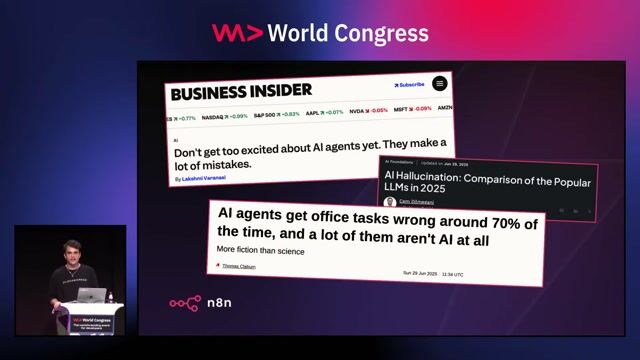
Limitations of current performance benchmarks for agentic AI
 Manuel Weichselbaum · World Congress 2026 Europe
5:27 min
Evaluating AI agents through unpredictable behavior and logic tests
 Chris Heilmann +2 · LIVE
1:48 min
Adapting observability strategies for long-running enterprise AI agents
Christian Heilmann +3 · World Congress 2026 Europe
More from World Congress 2026 Europe
Related videos
Related articles
AH
Aishi Huang
CH
Chris Heilmann

IK
Igor Khokhriakov
CH
Chris Heilmann
DC
Daniel Cranney

From learning to earning
Jobs that call for the skills explored in this talk.
23 days ago
Senior AI Developer

PwC
United States
Expert
Remote
Docker
Github
Fastapi
about 2 months ago
•
Verified
Senior AI/ML Engineer

PagerDuty
Lisbon, Portugal
Expert
Remote
AI Frameworks
AI-assisted coding tools
about 1 month ago
•
Verified
Staff Software Engineer, Agentic Platform

Docker, Inc.
Seattle, United States
Expert
Remote
Cloud (AWS/Google/Azure)
about 2 months ago
MLOps AI Engineer

TeamViewer Germany GmbH,
Austin, TX, United States
Expert
Caching
Routing
Standard Sql
about 1 month ago
•
Verified
ML Engineer
Docker, Inc.
Seattle, United States
Expert
Remote
Go
about 1 month ago
•
Verified
Staff ML Engineer
Docker, Inc.
Seattle, United States
Expert
Remote
Go