


World Congress 2026 Europe Jul 10, 2026 Session details

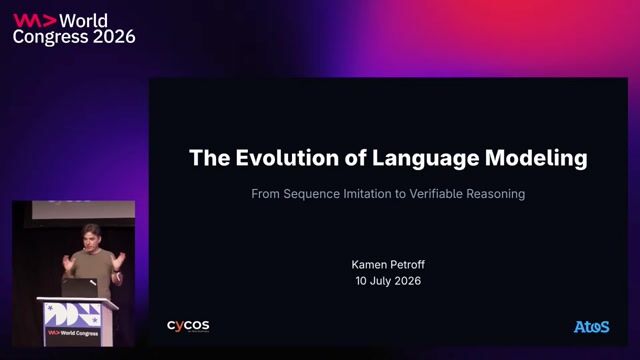
The LLM Evolution: From Sequence Imitation to Verifiable Reasoning

Kamen Petroff

What happens to software engineering when AI runs out of human text to imitate? Discover how test-time compute shifts developer roles from writing syntax to architecting rigorous specs.

Pause
Mute Enter Fullscreen
#1 about 3 min

Reaching the limits of imitation in artificial intelligence

The traditional method of scaling language models by continuously appending human data is permanently approaching statistical limits.

#2 about 2 min

Understanding language models as next-token predictors

Mathematical matrices systematically establish precision conditional probability distributions to analyze strings and successfully predict ongoing inputs.

#3 about 2 min

Evaluating statistical models and the bitter lesson

Unrestricted computational strategies massively outperform highly detailed human-engineered rules when scaling broad classification and textual systems.

#4 about 2 min

Neural networks and sequence representation bottlenecks

Word embeddings successfully plot discrete semantic meaning, whereas standard recurrent network architecture encounters severe long-sequence blockages.

#5 about 2 min

Transformers and highly scalable parallel processing

Advanced attention parameters efficiently circumvent sequence restrictions to ultimately unlock monumental parallel hardware scalability and pre-training.

#6 about 3 min

Discovering in-context learning and zero-shot capabilities

Massive scaling curves demonstrate emergent capability frameworks where foundation models natively problem-solve without specialized task formatting.

#7 about 3 min

Instruction fine-tuning and human feedback reinforcement

Models programmatically align toward desired communication metrics after analyzing complex behavioral outcomes guided exclusively via human rewards.

#8 about 1 min

Computing scaling laws and the data bottleneck

Precise mathematical constraints accurately predict ceiling capabilities balancing computing hardware budgets against available structural human dictionaries.

#9 about 2 min

Using test-time compute for verifiable reasoning

Deliberately allocating active analytical generation budgets enables progressive cognitive algorithms to successfully deconstruct problems sequentially.

#10 about 2 min

Replacing human training data with verification

Structured environments boasting strict deterministic parameters prompt algorithms to iteratively self-play until achieving absolute logical mastery.

#11 about 3 min

Training verifiable algorithmic patterns without human input

Automated recursive verifiers heavily reinforce condensed execution code paths enabling raw problem-solving across deterministic mathematics loops.

#12 about 2 min

The verifiers wall and jagged intelligence capabilities

Computational execution currently scales disproportionately toward programmatic sectors where clear objective evaluators reliably grade final outcomes.

#13 about 2 min

Connecting reasoning engines to autonomous coding agents

Interfacing conversational generators with robust executable external APIs organically creates persistent autonomous frameworks capable of programming.

#14 about 3 min

Shifting engineering focus to specifications and testing

Technical workflows shift dynamically from typing base logic components toward designing strict test scaffolding governing automated agents.

#15 about 2 min

Navigating the modern evolution of developer workflows

Architecting reliable acceptance systems anchors machine optimization routines, establishing system validation as the core developer deliverable.

Matching moments

2:38 min

The evolution toward agentic and literate software programming

Neel Sundaresan Neel Sundaresan +1 · World Congress 2026 Europe

1:56 min

Managing AI speed and the rise of verification debt

Werner Vogels Werner Vogels +1 · World Congress 2026 Europe

2:37 min

Understanding core parameters and mechanics of large language models

Julián Duque Julián Duque · World Congress 2025

4:28 min

Evolution of AI models into autonomous agents

Philipp Schmid Philipp Schmid · World Congress 2025

3:55 min

Evaluating generative AI capabilities and physical reasoning limitations

Jonas Andrulis Jonas Andrulis · World Congress 2024

3:01 min

Balancing artificial intelligence tools with foundational software engineering skills

Tim Ruscica · Coffee With Developers

Upcoming sessions on this topic

Open session

World Congress 2026 North America

September 24, 2026 · 16:10–16:40

Outdoor Stage

When Humans Stop Writing Code: Rethinking Languages, Compilers, and Responsibility

Simon Auer

Organizer of flutter vienna meetup and CEO of marqably

Simon Auer
Open session

World Congress 2026 North America

September 25, 2026 · 11:40–12:10

Stage 9

You Can’t Re-Run Sunlight: Designing ML Data Architectures for Physical AI

An Phan

Senior Data Infrastructure Engineer @ Hippo Harvest

An Phan
Open session

World Congress 2026 North America

September 23, 2026 · 10:00–17:00

Stage 11

Building Stuff with GenAI - The Open Minded Workshop beyond OpenAI

Andreas Erben

CTO for Applied AI and Metaverse at daenet

Andreas Erben
Open session

World Congress 2026 North America

September 25, 2026 · 11:40–12:10

Stage 2

Reinventing Testing Practices in the AI Era

Eric Deandrea

Java Champion & Senior Principal Software Engineer, IBM

Eric Deandrea
Open session

World Congress 2026 North America

September 24, 2026 · 15:30–16:00

Mainstage

Our Brains in the AI Era

Cassidy Williams

Senior Director of Developer Advocacy, GitHub

Cassidy Williams
Open session

World Congress 2026 North America

September 24, 2026 · 15:30–16:00

Stage 5

The reviewer can't be the author: independent verification for AI-generated code

Manish Kapur

VP, Product and Solutions at Sonar

Manish Kapur