



World Congress 2025 Aug 20, 2025 Session details

Inside the Mind of an LLM

Emanuele Fabbiani

Why do language models route translations through English? Learn how sparse autoencoders allow developers to mathematically suppress biases and deterministically control AI behavior.

Pause
Mute Enter Fullscreen
#1 about 3 min

Taking a leap of faith with large language models

Treating model interfaces like car controls obscures the underlying complexity and potential system failures.

#2 about 2 min

Spotting obvious factual errors in model outputs

Simple factual errors produced by language models are relatively easy for users to identify and discard.

#3 about 4 min

Replicating bad code distributions with generative models

Models trained on broad repositories often reproduce vulnerabilities and bugs from their training data.

#4 about 3 min

Pre-training language models to understand human text

Masking words in massive datasets teaches language models basic understanding and reliable text completion.

#5 about 1 min

Fine-tuning models to answer questions and execute tasks

Supervised learning on prompt and answer pairs transforms a text completion engine into a responsive assistant.

#6 about 4 min

Aligning models using reinforcement learning with human feedback

Training a reward proxy based on human preferences ensures outputs align with safety and societal expectations.

#7 about 2 min

Autoregressive token completion without internal reasoning

Large language models generate responses strictly by predicting the most likely next token without logical thought.

#8 about 6 min

Discovering English as an internal intermediate representation

Analyzing layer activations reveals that multilingual translation tasks often route through an English representation.

#9 about 5 min

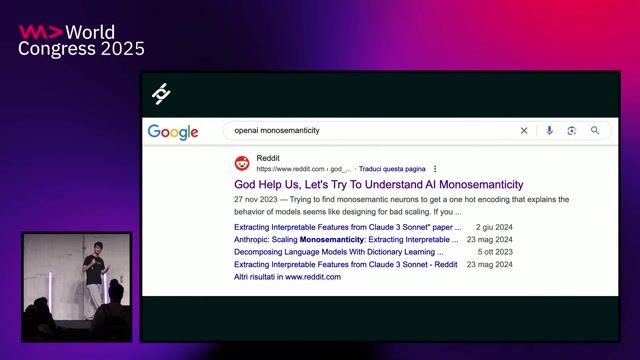
Controlling model behavior through monosemantic feature extraction

Mapping internal activations to singular semantic concepts allows deterministic manipulation of specific model outputs.

#10 about 2 min

Memorization of private training data in deep learning

The mathematical necessity of reducing loss forces models to memorize unique personal information from training sets.

Matching moments

2:37 min

Understanding core parameters and mechanics of large language models

Julián Duque Julián Duque · WWC 2025

5:25 min

Addressing core challenges in large language model deployments

Vijay Krishan Gupta +1 · LIVE

5:01 min

Leveraging large language models for code optimization and development

Stephan Gillich Stephan Gillich +3 · WWC 2024

4:25 min

Overcoming AI hallucinations and restrictive content guardrails

Perf + AI

2:20 min

Distinguishing large language models from autonomous AI agents

Coffee With Developers

2:25 min

Understanding the evolution and nature of large language models

Krzysztof Cieślak Krzysztof Cieślak · WWC 2024

Upcoming sessions on this topic

Open session

World Congress 2026 North America

Understanding LLM Architectures: Inside the Design of Modern Models

Jofia Jose Prakash

Enterprise AI Architect at American Chemical Society

Jofia Jose Prakash
Open session

World Congress 2026 North America

You Can’t Re-Run Sunlight: Designing ML Data Architectures for Physical AI

An Phan

Senior Data Infrastructure Engineer @ Hippo Harvest

An Phan
Open session

World Congress 2026 North America

No Single Model to Rule Them All: Building Resilient AI Agents Across Open & Closed LLMs

Emmanuel Acheampong

Senior Manager Developer Relations at Crusoe AI

Emmanuel Acheampong
Open session

World Congress 2026 North America

Fast, Cheap, and Accurate: Optimizing LLM Inference with vLLM and Quantization

Cedric Clyburn, Legare Kerrison

Cedric Clyburn
Legare Kerrison
Open session

World Congress 2026 North America

Building Stuff with GenAI - The Open Minded Workshop beyond OpenAI

Andreas Erben

CTO for Applied AI and Metaverse at daenet

Andreas Erben
Open session

World Congress 2026 North America

Context Engineering Kung Fu

Carl Lapierre

Tech Lead and AI Engineer at Osedea

Carl Lapierre