







DC
Daniel Cranney
- Discuss this with your agent
- Open in Claude
- Open in ChatGPT
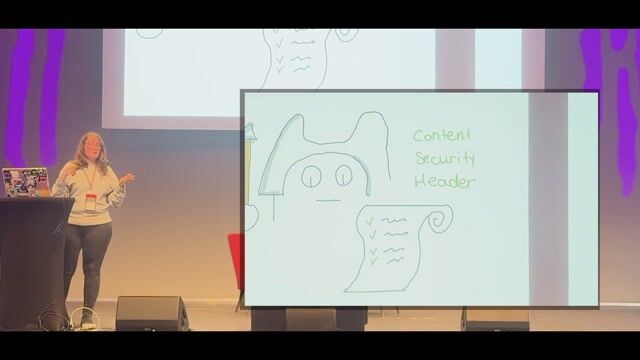
Relying solely on React or Vue for security is a dangerous anti-pattern. Through live sketchnoting, learn how to defend your front-end fortress against supply chain attacks, XSS, and clickjacking.
Matching moments
1:44 min
Evaluating framework architectures against cross-site scripting attack vectors
Philippe De Ryck · LIVE
1:05 min
Handling modern injection flaws and cross-site scripting
 Christian Wenz · World Congress 2026 Europe
3:02 min
Uncovering hidden vulnerabilities and bloat in web ecosystems
Bramus Van Damme +2 · LIVE
1:58 min
Securing frontend applications against untrusted user inputs
 Ramona Schwering · World Congress 2026 Europe
6:00 min
Navigating web element APIs and emerging software vulnerabilities
Jack Barber +3 · LIVE
48 sec
Overview of five common software security pitfalls
Alexander Pirker · World Congress 2022
More from HalfStack Vienna 2026
The Little iFrame That Wanted to Become the Biggest Payment Platform
Eduardo Aparicio Cardenes
Upcoming sessions on this topic
Starts in 6 days
Conference India 2026
November 25–26, 2026
Bengaluru, India
-
Supply Chain Security for the Everyday Engineer
 Pradumna Saraf · Kestra Technologies
Wed 25 Nov · Stage 3 - powered by GitHub
-
The UI Engineering Playbook: Modern CSS, Design Systems, Motion & AI-Assisted Workflows
 Wadad Parker · Ednius Inc.
Thu 26 Nov · Room 6
-
Your Server-Rendered App Doesn't Know Who It's Talking To
 Anshul Bansal · OLX India
Thu 26 Nov · Stage 2
Related videos
Security in modern Web Applications - OWASP to the rescue!
Jakub Andrzejewski
World Congress · 2023
A Primer in Single Page Application Security (Angular, React, Vue.js)
Thomas Konrad
LIVE · Dec 2020
Cross Site Scripting is yesterday's news, isn't it?
martinakraus · Kraus IT Consulting
World Congress · 2024
It's a (testing) trap! - Common testing pitfalls and how to solve them
Ramona Schwering · Auth0 by Okta
World Congress · 2024
Related articles

BB
Benedikt Bischof

CH
Chris Heilmann

CS
Christina Schaireiter

From learning to earning
Jobs that call for the skills explored in this talk.
25 days ago
Staff Developer Advocate, GitHub Security Lab

GitHub
San Francisco, CA, United States
Experienced
$323k
Git
Github
Databases
28 days ago
Product Security Incident Response Analyst
GitHub
United States
Expert
$329k
Remote
Github
Code Review
Data Analysis
2 months ago
•
Senior Product Security Architect

Expedia
Austin, United States
Expert
Hybrid · 3 days on-site
Agentic AI
Security Architecture
2 months ago
•
Principal Cybersecurity Engineer
Expedia
San Jose, United States
Expert
$249k–348k
Hybrid · 3 days on-site
Cybersecurity
23 days ago
Cyber Defense Specialist

Raiffeisen Bank International AG
Austria
€47k
Mitre Att&ck
Cyber Warfare
Cyber Security
5 days ago
Cyber Defense & Incident Response

Delivery Hero SE
Zaragoza, Spain
Remote
Golang
Cybercrime
Security Log