
World Congress 2024 • Aug 20, 2024 • Session details

How AWS Generates Polyglot Libraries Based on a Single TypeScript Codebase

Markus Ziller

How did AWS scale the CDK across Java, Python, .NET, and Go without duplicating code? Discover their open-source JSII toolchain that turns one TypeScript codebase into native polyglot libraries.

Pause
Mute Enter Fullscreen
#1 about 3 min

Scaling microservices with multi-language cross-cutting concerns

Decomposing monolithic business architectures creates technical overlap and shared tooling challenges across multiple programming languages.

#2 about 2 min

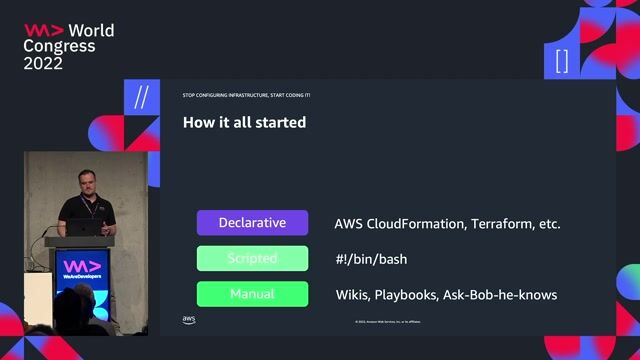
Managing infrastructure as code with AWS CDK

The AWS Cloud Development Kit replaces complex CloudFormation declaration templates with functional programmatic resource definitions.

#3 about 2 min

Building hierarchical infrastructure constructs with AWS CDK

Combining individual cloud resources into higher-level logical constructs automates complex cloud infrastructure provisioning operations.

#4 about 2 min

Scaling developer adoption by supporting additional programming languages

Expanding open-source availability beyond initial typescript logic fulfills diverse customer technical and platform deployment requirements.

#5 about 2 min

Enabling cross-language library interoperability with the JSII framework

The JSII toolchain facilitates seamless interactions with native typescript processes directly from external runtime environments.

#6 about 2 min

Understanding JSII compiler operations and architecture components

Generating language-agnostic frameworks requires a compiler build step that isolates core class and type metadata mappings.

#7 about 1 min

Developing a foundational TypeScript catalog application

Standard applications written with standard typescript logic operate as the underlying functionality payload model.

#8 about 3 min

Configuring package manifests to invoke JSII compilation

Modifying module manifest file attributes with required framework definitions establishes functional code bindings execution models.

#9 about 1 min

Building and distributing polyglot libraries with JSII Pacmak

Specialized toolchains process generated typescript metadata completely automatically into globally deployable, native package manager artifacts.

#10 about 2 min

Adhering to strict typing constraints for Java bindings

Translating typescript methods into strictly typed Java interfaces mandates strategic naming conventions to bypass rigid compiler restrictions.

#11 about 2 min

Bridging dynamic typing paradigms for Python cross-language libraries

Enforcing type safety during flexible runtime execution heavily dictates establishing intentionally non-idiomatic library interaction techniques.

#12 about 2 min

Resolving structural execution differences in C# and Go bindings

Translating javascript object inheritance designs into composition-heavy ecosystems forces developers into adopting explicitly unique syntax workflows.

#13 about 2 min

Implementing generated polyglot bindings in target applications

Acquiring compiled package artifacts enables simple external invocations capable of natively rendering underlying logic computations.

#14 about 3 min

Mapping runtime execution models with background node processes

Invoked native libraries resolve class methods accurately by streaming marshaled JSON operations continuously against nested Node hosts.

#15 about 2 min

Evaluating development advantages in multi-language ecosystems

Single-source polyglot library foundations lower operational redundancy rates across separated engineering teams rapidly building specialized tools.

#16 about 2 min

Assessing JSII latency overhead and complex debugging concerns

Constant execution serialization loops heavily tax raw compute latency metrics while framework abstractions routinely complicate critical troubleshooting.

#17 about 2 min

Determining effective deployment patterns for JSII framework implementations

Centralized software abstractions focusing heavily on internal systems engineering or cloud operations present highly ideal implementation scenarios.

Matching moments

8:12 min

Lambda compatibility, interface security, and career advice

Alexander Günsche Alexander Günsche · LIVE

2:33 min

Expanding JavaScript horizons with WebAssembly and backend possibilities

Sasha Shynkevich · LIVE

2:00 min

The origins and early problems solved by TypeScript

Dani Coll Dani Coll · WWC Europe 2026

1:53 min

Bringing JavaScript developers into web artificial intelligence

Jason Mayes · Coffee With Developers

2:20 min

Moving from the .NET ecosystem to JavaScript and Go

Brian Morrison · Coffee With Developers

22:32 min

Audience Q&A on language support, performance, and tradeoffs

Akmal Chaudhri Akmal Chaudhri · LIVE

Upcoming sessions on this topic

Open session

World Congress 2026 North America

From Cloud Native to Multi-Cloud Native: Write Once, Deploy Anywhere

Sandeep Pal

Principal Member of Technical Staff at Salesforce

Sandeep Pal
Open session

World Congress 2026 North America

When Humans Stop Writing Code: Rethinking Languages, Compilers, and Responsibility

Simon Auer

Organizer of flutter vienna meetup and CEO of marqably

Simon Auer
Open session

World Congress 2026 North America

Run your agents in Kubernetes: Build once, deploy anywhere. But really?

Michal Salanci

Senior Systems Engineer at ESET Cybersecurity

Michal Salanci
Open session

World Congress 2026 North America

Beyond Vibe Coding: Using CLI Tools as Your AI Counterpart in Pair Programming

Ron Veen

Java enthusiast and Special agent for Team Rockstars IT

Ron Veen
Open session

World Congress 2026 North America

The spectrum of agentic coding: From vibe coding to high-quality software engineering

YK Sugi

Developer Experience Manager at Eventual

YK Sugi
Open session

World Congress 2026 North America

Merging at Scale: From Broken Builds to Green Mainline

Preetam Dwivedi, Manjari Akella

Preetam Dwivedi
Manjari Akella