
World Congress 2024 Aug 20, 2024 Session details

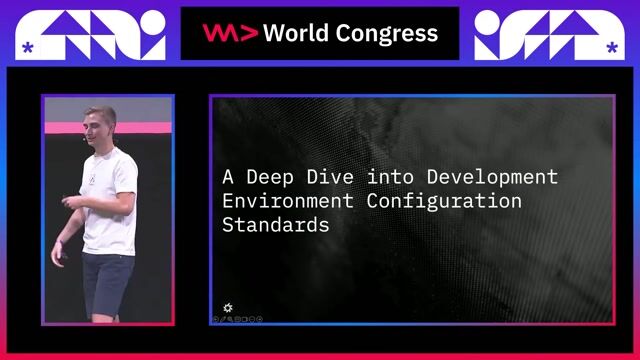
A Deep Dive into Development Environment Configuration Standards

Toma Puljak

Treating your development environment as code is the ultimate cure for engineering bottlenecks. Learn how Dev Containers, Devfile, and Nix permanently eliminate "it works on my machine" excuses.

Pause
Mute Enter Fullscreen
#1 about 2 min

Introduction to standardizing local development environments

Standardizing the development workstation eliminates manual setup configuration errors and boosts developer velocity.

#2 about 2 min

The inner and outer loop of developer workflows

The inner loop encompasses local execution and debugging while the outer loop strictly handles deployment operations.

#3 about 2 min

Anatomy of a comprehensive local development environment

A complete environment requires configured code access, project libraries, system packages, IDE settings, and compute resources.

#4 about 2 min

Standardizing development environments through configuration as code

Treating workspaces as code unifies system packages, IDE integrations, and resource provisioning across a team.

#5 about 3 min

Using Docker to configure and isolate workspace environments

Containerizing applications ensures deployment consistency but standard images often lack flexible local development features.

#6 about 6 min

Automating local workspaces with Microsoft dev containers

Dev containers utilize a JSON schema to define system dependencies, automate setup commands, and provision IDE customizations.

#7 about 5 min

Managing cloud-native environments using dev files and Kubernetes

The CNCF YAML-based standard integrates deeply with Kubernetes manifests and CLI tools to align local and production workloads.

#8 about 5 min

Ensuring immutable and deterministic workspaces with NixOS

Functional package management maps dependencies to exact cryptographic hashes to guarantee reproducible local environments.

#9 about 3 min

Choosing the right development standard for engineering teams

Selecting the appropriate standardization tool depends on existing container infrastructure, Kubernetes adoption, and architectural immutability requirements.

Matching moments

2:58 min

Containerizing applications and externalizing system configuration

Jens Eickmeyer · LIVE

4:42 min

Fostering team collaboration through common infrastructure abstractions

Chad Carlson · WWC 2021

6:00 min

Navigating the evolving landscape of specification tooling

Simon Maple · Coffee With Developers

4:31 min

Addressing local development challenges with Podman Desktop

Stevan Le Meur Stevan Le Meur · WWC 2024

2:17 min

Fundamental building blocks of an internal developer platform

Anna Ozor Anna Ozor · Europe 2026 Virtual

2:28 min

Overcoming cloud development friction with automated code spaces

Kyle Daigle · Coffee With Developers

Upcoming sessions on this topic

Open session

World Congress 2026 North America

Stop Running Mystery Meat in Production

Jeroen van Erp

Technical Advocate @ SUSE

Jeroen van Erp
Open session

World Congress 2026 North America

rm -rf: Horror Stories From Unsandboxed AI Agents (and How Docker Fixes This)

Rishab Kumar

Staff Developer Evangelist @ Twilio

Rishab Kumar
Open session

World Congress 2026 North America

From Cloud Native to Multi-Cloud Native: Write Once, Deploy Anywhere

Sandeep Pal

Principal Member of Technical Staff at Salesforce

Sandeep Pal
Open session

World Congress 2026 North America

Beyond Vibe Coding: Using CLI Tools as Your AI Counterpart in Pair Programming

Ron Veen

Java enthusiast and Special agent for Team Rockstars IT

Ron Veen
Open session

World Congress 2026 North America

Merging at Scale: From Broken Builds to Green Mainline

Manjari Akella, Preetam Dwivedi

Manjari Akella
Preetam Dwivedi
Open session

World Congress 2026 North America

It’s Alive! Taming the MLOps Franken-Stack: Write, Run, and Serve with Michelangelo

Paul Zimmerman, Eric Wang

Paul Zimmerman
Eric Wang