






LM
Luis Minvielle
WeAreDevelopers LIVE
•
Dec 16, 2024
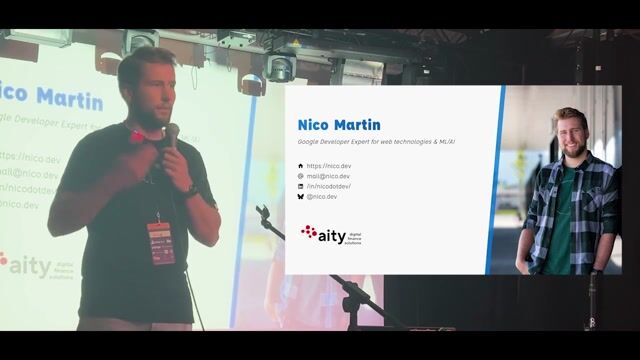
From ML to LLM: On-device AI in the Browser
Nico Martin
- Discuss this with your agent
- Open in Claude
- Open in ChatGPT
Run large language models entirely in the browser without making a single cloud request. Discover how WebGPU, 4-bit quantization, and local RAG unlock fast, privacy-preserving AI applications.
Matching moments
7:17 min
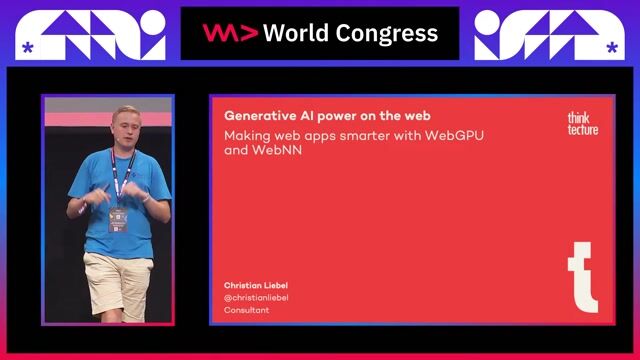
Accelerating in-browser AI with WebGPU and WebNN
 Christian Liebel · World Congress 2024
2:46 min
The case for native AI in web browsers
 Maxim Salnikov · World Congress 2025
1:04 min
Running local large language models securely using paired web GPUs
 Önder Ceylan · World Congress 2024
2:17 min
Accelerating local machine learning models via WebNN
Christian Liebel · World Congress 2026 Europe
2:54 min
Leveraging Chrome AI and nano models for web applications
Raymond Camden · Perf + AI
1:33 min
Real-world implementations of browser-based machine learning
Håkan Silfvernagel · LIVE
More from WeAreDevelopers LIVE
Related videos
Related articles
.png)
CH
Chris Heilmann

BB
Benedikt Bischof
.gif)
CH
Chris Heilmann
From learning to earning
Jobs that call for the skills explored in this talk.
about 1 month ago
•
Verified
LLM Training Engineer

Sciforium
San Francisco, United States
Expert
$155k–220k
Python
6 days ago
•
Verified
AI Software Engineer (Germany)

Sunhat
Berlin, Germany
Expert
€70k–100k
Remote
REST
TypeScript
AI Frameworks
21 days ago
Principal Software Engineer, AI Inference Runtime

ARM
Seattle, WA, United States
Expert
$262k
Compilers
Low Latency
Concurrency
about 1 month ago
•
Verified
ML Engineer

Docker, Inc.
Seattle, United States
Expert
Remote
Go
21 days ago
Principal Software Engineer, AI Inference Cloud
ARM
Seattle, WA, United States
Expert
$262k
Pytorch
TensorRT
Kubernetes
about 1 month ago
•
Verified
Senior AI/ML Engineer

PagerDuty
Lisbon, Portugal
Expert
Remote
AI Frameworks
AI-assisted coding tools