


World Congress 2025 Aug 20, 2025 Session details

The Dependency Cookbook - Recipes for Micro Frontend success

Lucas Braeschke , Stefan Bley

Are shared dependencies turning your micro frontends into a fragile monolith? Discover how to leverage browser import maps and Webpack Module Federation to completely eliminate cascading upgrade failures.

Pause
Mute Enter Fullscreen
#1 about 3 min

Modularizing applications for strict healthcare compliance

Strict healthcare requirements drive the need for independent micro frontend release processes.

#2 about 2 min

The maintenance cost of forced dependency updates

Tightly coupled dependencies force business teams to sacrifice functionality for technical upgrades.

#3 about 3 min

Core reasons for sharing micro frontend dependencies

Sharing dependencies improves performance, ensures UI consistency, prevents compatibility errors, and streamlines security patching.

#4 about 2 min

Categorizing dependency complexity in micro frontend architectures

Grouping libraries based on global variable usage and runtime strictness reveals three levels of dependency complexity.

#5 about 2 min

Use cases for managing micro frontend dependency versions

A robust dependency solution must handle version fallbacks, deduplication, and patch updates without requiring full redeployments.

#6 about 4 min

Using native browser import maps for dependency resolution

Native browser import maps provide a built-in mechanism to lazily load separate dependency versions dynamically.

#7 about 5 min

Applying module federation for advanced version negotiation

Webpack Module Federation configures shared entries to handle automatic version negotiation and fallbacks.

#8 about 4 min

Choosing between import maps and module federation tooling

Evaluating the scale of an architecture determines whether to use native browser imports or feature-rich federation tools.

Matching moments

6:44 min

Micro frontends and Webpack module federation challenges

Manfred Steyer Manfred Steyer · World Congress 2024

2:26 min

Summarizing module federation patterns and architectural choices

Manfred Steyer Manfred Steyer · JS Congress

9:16 min

Implementing micro frontends with webpack module federation

Manfred Steyer Manfred Steyer · World Congress 2021

13:09 min

Answering questions on micro-frontend adoption and tooling

Luca Mezzalira Luca Mezzalira · JS Congress

6:56 min

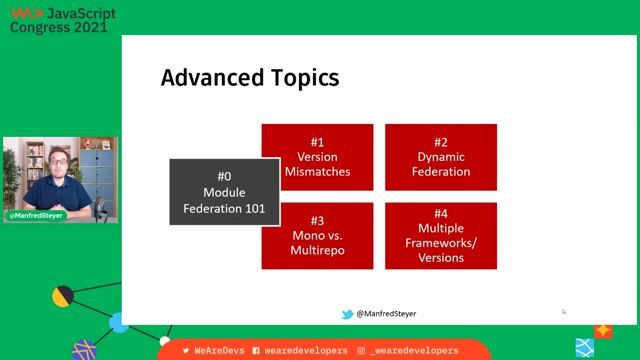
Resolving dependency version mismatches in micro frontends

Manfred Steyer Manfred Steyer · JS Congress

9:02 min

Resolving shared dependencies and namespace collisions

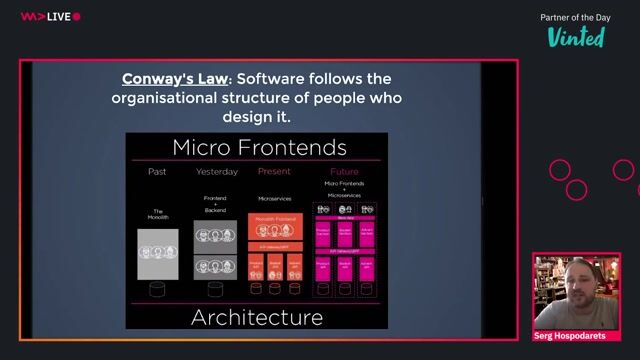
Alexander Günsche Alexander Günsche · LIVE

Upcoming sessions on this topic

Open session

World Congress 2026 North America

September 25, 2026 · 09:40–10:10

Stage 3

Still on 4.8 or lower? A Practical Guide to Moving Your "Un-Migratable" .NET Apps

Isaac Levin

Developer Advocate

Isaac Levin
Open session

World Congress 2026 North America

September 24, 2026 · 12:50–13:20

Stage 7

Architecting Agentic Apps: WebMCP, A2UI, and Agent Experience

Ankita Sood

Sr. Principal Engineer @ Secureworks | Angular GDE

Ankita Sood
Open session

World Congress 2026 North America

September 24, 2026 · 14:10–14:40

Stage 9

One Repo, One Strategy: Scalable Full-Stack Testing in a Monorepo World

Bartosz Leczycki, Paweł Matynia

Bartosz Leczycki
Paweł Matynia
Open session

World Congress 2026 North America

September 25, 2026 · 10:20–10:50

Outdoor Stage

MicroAgents: The Microservices of the Agentic Era

Ashish Shubham

Runs the show bussiness at ThoughtSpot

Ashish Shubham
Open session

World Congress 2026 North America

September 25, 2026 · 15:00–17:00

Stage 10

The AI Dependency Challenge: Your AI coding assistant is making dependency decisions. Who’s checking

Meredith Eisen, Vince Hinojosa

Meredith Eisen
Vince Hinojosa
Open session

World Congress 2026 North America

September 25, 2026 · 11:00–11:30

Stage 7

Beyond Vibe Coding: An AI Builder’s Guide to Migrating 10k+ React Components

Shubham Chaurasia

Senior Software Engineer at Meta

Shubham Chaurasia