World Congress 2025 Aug 20, 2025 Session details

Agentic AI - From Theory to Practice: Developing Multi-Agent AI Systems on Azure

Ricardo

Move beyond basic chat interfaces. Learn how to build, evaluate, and scale specialized multi-agent AI workflows on Azure using Semantic Kernel and robust CI/CD evaluators.

Pause
Mute Enter Fullscreen
#1 about 2 min

Shifting from chat interfaces to integrated AI agents

Embedding AI natively into business processes removes the need for manual chat interfaces.

#2 about 2 min

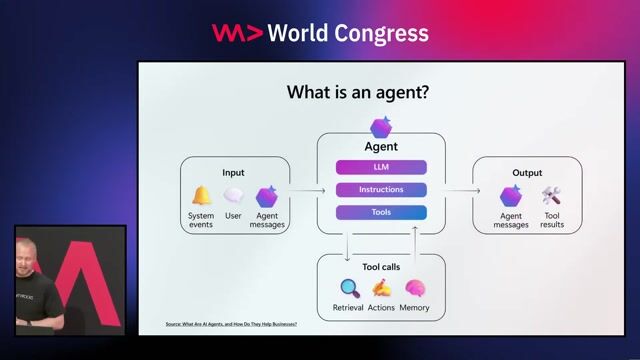
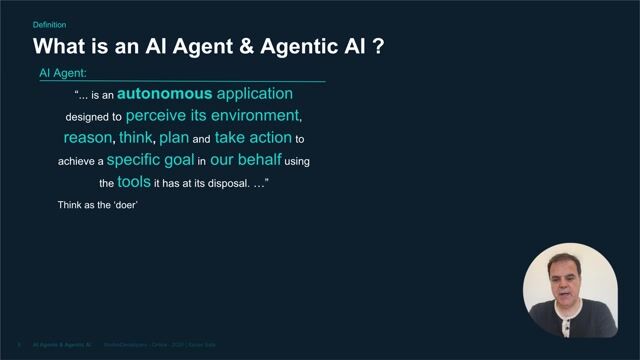
Core components of an AI agent architecture

Combining a large language model with specific instructions and tool access enables automated reasoning and execution.

#3 about 2 min

Resolving developer challenges in AI agent implementation

Identifying the right model, ensuring content safety, and maintaining observability are critical hurdles when bringing AI into production.

#4 about 2 min

Managing AI development with Azure AI Foundry

A centralized suite provides model catalogs, agent services, built-in integrations, and unified observability for enterprise AI development.

#5 about 2 min

Orchestrating enterprise agents via the Agent Service

An orchestration layer simplifies integration with existing SDKs, enterprise networks, knowledge bases, and industry protocols like MCP.

#6 about 2 min

Aligning AI projects across standard development phases

Creating successful AI products requires moving deliberately from ideation and rapid testing into robust implementation and operational monitoring.

#7 about 2 min

Testing AI models quickly using GitHub Models

A vast catalog of models can be explored and tested directly in the browser without requiring immediate infrastructure provisioning.

#8 about 3 min

Balancing prompt performance and model cost efficiency

Running systematic evaluations across different prompts, models, and datasets is essential to find the right balance between output quality and expense.

#9 about 2 min

Connecting agents to business tools and APIs

Configuring agents within Azure AI Foundry involves attaching them to internal REST APIs, existing files, and active workflow triggers.

#10 about 2 min

Automating quality testing through CI/CD evaluation pipelines

Embedding automated evaluations in deployment pipelines prevents prompt modifications or model swaps from degrading system reliability.

#11 about 3 min

Analyzing complex contracts using multi-agent workflows

Specialized agents sequentially extract, compare, and validate document compliance to accelerate manual contract reviews.

#12 about 2 min

Measuring AI agent performance within GitHub Workflows

Running nightly builds against test datasets provides concrete metrics on token usage, latency, and response quality.

#13 about 4 min

Sampling production traffic for end-to-end tracing observability

Applying performance sampling to a production subset allows teams to trace execution steps without incurring excessive overhead.

#14 about 3 min

Selecting communication patterns for multi-agent systems

Choosing between sequential, concurrent, and conversational patterns depends on whether process requirements are deterministic or probabilistic.

#15 about 2 min

Building scalable agent workflows using Semantic Kernel

Combining agent and process frameworks orchestrates complex AI logic for deployment across flexible cloud or on-premises infrastructure.

Matching moments

40 sec

Introduction to building real-world AI agent solutions

Dennis Zielke Dennis Zielke +1 · World Congress 2025

4:21 min

Scaling operations using Azure AI Foundry tools

Maxim Salnikov Maxim Salnikov · World Congress 2025

2:02 min

Shifting focus from isolated models to enterprise AI systems

Mohak Chadha Mohak Chadha · World Congress 2026 Europe

46 sec

Introduction to distributed multi-agent systems

Saoussen Chaabnia Saoussen Chaabnia · Europe 2026 Virtual

1:32 min

Architectural patterns for developing robust generative AI applications

Julián Duque Julián Duque · World Congress 2025

2:06 min

Rethinking team structures around AI agent capabilities

Mike Mike · World Congress 2025

Upcoming sessions on this topic

Open session

World Congress 2026 North America

September 24, 2026 · 11:00–11:30

Stage 5

The Missing Infrastructure for AI Agents

Chris Waterson

CTO and Co-Founder of Guild.ai

Chris Waterson
Open session

World Congress 2026 North America

September 24, 2026 · 11:40–12:10

Stage 1

The Next Wave of Agents: What’s Real, What’s Next, and What Matters

Mitesh Patel, Jay Rodge

Mitesh Patel
Jay Rodge
Open session

World Congress 2026 North America

September 24, 2026 · 14:50–15:20

Stage 7

When Agents Became Users: Rearchitecting Identity and Permissions for AI at Scale

Yoav Gal

Product Lead

Yoav Gal
Open session

World Congress 2026 North America

September 25, 2026 · 12:30–14:30

Stage 14

Build a Human + AI Agent Team in tools like Slack, Teams and Discord.

Phil Conway

Developer Advocate at Flint AI (SandboxAQ)

Phil Conway
Open session

World Congress 2026 North America

September 23, 2026 · 13:15–15:15

Stage 9

DeepAgents: Build Multi-Agent AI Systems That Actually Work

Anagha Rumade, Anjana Umapathy, Apoorva Jaiswal

Anagha Rumade
Anjana Umapathy
Apoorva Jaiswal
Open session

World Congress 2026 North America

September 23, 2026 · 10:00–17:00

Stage 11

Building Stuff with GenAI - The Open Minded Workshop beyond OpenAI

Andreas Erben

CTO for Applied AI and Metaverse at daenet

Andreas Erben