

World Congress 2025 Aug 20, 2025 Session details

What you can learn from an open-source project with 500 million downloads

Dennis Doomen

A project with 500 million downloads doesn't scale by accident. Discover the battle-tested open-source strategies—from strict automated guardrails to emoji reviews—that will bulletproof your enterprise development workflow.

Pause
Mute Enter Fullscreen
#1 about 2 min

Applying open source practices to internal company development

Overcoming internal collaboration friction by adapting open source lessons into corporate inner sourcing strategies.

#2 about 3 min

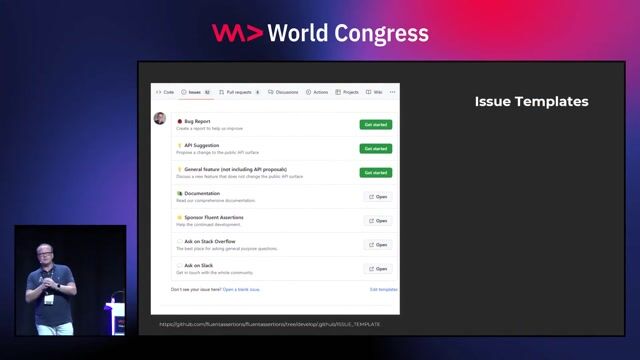
Streamlining feature requests and bug reports with templates

Configuring repository architecture with issue templates and labels improves cross-team collaboration.

#3 about 3 min

Designing library extension points and preventing breaking changes

Building extensible components requires careful planning to maintain consistency and API stability.

#4 about 2 min

Creating comprehensive project documentation and contribution guidelines

Structuring clear README files and contributing instructions reduces onboarding friction and code review frustration.

#5 about 2 min

Enhancing developer productivity with command line tools

Customizing terminal environments and utilizing CLI aliases accelerates daily source control operations.

#6 about 3 min

Enforcing coding standards with editor configurations and analyzers

Automating code layout rules and static analysis eliminates formatting debates during code reviews.

#7 about 2 min

Refactoring unit test naming conventions for functional clarity

Focusing test names on expected behavior rather than verbose logic creates readable functional specifications.

#8 about 2 min

Centralizing shared project settings and package version management

Managing dependencies globally across solutions prevents version drift and enables consistent language features.

#9 about 3 min

Applying SOLID principles to package and module architecture

Decoupling optional dependencies into separate libraries prevents bloated core packages and minimizes release cycles.

#10 about 2 min

Utilizing design patterns as refactoring goals and communication tools

Introducing known patterns during code evolution clarifies architectural intent rather than forcing upfront complexity.

#11 about 2 min

Replacing YAML build pipelines with compiled application code

Migrating continuous integration logic to a compiled language enables local debugging and step visualization.

#12 about 2 min

Detecting accidental public API changes with XML snapshots

Automating public contract comparison via snapshot testing prevents unintended breaking structural modifications.

#13 about 1 min

Isolating performance bottlenecks with profiling and micro benchmarks

Profiling production hotspots to create isolated benchmark tests ensures future commits maintain optimal performance.

#14 about 2 min

Automating document generation and markdown spell checking validation

Integrating static site generators and spellcheckers into local pipelines validates documentation changes instantly.

#15 about 2 min

Automating package dependency updates with scanning algorithms

Scheduling automated pull requests for library updates avoids compounding architectural drift and security vulnerabilities.

#16 about 2 min

Contextualizing code reviews with semantic emoji feedback indicators

Utilizing customized emojis during pull request feedback clarifies technical comment severity and required actions.

#17 about 3 min

Automating semantic versioning through branching conventions and tags

Extracting version constraints dynamically from git history standardizes release tagging and removes manual numbering.

#18 about 2 min

Consolidating repository configurations into an open source template

Centralizing boilerplate settings into a reusable starter kit propagates architectural best practices across environments.

Matching moments

3:28 min

Developing an open-source first engineering team culture

Jonathan Creamer · Coffee With Developers

2:29 min

Developing core open-source projects in scaling consulting environments

Aleksandra Desmurs-Linczewska · LIVE

1:48 min

Motivations and professional benefits of open sourcing

Johan Hutting Johan Hutting · WWC 2024

5:05 min

Shifting the developer mindset on dependency code responsibility

Feross Aboukhadijeh · Coffee With Developers

1:27 min

Learning software engineering through open source

Ramona Schwering Ramona Schwering · LIVE

2:16 min

Fostering soft skills and ethics in open source contributions

Mike Swift · Coffee With Developers

Upcoming sessions on this topic

Open session

World Congress 2026 North America

Merging at Scale: From Broken Builds to Green Mainline

Manjari Akella, Preetam Dwivedi

Manjari Akella
Preetam Dwivedi
Open session

World Congress 2026 North America

On the Public Clock: Open-Source Defense When You're Not in the Club

Nicholas Muy

VP Engineering Platform and Security at Scrut.io

Nicholas Muy
Open session

World Congress 2026 North America

GitHub’s Team X-Ray: Your Repository Knows More About Your Team Than Your Team Does

Andrea Griffiths

Senior Developer Advocate

Andrea Griffiths
Open session

World Congress 2026 North America

Lessons from 20 Years of Bootstrapping an Open Source Business to $50M+

Peter Farkas

Percona, Founder

Peter Farkas
Open session

World Congress 2026 North America

One Repo, One Strategy: Scalable Full-Stack Testing in a Monorepo World

Bartosz Leczycki, Paweł Matynia

Bartosz Leczycki
Paweł Matynia
Open session

World Congress 2026 North America

The spectrum of agentic coding: From vibe coding to high-quality software engineering

YK Sugi

Developer Experience Manager at Eventual

YK Sugi