







AJ
Austin Joy
In-depth .NET Azure Functions: Flex plan, Isolated mode and performance
- Discuss this with your agent
- Open in Claude
- Open in ChatGPT
The Azure Functions in-process model is ending by .NET 10. Master the new Kubernetes-backed Flex Consumption plan to optimize cold starts and scale event-driven architectures efficiently.
Matching moments
2:05 min
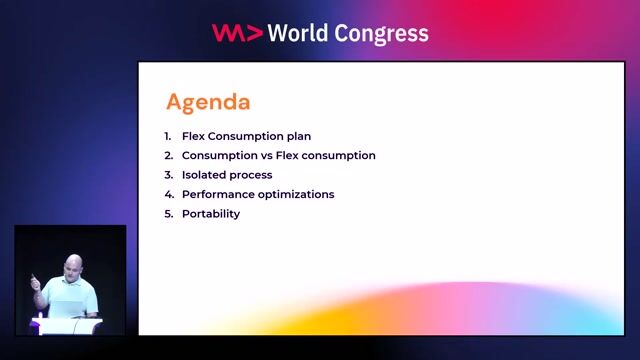
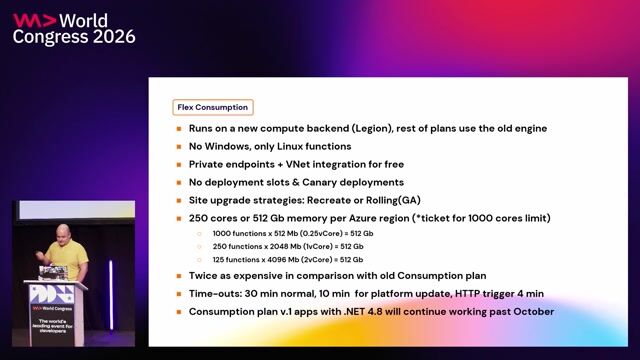
Azure functions hosting plans and migration challenges
 Stas Lebedenko · World Congress 2026 Europe
2:59 min
Adopting the .NET isolated worker model for functions
Stas Lebedenko · World Congress 2026 Europe
2:35 min
Transitioning from pure code functions to serverless containers
 Daniel Oh +1 · World Congress 2024
2:54 min
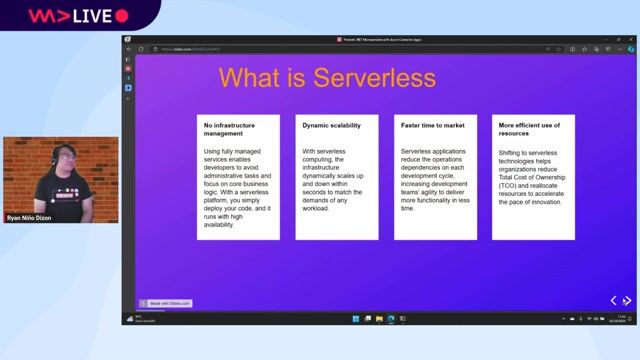
Comparing serverless functions against traditional monolithic architectures
Developersteve · LIVE
3:11 min
Running microservices on Azure Container Apps
Matthias Falkenberg +1 · World Congress 2022
2:16 min
Resolving resource scaling challenges with dynamic serverless deployments
Daniel Oh +1 · World Congress 2024
More from World Congress 2025
Related videos
Related articles

DC
Daniel Cranney

CH
Chris Heilmann

CH
Chris Heilmann

From learning to earning
Jobs that call for the skills explored in this talk.
about 1 month ago
Staff Software Engineer, Compute Platform

GitHub
United States
Experienced
Remote
Ruby
Istio
Linux
2 days ago
Staff Software Engineer, Performance Tooling

ARM
Austin, TX, United States
Expert
$170k–231k
Linux
Profiling
Kubernetes
about 2 months ago
•
Verified
GPU Cluster Engineer, Networking

Sciforium
San Francisco, United States
Expert
$150k–180k
Network Infrastructure
about 1 month ago
•
Verified
Principal Forward Deployed Engineer, Performance
Arm
Austin, United States
Experienced
$207k–281k
Azure
Kubernetes
Google Cloud Platform
about 2 months ago
•
Verified
Senior AI Serving Engineer, Backend
Sciforium
San Francisco, United States
Expert
$190k–250k
Rust
Python
2 months ago
Staff SoC Performance Architect - Next-Generation Server Platforms
ARM
San Diego, CA, United States
Expert
$198k–268k
SystemC
Profiling
InfiniBand