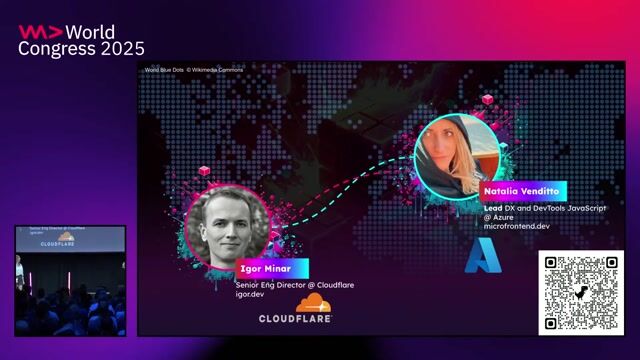


World Congress 2025 Aug 20, 2025 Session details

Web-Fragments: incremental micro-frontends migration approach for enterprise

Igor Minar , Natalia Venditto

Traditional micro-frontends lack true runtime isolation. Discover how Web-Fragments bring actual virtualization to the frontend, preventing one broken dependency from crashing your entire enterprise application.

Pause
Mute Enter Fullscreen
#1 about 2 min

Overcoming modernization challenges in aging monolithic codebases

Modernizing legacy applications requires strategies that decouple massive dependencies without forcing an unfeasible codebase rewrite.

#2 about 2 min

Applying backend microservice and virtualization patterns to frontends

Backend infrastructure solved scaling constraints by decoupling monoliths into microservices and isolating software dependencies via containerization.

#3 about 1 min

Solving frontend monolithic constraints using web fragments virtualization

Web fragments provide a unique micro-frontend architecture combined with critical environment encapsulation and browser-level isolation.

#4 about 2 min

Extracting and recomposing monolithic application parts independently

Legacy application scaling is achieved by decoupling independent features into standalone components that can be recomposed.

#5 about 3 min

Preventing application-wide fate sharing through developer environment isolation

Encapsulating module execution boundaries prevents isolated engineering errors from fundamentally crashing the shared global user experience.

#6 about 4 min

Modernizing legacy client-rendered components with server-side frameworks

Migrating heavy client-side React domains to server-side frameworks like Next.js and Qwik substantially improves initial page loading speed.

#7 about 2 min

Implementing routing middleware for seamless multi-fragment origination

Server-side middleware dynamically pipes distinct module requests back to independent origins without altering the expected end-user URL pathing.

#8 about 4 min

Isolating cascading styles and scripts using browser virtualization

Combining native shadow roots with reframed hidden iframes ensures complete script isolation while retaining full single-document interactivity.

#9 about 2 min

Prioritizing primary content rendering via server-rendered gateways

The web fragments gateway pattern selectively streams high-priority server-rendered data structures ahead of sluggish legacy legacy layouts.

#10 about 3 min

Debugging isolated contexts and managing dynamic browser memory

Developers can target virtualized javascript contexts within standard devtools and automatically garbage-collect unused dependencies by unloading modules.

#11 about 3 min

Escaping standard constraints of legacy iframe boundaries

Virtualized fragments break interface limitations by properly rendering dynamic full-screen modals outside the traditional framing area.

#12 about 2 min

Benchmarking performance overhead for isolated web components

Dropping stress-test tools inside web fragments proves that advanced browser boundary virtualization generates effectively zero runtime performance drag.

#13 about 3 min

Balancing shared platform resources with strict module encapsulation

Web fragments retain cooperative API mechanics like history navigation and caching while strongly isolating internal component states.

#14 about 2 min

Comparing virtualization with module federation and static iframes

Alternative workflows like module federation couple systems tightly to bundler limitations without addressing inherent javascript execution bleeding issues.

#15 about 4 min

Exploring the active roadmap and future web standard integrations

Future open-source features target comprehensive client dependency sharing alongside progressive integration with proposed W3C shadow domain standards.

Matching moments

1:43 min

Incremental frontend modernization avoiding full rewrites

Alexander Günsche Alexander Günsche · LIVE

2:07 min

Introduction to micro frontend architecture

Trishul Goel · JS Congress

13:09 min

Answering questions on micro-frontend adoption and tooling

Luca Mezzalira Luca Mezzalira · JS Congress

3:31 min

The reality of single-page applications versus legacy monoliths

Alexander Lichter · LIVE

2:13 min

Transitioning monolithic page structures to distributed front-end architectures

Luca Mezzalira Luca Mezzalira · World Congress 2024

5:01 min

Layering frontend frameworks using progressive decoupling strategies

Shedrack Akintayo · LIVE

Upcoming sessions on this topic

Open session

World Congress 2026 North America

September 25, 2026 · 09:40–10:10

Stage 3

Still on 4.8 or lower? A Practical Guide to Moving Your "Un-Migratable" .NET Apps

Isaac Levin

Developer Advocate

Isaac Levin
Open session

World Congress 2026 North America

September 25, 2026 · 15:30–15:40

Outdoor Stage

Offloading IoT State: Solving the Memory Crisis on Legacy Hardware

Pravin Nagare

Senior Software Engineer, Roku

Pravin Nagare
Open session

World Congress 2026 North America

September 24, 2026 · 17:30–18:00

Stage 7

Full Stack with Flutter - are we there yet?

Nemanja Stošić

Senior Flutter Developer

Nemanja Stošić
Open session

World Congress 2026 North America

September 24, 2026 · 10:20–10:50

Stage 1

The Browser Is Becoming an AI Runtime

Ajit Varma, Will Bryk

Ajit Varma
Will Bryk
Open session

World Congress 2026 North America

September 24, 2026 · 14:10–14:40

Stage 9

One Repo, One Strategy: Scalable Full-Stack Testing in a Monorepo World

Bartosz Leczycki, Paweł Matynia

Bartosz Leczycki
Paweł Matynia
Open session

World Congress 2026 North America

September 24, 2026 · 12:50–13:20

Stage 7

Architecting Agentic Apps: WebMCP, A2UI, and Agent Experience

Ankita Sood

Sr. Principal Engineer @ Secureworks | Angular GDE

Ankita Sood