





World Congress 2025 Aug 20, 2025 Session details

Your Next AI Needs 10,000 GPUs. Now What?

Anshul Jindal , Martin Piercy

Scaling massive AI models shatters traditional infrastructure because communication bottlenecks destroy performance. Learn how to architect networks that keep 10,000-GPU clusters operating at peak throughput.

Pause
Mute Enter Fullscreen
#1 about 3 min

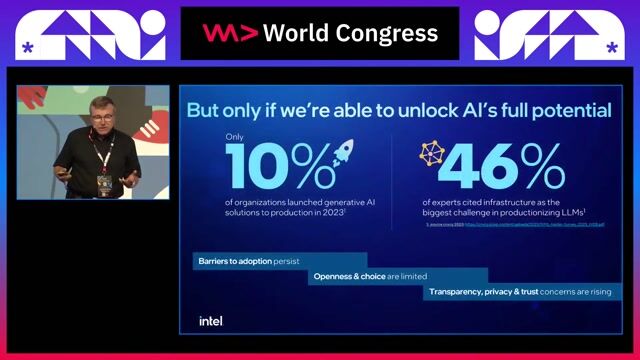
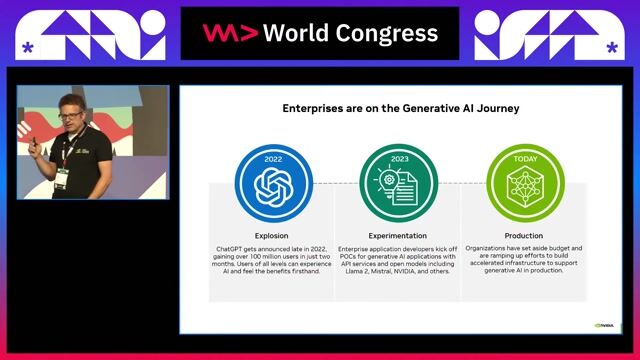
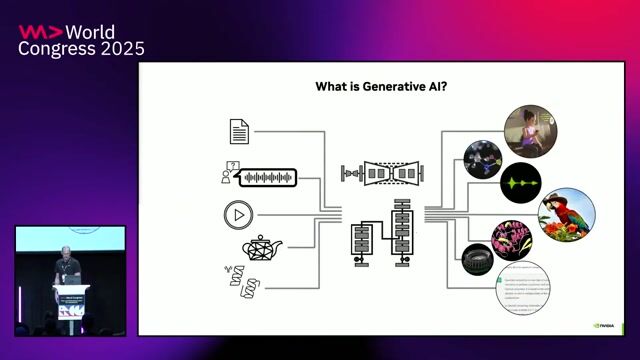
Evolution from traditional machine learning to generative models

Transitioning from predicting sequential data to creating novel content unlocks major industry use cases.

#2 about 2 min

Practical industry applications expanding beyond text generation

Utilizing generative tools accelerates coding tasks and enables interactive agents for enhanced customer experiences.

#3 about 3 min

Deploying optimized local models using inference microservices

Deploying containerized microservices simplifies the testing and integration of optimized machine learning pipelines locally.

#4 about 4 min

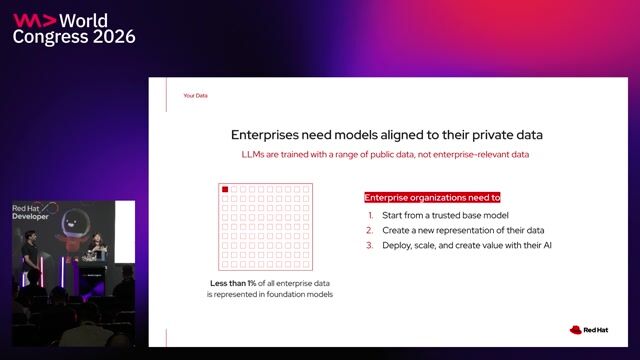
Integrating corporate knowledge with retrieval augmented generative models

Connecting foundational models to internal vector databases delivers contextually accurate answers using enterprise data securely.

#5 about 5 min

Essential phases in building and refining language models

Constructing robust systems demands data curation, distributed training frameworks, model alignment, and implementation of safety guardrails.

#6 about 5 min

Distributing large scale models across distributed hardware clusters

Applying tensor, pipeline, and data parallelism strategies minimizes communication bottlenecks across multi-node hardware clusters.

#7 about 3 min

Evaluating computing scale demands for training and inference

Analyzing extensive compute hours required for training uncovers the necessity to appropriately allocate infrastructure for scalable inference.

#8 about 3 min

Designing hardware infrastructure and networking for distributed compute

Defining rail-optimized architectures and dedicated networking links mitigates communication latency during intensive multi-node computational tasks.

#9 about 4 min

Connecting developers to computing power via cloud platforms

Utilizing a global infrastructure marketplace connects distributed workloads with decentralized hardware partners to alleviate computing constraints.

Matching moments

2:08 min

Navigating the components of the modern generative AI stack

Julián Duque Julián Duque · WWC 2025

3:09 min

Evolution of machine learning and generative AI

Aarno Aukia · LIVE

2:52 min

Scaling generative AI use cases across large enterprises

Mike Butcher Mike Butcher +3 · WWC 2024

2:31 min

Integrating generative AI into cloud-native applications

Cedric Clyburn Cedric Clyburn · WWC 2024

1:38 min

Scaling bottlenecks in generative AI applications

Stan Girard Stan Girard · WWC 2024

4:48 min

Highlighting leading generative artificial intelligence industry use cases

Simi Olabisi · LIVE

Upcoming sessions on this topic

Open session

World Congress 2026 North America

Building Stuff with GenAI - The Open Minded Workshop beyond OpenAI

Andreas Erben

CTO for Applied AI and Metaverse at daenet

Andreas Erben
Open session

World Congress 2026 North America

Agents That Own Their Inference: Building Production AI Agents on Dedicated GPUs

Duan Lightfoot

Sr. AI Engineer, Akamai

Duan Lightfoot
Open session

World Congress 2026 North America

Compute for your AI model: GPUs, LPUs, TPUs and beyond..

Kushaagra Goyal

Tech Lead at Rubrik, ex-CTO at Gan.AI, ex-Databricks

Kushaagra Goyal
Open session

World Congress 2026 North America

Trust, But Verify: Continuous GPU Validation at Scale

Kyle Bell

VP of AI @ TensorWave

Kyle Bell
Open session

World Congress 2026 North America

No Single Model to Rule Them All: Building Resilient AI Agents Across Open & Closed LLMs

Emmanuel Acheampong

Senior Manager Developer Relations at Crusoe AI

Emmanuel Acheampong
Open session

World Congress 2026 North America

Autonomous Infrastructure: Building AI Agents for Global-Scale Capacity Efficiency

Gregoire Colin, Tommy Tran

Gregoire Colin
Tommy Tran