World Congress 2025 Aug 20, 2025 Session details

How Robots Learn to be Robots

Alexander Schwarz

Training autonomous robots is bottlenecked by costly real-world testing. What if they could master kinematics inside photorealistic digital twins first? Discover how generative AI bridges the sim-to-real gap.

Pause
Mute Enter Fullscreen
#1 about 2 min

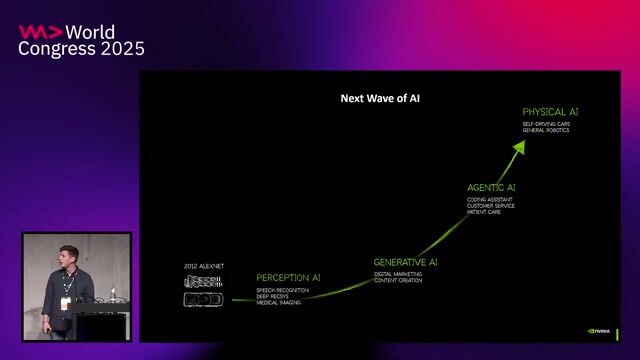
Transitioning from digital AI agents to physical AI

Defining physical AI systems that interpret 3D environments and physical behaviors.

#2 about 2 min

Translating sensory inputs into physical robot actions

How robots process camera inputs and language instructions to coordinate physical movements.

#3 about 2 min

Bottlenecks in capturing real-world operational data

The scalability and safety limitations of physical teleoperation and real-world testing.

#4 about 2 min

A three-computer paradigm for robotics development

Structuring workflows around neural network training, synthetic data generation, and digital twin simulation.

#5 about 2 min

Managing heterogeneous AI policies across robot embodiments

Deploying specific foundation models for separate skills like perception, navigation, and manipulation.

#6 about 2 min

Accelerating reinforcement learning through parallel simulation

Training trial-and-error behaviors exponentially faster by running thousands of environments simultaneously on GPUs.

#7 about 1 min

Bootstrap datasets via imitation learning and teleoperation

Capturing expert human trajectories to establish baseline behaviors for complex tasks.

#8 about 2 min

Establishing standardized 3D workflows using OpenUSD

Leveraging the OpenUSD framework to build interoperable, non-destructive digital twins.

#9 about 3 min

Scaling human demonstrations with domain randomization algorithms

Applying perturbations to small sets of simulated teleoperation runs to multiply synthetic training trajectories.

#10 about 3 min

Categorizing world foundation models for physical AI

Introducing models optimized for future state prediction, style transfer, and spatial reasoning.

#11 about 2 min

Bridging the sim-to-real gap with multi-control networks

Converting coarse simulation segmentations into photorealistic video datasets to improve model generalization.

#12 about 3 min

Hallucinating valid trajectories using video diffusion models

Post-training prediction models with robot kinematics to generate new training scenarios without full physics rendering.

#13 about 3 min

Fusing internet video and synthetic telemetry for foundation models

Combining massive unstructured external data with targeted simulated outputs to pre-train highly adaptable control policies.

#14 about 2 min

Validating deployed robotic policies in digital factory environments

Performing large-scale software-in-the-loop testing within virtual industrial spaces before physical rollout.

Matching moments

2:22 min

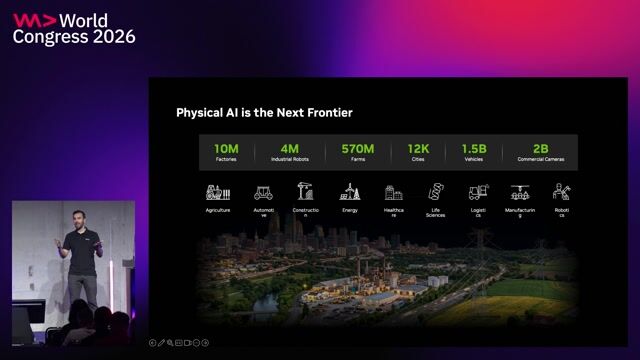
Introduction to physical AI and the physical world

Moe Sani Moe Sani · World Congress 2026 Europe

2:58 min

Introduction to Omniverse and Isaac Sim platforms

Teresa Conceicao · World Congress 2022

1:20 min

Shifting focus from large language models to physical AI

Sergio Perez Sergio Perez · World Congress 2026 Europe

2:23 min

Development roadmap for world models and physical robotics

Joerg Krall Joerg Krall · World Congress 2026 Europe

1:40 min

The three essential phases for physical AI development

Sergio Perez Sergio Perez · World Congress 2026 Europe

2:55 min

Moving from AI software buzzwords to building actual robots

Iulia Feroli Iulia Feroli · World Congress 2026 Europe

Upcoming sessions on this topic

Open session

World Congress 2026 North America

September 25, 2026 · 12:55–13:25

Stage 1

From Simulation to Reality: Overcoming the Data Scarcity Crisis in Physical AI

Mitesh Patel

NVIDIA Corporation, Developer Advocate -- Manager

Mitesh Patel
Open session

World Congress 2026 North America

September 24, 2026 · 11:00–11:30

Tech Leaders Stage

Building AI for the Physical World

Alex Spinelli, Eystein Stenberg, Gerardo Pardo-Castellote

Alex Spinelli
Eystein Stenberg
Gerardo Pardo-Castellote
Open session

World Congress 2026 North America

September 25, 2026 · 11:40–12:10

Stage 9

You Can’t Re-Run Sunlight: Designing ML Data Architectures for Physical AI

An Phan

Senior Data Infrastructure Engineer @ Hippo Harvest

An Phan
Open session

World Congress 2026 North America

September 25, 2026 · 10:20–10:50

Stage 5

Physical AI: 5 Things You Can Build That Aren't Another Chatbot

Vini Senger

Senior Technical Evangelist for Startups

Vini Senger
Open session

World Congress 2026 North America

September 23, 2026 · 10:00–17:00

Stage 11

Building Stuff with GenAI - The Open Minded Workshop beyond OpenAI

Andreas Erben

CTO for Applied AI and Metaverse at daenet

Andreas Erben
Open session

World Congress 2026 North America

September 24, 2026 · 12:50–13:20

Stage 5

For Physical AI, data is the problem, but data is not the solution

Ashutosh Saxena

CEO at TorqueAGI

Ashutosh Saxena