
World Congress 2021 Jun 30, 2021

Intro to Flutter Development

Mira Jago

Stop duplicating code for iOS and Android. Discover how Flutter's single codebase and Hot Reload feature deliver pixel-perfect, high-performance apps in half the time.

Pause
Mute Enter Fullscreen
#1 about 3 min

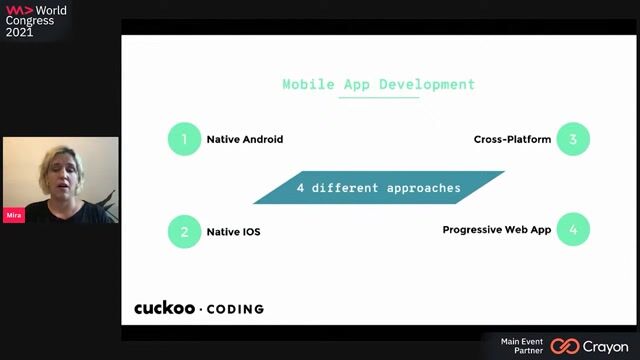
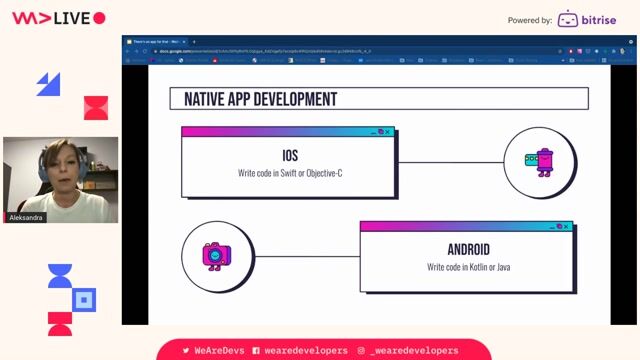
Transitioning to cross-platform mobile app development

Reducing the requirement for duplicate native development saves significant time and maintenance costs.

#2 about 2 min

Evaluating progressive web apps for mobile deployment

Relying on browser adoption and service workers introduces variability compared to consistent cross-platform frameworks.

#3 about 3 min

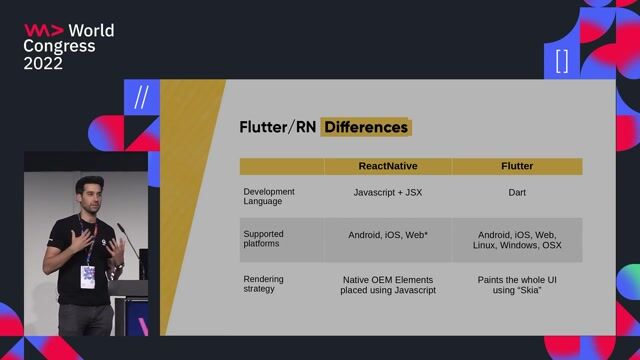
Comparing hybrid app frameworks with React Native and Flutter

Frameworks spanning different languages contrast starkly against approaches defining interface pixels individually.

#4 about 3 min

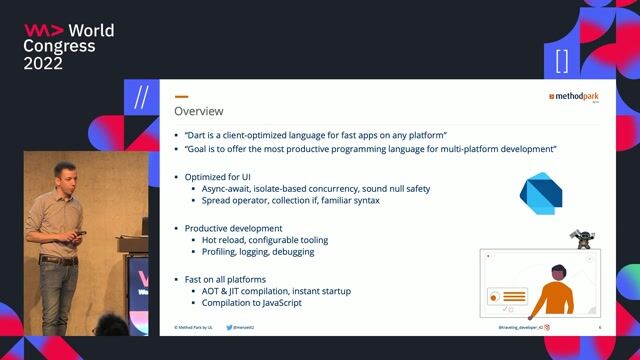
Core benefits of using the Dart programming language

Developing interfaces requires a fast compiling architecture that accelerates iterations while preserving application state dynamically.

#5 about 5 min

Understanding Flutter widget tree structures and state updates

Composing hierarchical layouts requires explicitly signaling mutation events directly to nested interface properties.

#6 about 2 min

Setting up the local Flutter software development environment

Installing language toolchains via standard editors unblocks multi-target compilation commands.

#7 about 3 min

Navigating default Flutter project folder structures and dependencies

Exploring repository templates reveals fundamental locations spanning platform integrations and package configurations.

#8 about 2 min

Initializing applications via the main Dart execution file

Establishing underlying framework wrappers enables global variable overrides routing users sequentially.

#9 about 4 min

Defining global themes and custom foundational color swatches

Predefining standardized chromatic values ensures uniform styling properties across subsequent display elements logically.

#10 about 3 min

Scaffolding a structured stateful widget layout hierarchy baseline

Assembling core layout skeletons standardizes common components enveloping visual document bodies identically.

#11 about 4 min

Extracting duplicative user interface code into reusable widgets

Refactoring explicit definitions generates robust modular blocks ensuring consistency whenever duplicating list items visually.

#12 about 3 min

Adding user interactivity and dynamic screen navigation routing

Wrapping static nodes transforms localized actions directly into contextual screen transitions reliably.

#13 about 2 min

Generating dynamic application content using an iterative builder

Parameterizing output algorithms maps server responses perfectly into performant scrolling view layers continuously.

#14 about 2 min

Delivering platform-specific native user interface component rendering

Polling the current operating system displays completely distinct styling libraries transparently.

#15 about 3 min

Building smooth interface transitions with animated opacity parameters

Injecting mathematical sequences handles timing variations smoothly when alternating boolean visibility bounds mathematically.

#16 about 2 min

Manipulating spatial geometry via runtime application transform widgets

Translating positional offset arguments offsets visual alignments according to user slider adjustments instantaneously.

#17 about 3 min

Selecting foundational architectures and backend infrastructure integration solutions

Adopting structured communication boundaries secures robust data manipulation patterns communicating toward remote environments accurately.

#18 about 9 min

Resolving integration conflicts and architectural constraints during implementation

Answering common troubleshooting scenarios illuminates the practical constraints spanning interface accessibility bounds.

Matching moments

5:05 min

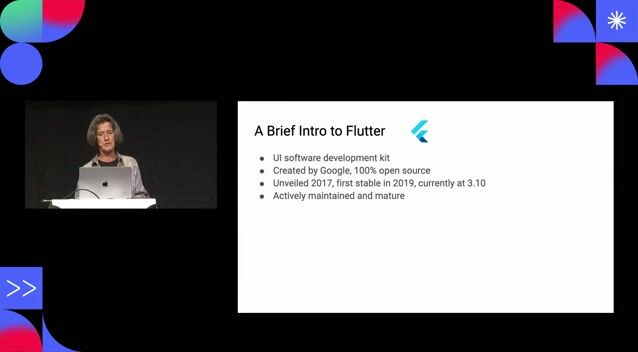
Introduction to Flutter and cross-platform UI development

Sylvia Dieckmann · LIVE

4:57 min

Introduction to cross-platform application development with Flutter

Simon Auer Simon Auer · WWC 2022

4:12 min

Introduction to cross-platform mobile development with Flutter

Majid Hajian · LIVE

1:11 min

Best practices for building scalable Flutter applications

Simon Auer Simon Auer · WWC 2022

1:45 min

Comparing declarative cross-platform architectures like Flutter and React Native

Sylvia Dieckmann · LIVE

5:03 min

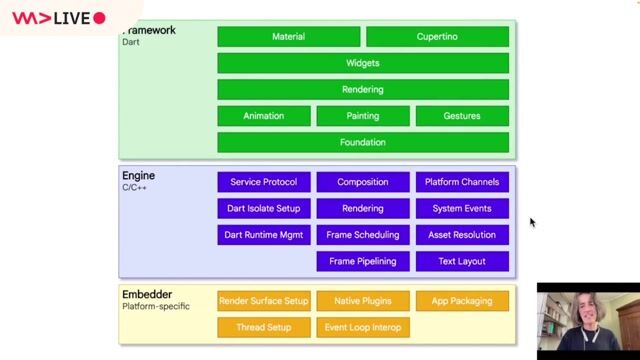
Core pillars and foundational components of the Flutter framework

Sylvia Dieckmann · WWC 2023

Upcoming sessions on this topic

Open session

World Congress 2026 North America

Full Stack with Flutter - are we there yet?

Nemanja Stošić

Senior Flutter Developer

Nemanja Stošić
Open session

World Congress 2026 North America

How to generate business value through performance optimizations

Nikolai Sidiropulo

Software Engineer at Meta

Nikolai Sidiropulo
Open session

World Congress 2026 North America

From Cloud Native to Multi-Cloud Native: Write Once, Deploy Anywhere

Sandeep Pal

Principal Member of Technical Staff at Salesforce

Sandeep Pal
Open session

World Congress 2026 North America

Architecting AI in Angular: WebMCP, A2UI, and the Agent Experience

Ankita Sood

Sr. Principal Engineer @ Secureworks | Angular GDE

Ankita Sood
Open session

World Congress 2026 North America

Beyond Vibe Coding: An AI Builder’s Guide to Migrating 10k+ React Components

Shubham Chaurasia

Senior Software Engineer @ Meta

Shubham Chaurasia
Open session

World Congress 2026 North America

One Repo, One Strategy: Scalable Full-Stack Testing in a Monorepo World

Bartosz Leczycki, Paweł Matynia

Bartosz Leczycki
Paweł Matynia