



World Congress 2026 Europe - Virtual Stage • Jul 1, 2026 • Session details

Building Trustworthy AI in Industry: Beyond Traditional Cybersecurity

Matteo Meucci

Secure code does not guarantee trustworthy AI. Discover why traditional cybersecurity fails against probabilistic models and how to build an evidence-based AI development lifecycle.

Pause
Mute Enter Fullscreen
#1 about 3 min

Moving from secure software behavior to trustworthy AI

Traditional security mechanisms cannot guarantee trusting generative AI behavior in the face of evolving prompts and external content.

#2 about 3 min

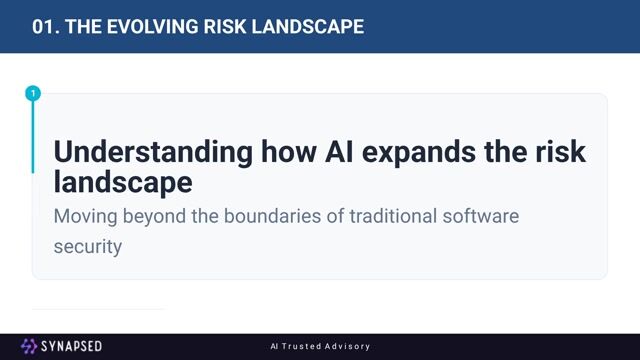
Emerging risks and attack vectors in AI systems

Probabilistic models introduce unpredictable behaviors and new attack surfaces like prompt injection that influence active internal workflows.

#3 about 2 min

Limitations of traditional static testing for AI models

Static analysis tools struggle with context-dependent AI behavior such as hallucinations or execution of malicious prompts.

#4 about 2 min

Assisting security analysis using AI code review tools

AI models accelerate vulnerability remediation but still require human security expertise to validate incomplete or invented fixes.

#5 about 3 min

Expanding security boundaries beyond code and application runtime

Securing AI requires validating data quality, model behavior, and inference contexts rather than just reviewing explicit source code.

#6 about 4 min

Transitioning toward a trustworthy AI development life cycle

Developing safe models demands continuous inference testing across data, robust model validation, and cross-functional team governance.

#7 about 2 min

Defining the core dimensions of generative AI security

Comprehensive system trustworthiness merges responsible AI, robust security controls, and strict privacy compliance to ensure safe user interaction.

#8 about 6 min

Operationalizing validation using OWASP AI testing guidelines

Structured testing methodologies validate architectural layers against complex threats like indirect prompt manipulation or excessive agent agency.

#9 about 5 min

Measuring organizational readiness with AI maturity assessments

Evaluating gap analysis scores across governance, policy, and engineering practices helps structure continuous organizational improvement for safe AI adoption.

Matching moments

3:08 min

Managing the impact of AI on software trust

Serge Baumberger Serge Baumberger · Europe 2026 Virtual

1:20 min

Utilizing industry threat models for AI security

Balázs Kiss · World Congress 2023

2:13 min

Identifying and hardening against generative AI risks

Rebekka Weiss Rebekka Weiss +1 · World Congress 2025

1:46 min

Evaluating the security and trustworthiness of generative AI agents

Maish Saidel-Keesing Maish Saidel-Keesing · World Congress 2025

2:58 min

Managing vulnerabilities in auto-generated software development processes

Chris Wysopal Chris Wysopal +2 · World Congress 2024

4:15 min

Security integration and AI skepticism in developer tooling

Chris Heilmann Chris Heilmann +2 · LIVE