

BB
Benedikt Bischof
We Gave Every Tenant a Postgres Connection String
- Discuss this with your agent
- Open in Claude
- Open in ChatGPT
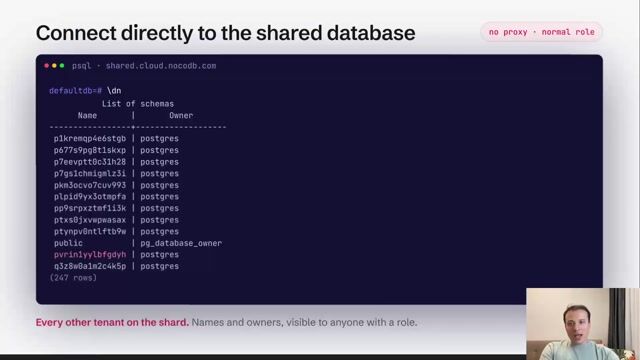
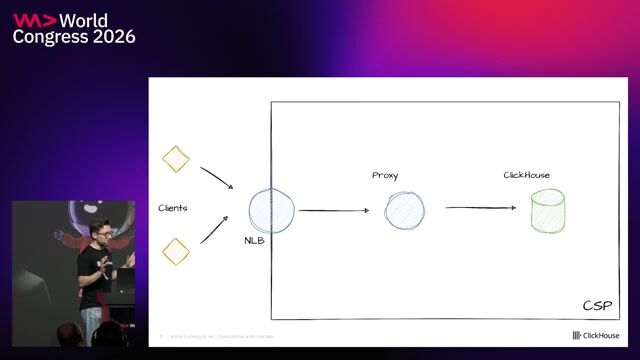
How do you give SaaS tenants a raw Postgres connection string without leaking shared metadata? Learn how a custom TCP proxy achieves virtual single tenancy at the protocol level.
Matching moments
1:40 min
Deployment architectures for scalable multi-tenant database environments
 Alper Ebicoglu · World Congress 2025
5:53 min
Choosing relational databases over NoSQL for most workloads
 Josip Stuhli · World Congress 2026 Europe
2:09 min
Migrating moving data targets without disrupting active engineering teams
 Max Fischer +1 · World Congress 2026 Europe
1:39 min
Making Postgres databases stateless using cloud-native storage systems
 Nikita Shamgunov · World Congress 2024
5:55 min
Advantages and challenges of multi-tenant application architecture
Alper Ebicoglu · World Congress 2025
2:05 min
Embracing high opinionation to simplify web application architecture
Daniel Hepper · LIVE
More from World Congress 2026 Europe - Virtual Stage
Related videos
Related articles
.gif)
DC
Daniel Cranney

IK
Igor Khokhriakov
CH
Chris Heilmann


From learning to earning
Jobs that call for the skills explored in this talk.
about 1 month ago
Principal Systems Engineer, Database Infrastructure

GitHub
United States
Expert
Remote
Ruby
MySQL
Golang
about 1 month ago
•
Verified
Data Governance Lead

Dynatrace
Boston, United States
Expert
Remote
PostgreSQL
Data analysis
Data Warehouse
about 1 month ago
Staff Systems Engineer, Database Infrastructure
GitHub
United States
Experienced
Remote
Ruby
MySQL
Golang
11 days ago
Stackit Database - Go Developer

Stackit
Madrid, Spain
Grpc
MongoDB
Databases
about 1 month ago
•
Verified
Lead Data Product Owner - Finance
Dynatrace
Boston, United States
Expert
Remote
JIRA
PostgreSQL
Data analysis
about 1 month ago
•
Verified
Sr Data Analyst
Dynatrace
United States
Expert
Remote
Tableau
PostgreSQL
Data analysis