





DC
Daniel Cranney
World Congress 2021
•
Jul 1, 2021
Developing an AI.SDK
Daniel Graff , Andreas Wittmann
- Discuss this with your agent
- Open in Claude
- Open in ChatGPT
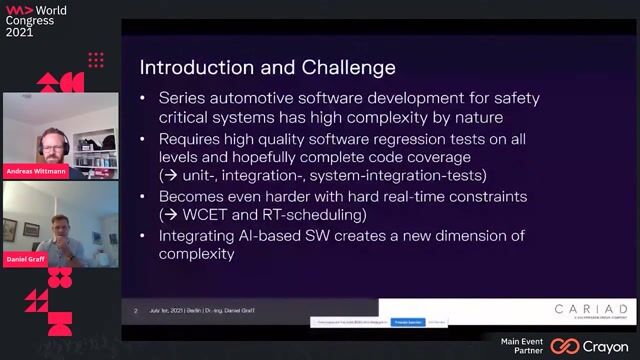
Deploying safety-critical AI to millions of vehicles requires bridging cloud-native scale with embedded constraints. Explore how CARIAD's dual-component AI SDK optimizes neural training and in-car execution.
Matching moments
2:21 min
Introduction to machine learning in the automotive industry
Jan Zawadzki · LIVE
3:16 min
Driving developer productivity with AI in automotive tech
 Mike Butcher +3 · World Congress 2024
1:53 min
Unified tech stack and hardware for Volkswagen
Liang Yu · World Congress 2022
10:40 min
Evaluating automotive software architectures and backend technologies
Georg Kühberger +1 · LIVE
2:52 min
Introduction to safety-critical machine learning in automotive contexts
Jan Zawadzki · World Congress 2022
2:41 min
Exploring modern AI SDKs and production deployment challenges
 Michał Michalczuk · Europe 2026 Virtual
More from World Congress 2021
Related videos
Related articles

DC
Daniel Cranney
BB
Benedikt Bischof
.gif)
BB
Benedikt Bischof
.gif)
From learning to earning
Jobs that call for the skills explored in this talk.
22 days ago
Principal Software Engineer, AI Inference Runtime

ARM
Seattle, WA, United States
Expert
$262k
Compilers
Low Latency
Concurrency
22 days ago
Principal Software Engineer, AI Inference Cloud
ARM
Seattle, WA, United States
Expert
$262k
Pytorch
TensorRT
Kubernetes
22 days ago
Staff Software Engineer, AI Inference Runtime
ARM
Seattle, WA, United States
Expert
$209k–282k
Compilers
Low Latency
Concurrency
22 days ago
Staff Software Engineer, AI Inference Cloud
ARM
Seattle, WA, United States
Expert
$209k–282k
Pytorch
TensorRT
Kubernetes
24 days ago
Senior AI Software Engineer iv)

Bosch-Gruppe Österreich
Linz, Austria
Expert
€55k
JSON
Docker
Nintex
22 days ago
Principal Software Engineer, AI Compute Infrastructure
ARM
Seattle, WA, United States
Expert
$262k
Linux
Grafana
Pytorch