

CH
Chris Heilmann
Compliance & Risk: Shipping Open Source, AI, and Containers
- Discuss this with your agent
- Open in Claude
- Open in ChatGPT
Could your next container deployment inadvertently force you to open-source your proprietary code? Discover how to automate legal compliance within your architecture before you ship.
Matching moments
5:18 min
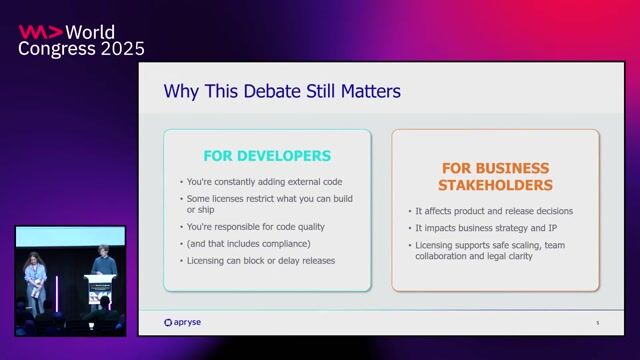
Evolving software licenses for AI and fair use models
 Andrew MacLean +2 · LIVE
1:52 min
Aligning open source frameworks with emerging AI compliance regulations
1:03 min
Navigating European software legislation with open regulatory compliance processes
 Francisco Carneiro · World Congress 2025
1:59 min
Leveraging AI to accelerate compliance and time to market
 Alexandre Guenoun +3 · World Congress 2026 Europe
53 sec
Avoiding common pitfalls in code attribution and license compatibility
 Kevin +1 · World Congress 2025
2:16 min
Implementing compliance by design for software reliability
Kevin +1 · World Congress 2025
More from World Congress 2026 Europe - Virtual Stage
Related videos
Related articles
DC
Daniel Cranney

BR
Benjamin Ruschin

DC
Daniel Cranney
From learning to earning
Jobs that call for the skills explored in this talk.
about 1 month ago
•
Verified
Principal Software Engineer, AI Tools and Security
Docker, Inc.
San Francisco, United States
Expert
Remote
Go
Cloud (AWS/Google/Azure)
about 1 month ago
Principal Solutions Architect, Professional Services
Docker, Inc.
Valencia, Spain
€119k–170k
Okta
Docker
OpenID
about 1 month ago
Principal Solutions Architect, Professional Services
Docker, Inc.
Barcelona, Spain
€119k–170k
Okta
Docker
OpenID
about 1 month ago
Principal Solutions Architect, Professional Services
Docker, Inc.
Badajoz, Spain
€119k–170k
Okta
Docker
OpenID
about 1 month ago
Principal Solutions Architect, Professional Services
Docker, Inc.
Santiago de Compostela, Spain
€119k–170k
Okta
Docker
OpenID
about 1 month ago
Principal Solutions Architect, Professional Services
Docker, Inc.
A Coruña, Spain
€119k–170k
Okta
Docker
OpenID