
World Congress 2026 Europe - Virtual Stage Jul 2, 2026 Session details

Living Documentation That Can't Die

Roman Liukevich

Stale documentation is actively breaking your AI coding agents by feeding them outdated instructions. Discover how a unified docs-as-code approach transforms passive guidelines into active IDE warnings.

Pause
Mute Enter Fullscreen
#1 about 2 min

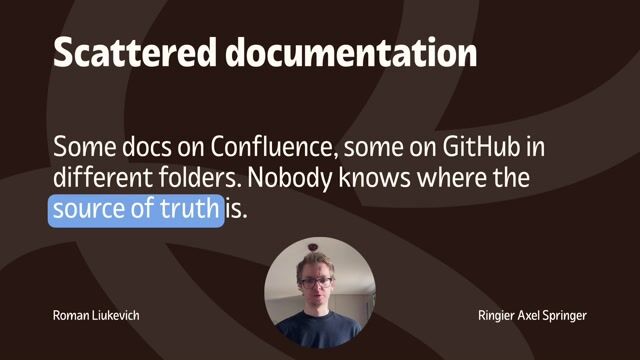
Why scattered knowledge bases lead to stale documentation

Spreading documentation across multiple platforms prevents teams from knowing where the actual source of truth resides.

#2 about 3 min

The persistent gap between AI code agents and documentation

AI assistants integrated into the IDE still lack awareness of external documentation platforms like Confluence or Notion.

#3 about 2 min

Relocating documentation to the main codebase repository

Placing documentation in the same repository as code allows AI agents to read and rely on accurate context.

#4 about 5 min

Evaluating documentation folders versus Git submodules and wikis

Teams must choose between the friction of pull requests in a docs folder or the manual syncing of a separate wiki repository.

#5 about 2 min

Generating and syncing documentation automatically with AI

Configuring AI agents to read and update documentation files during code changes prevents knowledge from falling out of sync.

#6 about 1 min

Managing agent token consumption with an index file

Creating a simple index document helps AI agents selectively read relevant files instead of consuming entire documentation folders.

#7 about 1 min

Validating code style and rules against documentation

Agents can automatically check any code file against documented standards during the review and onboarding processes.

#8 about 2 min

Converting architectural guidelines into custom lint rules

Transforming lengthy lists of architectural rules into hard linting constraints ensures compliance without relying on human memory.

#9 about 4 min

Operating a unified documentation system day to day

Integrating code, documentation, and AI agents into a single automated loop drastically reduces the cost of keeping information current.

Matching moments

1:09 min

The emergent readers of software documentation

Emil Sorensen Emil Sorensen · World Congress 2026 Europe

4:08 min

Transitioning documentation from human readers to AI agents

Edvin Teskeredzic Edvin Teskeredzic · World Congress 2026 Europe

2:09 min

Assessing the limitations of generating documentation directly from codebases

Chris Heilmann +2 · LIVE

3:38 min

Adopting documentation-led specification for optimal agent code generation

Lee Stott · Coffee With Developers

2:55 min

Enhancing AI agents with trusted documentation and logical restraints

Chris Heilmann +2 · LIVE

2:22 min

Orchestrating local developer environments with AI tools

Angie Jones Angie Jones · World Congress 2025

Upcoming sessions on this topic

Open session

World Congress 2026 North America

Agentic Drift: keeping pace with your agents

John Coghlan

Senior Director, Developer Advocacy at GitLab

John Coghlan
Open session

World Congress 2026 North America

DeepAgents: Build Multi-Agent AI Systems That Actually Work

Anagha Rumade, Anjana Umapathy, Apoorva Jaiswal

Anagha Rumade
Anjana Umapathy
Apoorva Jaiswal
Open session

World Congress 2026 North America

How AI Agents Tripled Our Test Coverage on a 1.8M-Line iOS Codebase

Kush Agrawal

Staff Software Engineer, Platform

Kush Agrawal
Open session

World Congress 2026 North America

Agents Can't Iterate Against Tests That Lie

Rocky Warren

Senior Staff Software Engineer at Clipboard

Rocky Warren
Open session

World Congress 2026 North America

When Humans Stop Writing Code: Rethinking Languages, Compilers, and Responsibility

Simon Auer

Organizer of flutter vienna meetup and CEO of marqably

Simon Auer
Open session

World Congress 2026 North America

The Broken Rung: How AI is Rebuilding Software Development from the Ground Up

Tomislav Tipurić

Chief Technology Officer, Nephos

Tomislav Tipurić