

World Congress 2026 Europe - Virtual Stage β€’ Jul 2, 2026 β€’ Session details

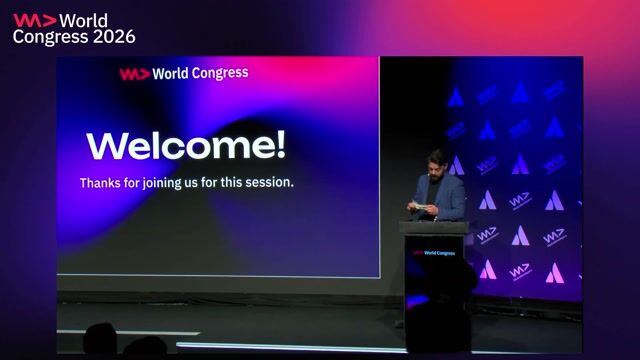
AI and Agility: The Dynamic Duo for Disruption

Christopher May

Why do 70% of enterprise AI projects fail? Survive disruption by evolving agile frameworks to treat AI agents as official team headcount and multiply development velocity.

Pause
Mute Enter Fullscreen
#1 about 3 min

AI adoption barriers and process struggles

Why organizations fail to achieve value from investments due to unaligned human workflows and legacy structures.

#2 about 4 min

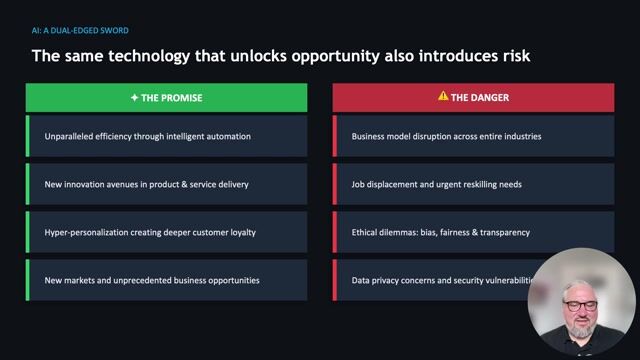
Rewards and potential disruption risks of AI

Balancing massive efficiency gains against future cybersecurity vulnerabilities and shifting workforce models.

#3 about 3 min

Enabling hyperagility multipliers through agentic tools

How automated systems compress iterative feedback loops and permanently supercharge agile team velocity metrics.

#4 about 3 min

Core dimensions of supercharged accelerated prototyping

Leveraging dynamic data simulations and real-time generation to test complex hypotheses in hours rather than weeks.

#5 about 4 min

Combining emotional intelligence with processing power

Why nuanced human judgment pairs perfectly with the endless pattern recognition capabilities of large models.

#6 about 4 min

Five essential human capabilities for machine collaboration

Adapting continuous learning, prompt engineering, and ethical governance to validate machine-generated solutions securely.

#7 about 2 min

Integrating intelligent support into modern agile practices

Enhancing everyday team rituals using project risk assessment trackers and fully automated retrospective summaries.

#8 about 4 min

Analyzing how tech leaders deploy agile automation

How data-driven deployments optimize functional feedback cycles inside top modern enterprise architectures.

#9 about 2 min

Evaluating current enterprise artificial intelligence production maturity

Bridging the massive execution gap between struggling early proof of concepts and robust functional deployments.

#10 about 5 min

Shifting responsibility to top-down operational strategy mandates

Constructing formal governance frameworks and role expectations instead of relying exclusively on localized team experiments.

#11 about 2 min

Self-assessing organizational readiness for functional algorithm scaling

Measuring internal systemic capacity through standardized evaluation parameters to identify necessary operational growth paths.

#12 about 5 min

Three foundational phases of enterprise-wide strategic adaptation

Progressing consistently from clean data architecture foundations towards fully measured operational innovation labs.

#13 about 6 min

Proactive resolutions for systemic infrastructure and compliance bottlenecks

Combatting inherently poor model output through strict centralized data validation and comprehensive change management upskilling.

#14 about 4 min

Top baseline behaviors among competitive market leaders

Why integrating deep cultural investments directly connects to extremely fast execution speed and reliable deployments.

#15 about 4 min

Developing healthy sustainable environments for localized experimentation failures

Embracing transparent continuous experimentation missteps directly into the core corporate development lifecycle to fuel insight.

#16 about 5 min

Constructing the unified dual-track agentic operating model

Splitting discovery hypotheses logically from continuous production delivery loops and infrastructure health monitoring.

#17 about 3 min

Rebuilding daily sprint ceremonies around measurable hypothesis tracking

Modifying standard iterative progress updates into strict tactical feedback checkpoints targeting model accuracy and precision.

#18 about 2 min

Comparing traditional software delivery increments to neural workflows

Transitioning entirely away from fixed feature requirements toward constantly adjusting business KPI generation targets.

#19 about 3 min

Final technical pillars to ensuring ethical sustainable deployments

Guaranteeing properly robust automated reliability pipelines remain fully combined with clear explainability thresholds before shipping.

Matching moments

2:08 min

The collaboration gap between AI influence and agile processes

Vera Slavnić Vera Slavnić · Europe 2026 Virtual

3:01 min

Adapting team structures and agile workflows for agentic tools

Clemens Wasner Clemens Wasner +4 Β· WWC Europe 2026

5:29 min

Redefining the scrum master role as an AI orchestrator

Vera Slavnić Vera Slavnić · Europe 2026 Virtual

1:47 min

The growing necessity of orchestrating AI in software teams

Vera Slavnić Vera Slavnić · Europe 2026 Virtual

4:08 min

Transitioning software engineering teams to AI-native development workflows

Florian Deter Florian Deter +4 Β· WWC Europe 2026

2:26 min

Shifting from product silos to collaborative process models

Mike Mike Β· WWC 2025

Upcoming sessions on this topic

Open session

World Congress 2026 North America

Beyond the Code: Human-AI Synergies in Product Development

Ajita Kanchivakam Ananth

Staff Technical Program Manager at Google

Ajita Kanchivakam Ananth
Open session

World Congress 2026 North America

Reinventing Testing Practices in the AI Era

Eric Deandrea

Java Champion & Senior Principal Software Engineer, IBM

Eric Deandrea
Open session

World Congress 2026 North America

The Broken Rung: How AI is Rebuilding Software Development from the Ground Up

Tomislav Tipurić

Chief Technology Officer, Nephos

Tomislav Tipurić
Open session

World Congress 2026 North America

AI ROI: The Hard Unit Economics of AI-Native Engineering

Manu Gurudatha

Manu Gurudatha, VP of Engineering at PagerDuty

Manu Gurudatha
Open session

World Congress 2026 North America

Agentic Drift: keeping pace with your agents

John Coghlan

Senior Director, Developer Advocacy at GitLab

John Coghlan
Open session

World Congress 2026 North America

Engineering the Pivot: How Creative Strategy Solves the Hard Problems of AI Accuracy and Scale

Shruti Tiwari

AI/ML product manager, Dell

Shruti Tiwari