



World Congress 2026 Europe - Virtual Stage • Jul 3, 2026 • Session details

AI Code then vs now: From Complex rubbish to co-piloting in 12 months

Sergej Reznik

A year ago, AI generated unmaintainable rubbish, but today's context-aware copilots debug entire codebases natively. Discover why hyper-speed coding still demands human architects to prevent catastrophic bugs.

Pause
Mute Enter Fullscreen
#1 about 3 min

Moving from manual coding to fragmented AI workflows

The shift from manual coding to orchestrating generated snippets across fragmented low-code platforms.

#2 about 1 min

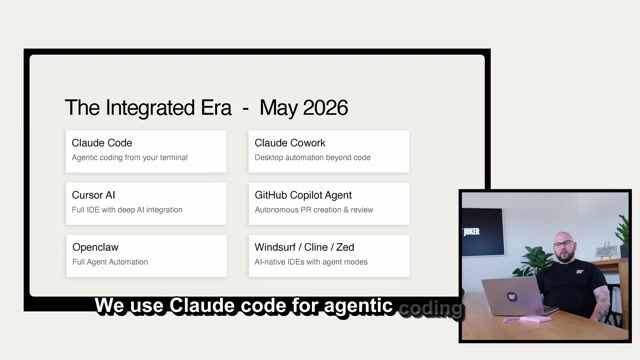
Transitioning into the integrated era of agentic IDEs

How modern terminal agents and integrated tools compile workflows seamlessly without tab switching.

#3 about 1 min

Empowering non-developers with accessible no-code platforms

The rapid growth of intuitive application platforms enabling non-technical builders to bypass traditional workflows.

#4 about 1 min

Balancing development speed with long-term software sustainability

Why prioritizing pure generation velocity over code maintainability leads to professional tech debt.

#5 about 1 min

Shifting from chat interfaces to autonomous agentic co-piloting

Moving away from copy-pasting code snippets toward agents that autonomously read, edit, and test codebases.

#6 about 2 min

Managing security vulnerabilities and data privacy compliance issues

Proactively identifying insecure APIs, data breaches, and privacy compliance requirements when relying on AI generation.

#7 about 1 min

Enforcing strict quality assurance against rapid bug regressions

The critical need for robust testing protocols when facing the rapid bug introduction rates of AI-generated code.

#8 about 1 min

Overcoming early AI hallucinations and unmaintainable spaghetti code

Resolving the initial generations of missing context and outdated imports that led to unmaintainable code patterns.

#9 about 2 min

Utilizing full codebase context for iterative agentic debugging

The adoption of copilots with full environment memory that actively run tests and fix their own errors.

#10 about 1 min

Implementing authenticated routing infrastructure via terminal agent instructions

A practical example of using automated file and architecture scaffolding to implement authenticated components seamlessly.

#11 about 2 min

Automating environments with cross-platform context protocol integrations

Connecting separate workspace systems to unified autonomous agents through modular context tools and background execution loops.

#12 about 1 min

Preserving core engineering fundamentals against complete AI reliance

Ensuring junior developers deeply understand their architectures rather than merely fetching external solutions for dopamine hits.

#13 about 2 min

Avoiding platform vendor lock-in across centralized generation tools

Ensuring data interoperability and ecosystem flexibility prevents complete operational loss if a central provider shuts down.

#14 about 1 min

Defining realistic budget expectations for escalating token costs

Calculating the true financial impact of scalable API consumption against the long-term price drivers of package updates.

#15 about 2 min

Recapping vital capability shifts across security and enterprise infrastructure

Synthesizing the 12-month evolution towards production pipelines, localized data control, and leveraging senior architect mentalities.

#16 about 2 min

Embracing sustainable engineering mindsets beyond pure generation velocity

Maintaining technical intuition, skepticism of hype, and a strict focus on sustainable quality above mere volume.

#17 about 2 min

Validating proof of concepts through iterative low-code prototyping

A real-world demonstration of facing API crashes and logical failures while generating mock-location applications externally.

#18 about 2 min

Refactoring bloated legacy outputs and managing aggressive dependency creep

Uncovering massive package inflation hidden by automation tools and starting the workflow refactoring inside dedicated IDE environments.

#19 about 2 min

Achieving lightweight production deployments via optimized AI toolchains

Concluding the application migration heavily reducing dependencies by pairing localized agents with robust background regression testing.

Matching moments

1:55 min

Shifting developer workloads and realistic AI productivity gains

Chris Heilmann Chris Heilmann +2 · LIVE

3:06 min

Addressing the gap between coding assistants and complex workflows

Julia Kordick Julia Kordick · World Congress 2026 Europe

5:30 min

Developer role changes in the AI era

Zaak Chalal Zaak Chalal · World Congress 2026 Europe

5:16 min

Motivations for adopting AI to enhance developer productivity

3:45 min

Balancing AI tool mandates with developer trust and productivity

Chris Heilmann Chris Heilmann +2 · LIVE

2:34 min

Balancing developer autonomy with the adoption of coding agents

Clemens Wasner Clemens Wasner +4 · World Congress 2026 Europe