



WeAreDevelopers LIVE Sep 1, 2021

Microservices with Micronaut

Moritz Kammerer

Eliminate costly Java cold starts by shifting framework magic to compile-time. Micronaut and GraalVM unlock sub-70ms startups, finally making scale-to-zero backend architectures a reality.

Pause
Mute Enter Fullscreen
#1 about 2 min

Challenges of scaling Java cloud services to zero

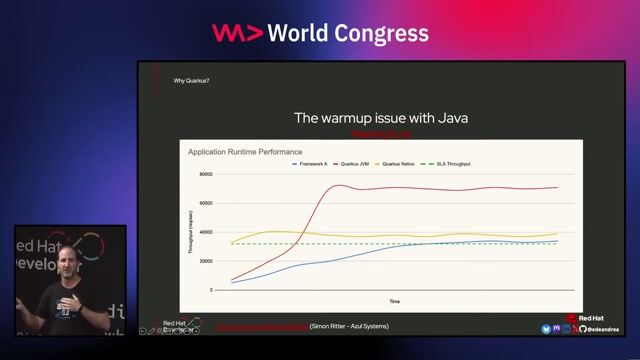
High startup times in traditional Java applications prevent efficient scaling and agile resource utilization in demanding cloud environments.

#2 about 2 min

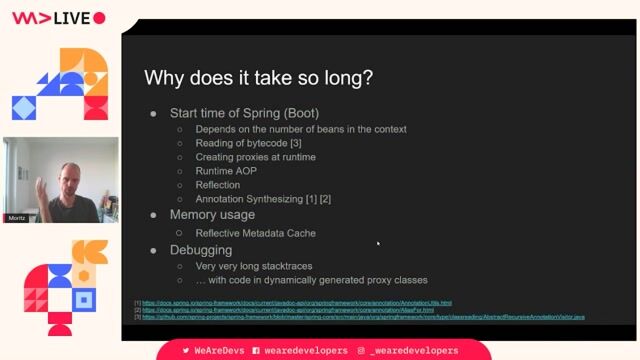
Analyzing startup performance bottlenecks in Spring Boot

Heavy reliance on runtime proxies, dynamic reflection, and auto-configuration drastically increases class loading time alongside system memory usage.

#3 about 3 min

Eliminating runtime reflection with compile-time processing

Shifting dependency injection and dynamic proxy generation to compile time ensures faster startup events, lower memory footprints, and readable stack traces.

#4 about 3 min

Benchmarking bean class scanning and loading metrics

An analysis of component scanning versus auto-configuration reveals that deep class loading operations are significantly more resource-intensive than metadata processes.

#5 about 3 min

Understanding the build time trade-offs of Micronaut

The primary operational cost associated with eliminating runtime reflection remains prolonged build durations due directly to intensive annotation processor requirements.

#6 about 5 min

Exploring full-stack framework capabilities in Micronaut

Adopting a dedicated full-stack framework provides developer features like declarative HTTP clients, distributed system tracing capabilities, system metrics, and serverless deployment integrations.

#7 about 4 min

Bootstrapping a project utilizing the command-line interface

The dedicated command-line interface dynamically establishes structured build tools and incorporates features like complex database migration libraries and distributed tracing plugins automatically.

#8 about 2 min

Authoring and exposing web service endpoints via controllers

Mapping fundamental application route patterns using established standard annotations automatically implements functionality regulating underlying HTTP connectivity and seamless JSON serialization processes.

#9 about 4 min

Constructing dependency injection across decoupled backend services

Statically registering underlying architectural interfaces and establishing singleton patterns enables scalable structure alongside highly reliable programmatic object resolution throughout application execution.

#10 about 4 min

Integrating declarative HTTP clients via generated interfaces

Automatically generating internal implementation code executes external API calls directly while managing explicit object transformation logic without establishing redundant boilerplate structures.

#11 about 4 min

Applying component caching and systematic failure recovery

Implementing specialized logic decorators for primary execution parameters facilitates faster data retrieval performance alongside consistent component fallback resilience during operational execution delays.

#12 about 5 min

Comparing memory usage and request throughput limits

Subjecting discrete application binaries against consistent concurrent request environments immediately underscores measurable scaling advantages inside startup processing operations and throughput thresholds.

#13 about 5 min

Generating native executables using GraalVM ahead-of-time compilation

Delivering an entirely independent functional binary removes external virtual machine configuration dependencies while achieving nearly instantaneous initialization parameters with notable constraints surrounding framework reflection.

#14 about 4 min

Evaluating production readiness and platform adoption limitations

Assessing underlying platform distribution limitations parallel against strict programmatic boundaries identifies specific development bottlenecks and operational framework restrictions targeting larger environment scales.

#15 about 8 min

Addressing technical nuances during the audience Q&A

Expanding further into platform architectural execution models, ecosystem interoperability, and active memory allocation optimization techniques delineates boundaries necessary establishing stable baseline deployment capabilities.

Matching moments

2:55 min

Adopting modern microservice frameworks for lightweight Java runtimes

Markus Kett Markus Kett · WWC 2022

3:35 min

Optimizing Java startup processes for fast serverless workloads

Daniel Oh Daniel Oh +1 · WWC 2024

2:20 min

Overcoming Java cold starts using the Quarkus framework

Alex Soto Alex Soto · LIVE

55 sec

Choosing a Java framework for microservice development

Aleksandr Kalikov · LIVE

2:37 min

Optimizing container workloads with Quarkus and lightweight JVMs

Niklas Heidloff · LIVE

1:35 min

Optimizing Spring Boot applications with AOT caching

Ana Maria Mihalceanu Ana Maria Mihalceanu · WWC Europe 2026

Upcoming sessions on this topic

Open session

World Congress 2026 North America

MicroAgents: The Microservices of the Agentic Era

Ashish Shubham

Runs the show bussiness at ThoughtSpot

Ashish Shubham
Open session

World Congress 2026 North America

Look What Java Can Do Now: Live-Coding a GenAI MCP Server with the JAQ Stack

Suren Konathala

Senior Engineering Leader, Marketing & AdTech, AI GTM & Digital Experience Platforms, Java x AI

Suren Konathala
Open session

World Congress 2026 North America

Microservice Cognitive Index for Deploy Diagnosis and Change Impact

Sachin Gupta

Member of Technical Staff 2 at eBay

Sachin Gupta
Open session

World Congress 2026 North America

From Cloud Native to Multi-Cloud Native: Write Once, Deploy Anywhere

Sandeep Pal

Principal Member of Technical Staff at Salesforce

Sandeep Pal
Open session

World Congress 2026 North America

It’s Alive! Taming the MLOps Franken-Stack: Write, Run, and Serve with Michelangelo

Paul Zimmerman, Eric Wang

Paul Zimmerman
Eric Wang
Open session

World Congress 2026 North America

Run your agents in Kubernetes: Build once, deploy anywhere. But really?

Michal Salanci

Senior Systems Engineer at ESET Cybersecurity

Michal Salanci