Rob Richardson
At The Helm of Kubernetes: Repeatable Infrastructure Creation for Mere Mortals
#1about 1 minute
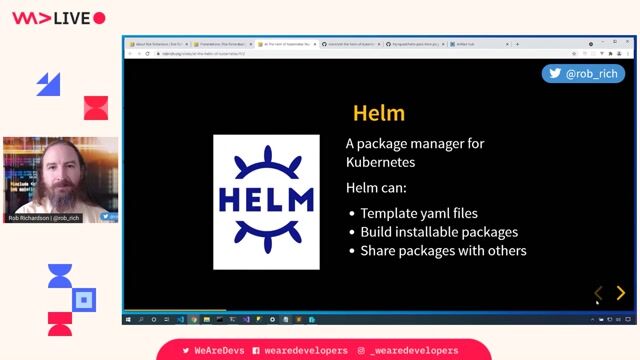
Understanding Helm as a package manager for Kubernetes
Helm acts as a package manager for Kubernetes, templating the YAML configuration that surrounds your containers, which is a different role than Docker.
#2about 4 minutes
Creating a basic Helm chart from scratch
Build a new Helm chart by creating a `values.yaml` file to extract and centralize configuration variables from existing Kubernetes manifests.
#3about 2 minutes
Defining chart metadata using the Chart.yaml file
The `Chart.yaml` file provides essential metadata for your package, including API version, name, description, and separate versions for the chart and the application.
#4about 6 minutes
Templating Kubernetes resources with Go templates
Replace hardcoded values in your Kubernetes YAML files with dynamic Go template expressions that reference variables from `values.yaml` and `Chart.yaml`.
#5about 7 minutes
Validating and rendering charts with the Helm CLI
Use `helm lint` to check for syntax errors and `helm template` to render the final Kubernetes YAML, overriding default values with the `--set` flag for dynamic configurations.
#6about 3 minutes
Packaging charts for distribution and reuse
Use `helm package` to create a versioned tarball of your chart, and leverage the `helm-pack` plugin to inject values during the packaging process.
#7about 4 minutes
Installing and managing application releases with Helm
Manage the lifecycle of a deployed application using `helm install` to create a release, `helm status` to check it, and `helm upgrade` to apply new versions.
#8about 5 minutes
Enabling multiple instances with release names
Modify templates to incorporate the `Release.Name` variable, which ensures resource names are unique and allows multiple instances of the same chart to coexist in a cluster.
#9about 2 minutes
Sharing and consuming public Helm charts
Discover and install third-party applications from public repositories like Artifact Hub by adding the repository and using `helm install`.
#10about 4 minutes
Understanding Helm's limitations and its alternatives
Helm excels at packaging and deployment but lacks runtime operational capabilities, for which more advanced tools like Kubernetes Operators are better suited.
#11about 7 minutes
Q&A: Helm's value, migration, and operator comparison
Helm's complexity is justified for managing many variables, migration from v2 to v3 involves removing Tiller, and it serves as a pragmatic alternative to building full Kubernetes Operators.
Related jobs
Jobs that call for the skills explored in this talk.
MARKT-PILOT GmbH
Stuttgart, Germany
Remote
€75-90K
Senior
Kubernetes
Terraform
+1
Wilken GmbH
Ulm, Germany
Senior
Kubernetes
AI Frameworks
+3
Rhein-Main-Verkehrsverbund Servicegesellschaft mbH
Frankfurt am Main, Germany
Senior
Kubernetes
DevOps
+1
Matching moments
Featured Partners
Related Videos
Mastering Kubernetes – Beginner Edition
Hannes Norbert Göring
Developing locally with Kubernetes - a Guide and Best Practices
Dan Erez
Program your infrastructure with CDK and TypeScript
Robert Hoffmann
Local Development Techniques with Kubernetes
Rob Richardson
5 steps for running a Kubernetes environment at scale
Stijn Polfliet
A Practitioners Guide to GitOps - Introduction, Principles and Implementation
Thomas Schütz
Practical tips and tricks for CI/CD success
Zan Markan
GitOps keeps focus on apps, not on infrastructure
Chad Carlson
Related Articles
View all articles


From learning to earning
Jobs that call for the skills explored in this talk.

Dembach Goo Informatik GmbH & Co. KG
Remote
Redis
Kafka
Ansible
RabbitMQ
+4


Dembach Goo Informatik GmbH & Co. KG
Hannover, Germany
Redis
Kafka
DevOps
Ansible
RabbitMQ
+3


Dembach Goo Informatik GmbH & Co. KG
Remote
Redis
Kafka
DevOps
Ansible
+5


Passion for People GmbH
Karlsruhe, Germany
Remote
€70-90K
Azure
DevOps
Gitlab
+10