
WeAreDevelopers LIVE Oct 27, 2021

RPA crash course for .Net developers – intro into the world of RPA from the perspective of a .Net developer

Maria Doina Irimias

Accelerate enterprise automation without abandoning clean architecture. Discover how to combine UiPath’s low-code workflows with your advanced .NET skills, custom C# packages, and SOLID principles.

Pause
Mute Enter Fullscreen
#1 about 6 min

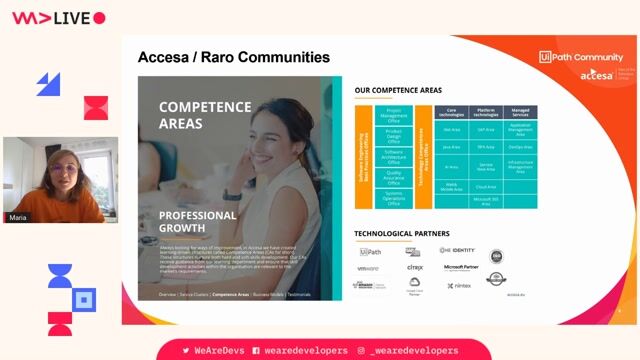
Speaker background and the UiPath ecosystem

Community resources and ecosystem learning materials lower the barrier for traditional developers entering process automation.

#2 about 2 min

Core concepts and definition of robotics process automation

Robotic process automation utilizes software tools to mimic human interactions with digital systems.

#3 about 2 min

Capabilities and primary benefits of software robots

Software robots handle predefined digital actions to increase operational execution speed and accuracy.

#4 about 2 min

Implementing automation across various enterprise departments

Automated processes optimize repeatable tasks across supply chain, human resources, and client service departments.

#5 about 4 min

Differences between RPA platforms and the .NET framework

Evaluating the technological distinctions clarifies when to use rapid application development platforms versus business process automation tools.

#6 about 7 min

Transitioning from software engineering to process automation

Applying established software engineering principles to business optimization problems offers a fulfilling low-code developer experience.

#7 about 3 min

Preparing the first runtime environment for automation

Setting up the initial automation workspace visually emphasizes delegating mundane organizational tasks to machines.

#8 about 4 min

Core components of the UiPath automation platform

Centralized platform tools provide native capabilities for process discovery, execution, and human-in-the-loop validation actions.

#9 about 3 min

Managing runtime execution with the orchestrator

Unattended logic execution models coordinate directly with human supervisors and background processing orchestrators.

#10 about 7 min

Creating automated workflows within the designer interface

Navigating the designer properties panel simplifies debugging execution logs through a basic automated sequence.

#11 about 7 min

Managing runtime packages and built-in activity recordings

Automatic screen capture features translate UI actions into discrete workflow sequences while managing internal package dependencies.

#12 about 14 min

Best practices for architecting scalable process automations

Designing modular execution mechanisms with state machine routing ensures process stability and simplifies scalable development.

#13 about 14 min

Configuring a practical web interaction sequence

Implementing UI instruction sets simplifies navigating web forms, extracting labels, and storing text inside runtime variables.

#14 about 9 min

Creating custom activity libraries within Visual Studio

Bridging standardized object-oriented class hierarchies exports specialized operational logic back into modular runtime activities.

#15 about 5 min

Compiling logic routines into local package sources

Implementing custom logic operators into local packages creates distributable assemblies configured for remote debugging.

#16 about 3 min

Loading and executing custom package libraries

Mapping local system directories exposes uniquely compiled activity functions directly to the main workflow designer environment.

#17 about 6 min

Knowledge validation and learning from community platforms

Platform assessment challenges validate foundational understanding while navigating available resources provided by the training academy.

#18 about 5 min

Enhancing legacy record extraction using machine learning

Predictive interpretation frameworks parse inconsistent document layouts dynamically by utilizing pretrained machine learning models.

#19 about 7 min

Navigating career paths and technical prerequisites

Understanding typical project roles highlights the foundational collaboration required across enterprise automation lifecycles.

#20 about 7 min

Code reviews and establishing dedicated developer teams

Integrating version control repositories streamlines code reviews while defining clear operational boundaries across deployment squads.

Matching moments

7:48 min

Introduction to UiPath and robotic process automation

Boris Krumrey +2 · LIVE

4:37 min

Introduction to the speakers and process automation transformation journey

Kevin Kaiser Kevin Kaiser +1 · WWC 2025

7:34 min

Core components and architecture of the UiPath platform

Alp Uguray · JS Congress

4:27 min

Understanding the basics of robotic process automation

Alp Uguray · JS Congress

9:00 min

Introduction to UiPath web automation and speaker background

Alp Uguray · JS Congress

4:01 min

How automation shifts software engineering toward high-level abstraction

David Tielke David Tielke · WWC Europe 2026

Upcoming sessions on this topic

Open session

World Congress 2026 North America

The Broken Rung: How AI is Rebuilding Software Development from the Ground Up

Tomislav Tipurić

Chief Technology Officer, Nephos

Tomislav Tipurić
Open session

World Congress 2026 North America

Ship 10x Faster: AI-Powered Development with Claude Code and MCP Tools

Viktoria Semaan

Principal Technical Evangelist at Databricks

Viktoria Semaan
Open session

World Congress 2026 North America

AI ROI: The Hard Unit Economics of AI-Native Engineering

Manu Gurudatha

Manu Gurudatha, VP of Engineering at PagerDuty

Manu Gurudatha
Open session

World Congress 2026 North America

Beyond the Code: Human-AI Synergies in Product Development

Ajita Kanchivakam Ananth

Staff Technical Program Manager at Google

Ajita Kanchivakam Ananth
Open session

World Congress 2026 North America

Building Pragmatic AI: 10 AI Features Your Users Actually Want

Jonathan "J." Tower

.NET Foundation Board | 12x Microsoft MVP | Founder & Consultant

Jonathan "J." Tower
Open session

World Congress 2026 North America

Building Stuff with GenAI - The Open Minded Workshop beyond OpenAI

Andreas Erben

CTO for Applied AI and Metaverse at daenet

Andreas Erben