


JavaScript Congress Nov 24, 2021

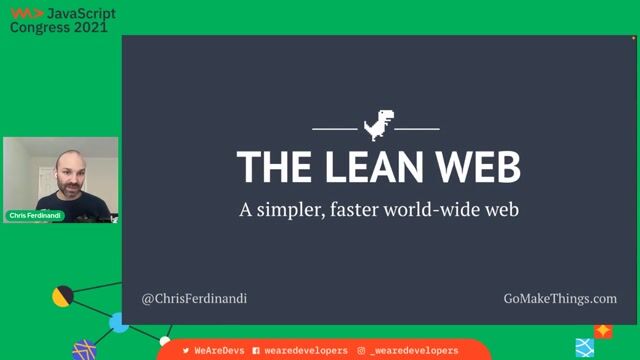
The Lean Web

Chris Ferdinandi

Heavy JavaScript frameworks are breaking the modern web. Discover how the Lean Web methodology leverages micro-libraries and pre-rendered HTML to build resilient, lightning-fast applications.

Pause
Mute Enter Fullscreen
#1 about 3 min

The core thesis behind building a simpler and faster web

Despite increases in network bandwidth, modern web load times and perceived performance remain largely stagnant.

#2 about 4 min

How heavy JavaScript payloads degrade browser performance and resilience

JavaScript parsing and execution fundamentally block rendering pipelines and fail catastrophically compared to HTML or CSS.

#3 about 5 min

The technology hype cycle and its impact on developer choices

Developer anxiety and prominent tech company evangelism drive widespread adoption of unnecessarily complex library toolchains.

#4 about 5 min

Moving from single page apps to static site generators

Serving pre-rendered HTML routes avoids expensive client-side hydration while maintaining instantaneous user interface responses.

#5 about 2 min

Enhancing multi-page applications with local service worker caching

Service workers intercept network requests to cache assets locally for zero-latency loads and offline application resilience.

#6 about 6 min

Reducing application footprints with micro libraries and pre-compilers

Pre-compilers like Svelte and Astro generate highly optimized static assets to minimize payload weight at runtime.

#7 about 4 min

Shifting interactive components to native web platform features

Replacing complex custom scripts with robust native elements and stylesheet behaviors significantly lightens front-end applications.

#8 about 3 min

Historical waves of web development and shipping less JavaScript

Component frameworks eventually mature into native platform capabilities as the development ecosystem follows regular cyclical patterns.

#9 about 3 min

Refactoring single page applications into progressively enhanced websites

Reverting to hard page loads layered with asynchronous enhancements restores native browser functionality while providing robust fallbacks.

#10 about 2 min

Upcoming native specifications for transitional animations between page routes

Emerging browser specifications aim to support seamless visual animations across traditional multi-page navigation events.

#11 about 2 min

Offloading tracking tasks from the main thread to web workers

Transferring non-essential operations to background environments prevents severe performance bottlenecks on the primary interface thread.

#12 about 5 min

The balance between framework conventions and native web components

Broad library adoption provides standardized integration workflows and detailed documentation that native web primitives often lack.

#13 about 4 min

Managing developer imposter syndrome with just-in-time learning strategies

Avoiding constant technology tracking in favor of targeted exploration reduces burnout and framework fatigue across engineering teams.

#14 about 2 min

Matching architectural approaches directly to specific project requirements

Embracing experimental component architectures allows engineering teams to optimize specific solutions rather than accepting heavy boilerplate globally.

#15 about 2 min

Queuing asynchronous tasks during network failures using service workers

Background synchronization mechanisms allow local clients to queue and safely retry network requests when mobile connectivity fails.

#16 about 2 min

Assessing newly released web frameworks before reaching technical consensus

Exploring newly released component ecosystems typically requires extensive practical testing before engineers can form any valid architecture decisions.

Matching moments

4:22 min

Rethinking the architecture of single page web applications

Jeremy Keith · World Congress 2021

2:15 min

Transitioning native desktop graphics implementations to the web

Chris Heilmann +3 · LIVE

3:48 min

Adopting progressive enhancement workflows to prevent frontend bloat

Chris Heilmann +2 · LIVE

4:30 min

Tracking open source community trends in JavaScript native frameworks

Dan Cranney +2 · LIVE

1:17 min

Betting on native web platform features over JavaScript

Chris Heilmann · LIVE

2:28 min

Expected features and performance defaults in modern JavaScript frameworks

Sasha Shynkevich · LIVE

Upcoming sessions on this topic

Open session

World Congress 2026 North America

September 24, 2026 · 14:50–15:20

Stage 9

How to generate business value through performance optimizations

Nikolai Sidiropulo

Software Engineer at Meta

Nikolai Sidiropulo
Open session

World Congress 2026 North America

September 24, 2026 · 12:50–13:20

Stage 7

Architecting Agentic Apps: WebMCP, A2UI, and Agent Experience

Ankita Sood

Sr. Principal Engineer @ Secureworks | Angular GDE

Ankita Sood
Open session

World Congress 2026 North America

September 24, 2026 · 16:10–16:40

Outdoor Stage

When Humans Stop Writing Code: Rethinking Languages, Compilers, and Responsibility

Simon Auer

Organizer of flutter vienna meetup and CEO of marqably

Simon Auer
Open session

World Congress 2026 North America

September 25, 2026 · 09:40–10:10

Stage 3

Still on 4.8 or lower? A Practical Guide to Moving Your "Un-Migratable" .NET Apps

Isaac Levin

Developer Advocate

Isaac Levin
Open session

World Congress 2026 North America

September 25, 2026 · 15:30–16:00

Stage 6

Small LLM in your Browser: Huge Opportunities for Web Applications

Daniel Ostrovsky

UI/UX Architect at Payoneer | AI Architect | Full Cycle Development Expert | Public Speaker | Open Source Contributor |

Daniel Ostrovsky
Open session

World Congress 2026 North America

September 24, 2026 · 17:30–18:00

Stage 7

Full Stack with Flutter - are we there yet?

Nemanja Stošić

Senior Flutter Developer

Nemanja Stošić