

JavaScript Congress Nov 23, 2021

State of Angular

Jessica Janiuk

Legacy IE11 support is finally dead. Angular v13 enforces the Ivy engine to drastically reduce enterprise build times. Learn how standalone components will transform your future app architecture.

Pause
Mute Enter Fullscreen
#1 about 2 min

Core principles of the Angular framework

Why Angular remains a stable, scalable, and opinionated platform built specifically for web development.

#2 about 2 min

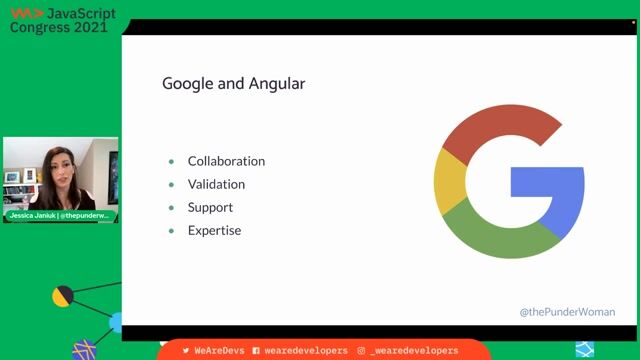
How Google collaborates and validates Angular

The core teams leverage internal Google projects to heavily validate and support the framework.

#3 about 3 min

Framework integrations with Firebase and TensorFlow JS

Collaborations with adjacent Google teams produce powerful capabilities like predictive prefetching for e-commerce.

#4 about 3 min

Developing and launching the Ivy renderer

Two years of development produced a smaller window of code and fundamentally improved rendering speeds.

#5 about 2 min

Internal developer productivity wins from Ivy

Transitioning to Ivy reduced Google's computational resources and significantly shaved off internal build times.

#6 about 2 min

Debugging with the Angular DevTools extension

A highly requested Chrome extension provides deeper application profiling and clarifies complex framework errors.

#7 about 2 min

Establishing clarity with a public roadmap

A public roadmap gives external developers and enterprises confidence in the future direction of the framework.

#8 about 4 min

Triaging issues and prioritizing feature requests

Dedicated bots and focused triage efforts drastically reduced outstanding pull requests and improved community responsiveness.

#9 about 3 min

Breaking changes and features in version 13

The latest release removes legacy Internet Explorer support to fully leverage modern ECMAScript interfaces.

#10 about 2 min

Improving build flows and component accessibility

The framework replaces its build optimizer with Babel and upgrades material components for improved accessibility standards.

#11 about 2 min

Preventing bugs with extended template analysis

Upcoming tooling acts like a linter for templates to intercept syntax errors within standard code editors.

#12 about 4 min

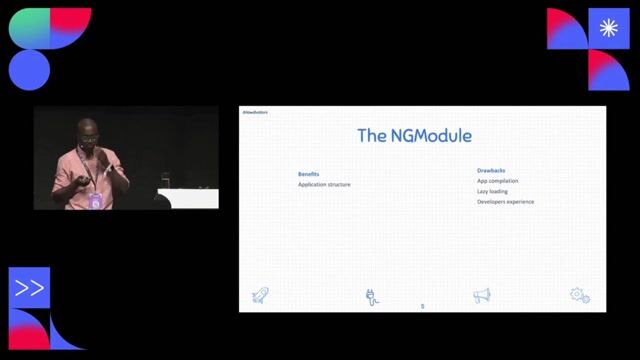
Prototyping standalone components to reduce boilerplate

Overhauling the module system promises to simplify mental models by allowing components to exist independently.

#13 about 3 min

Embracing web framework competition as positive pressure

The maintainers view other tools in the JavaScript ecosystem as great sources of inspiration for standardizing best practices.

#14 about 2 min

Maintaining backward compatibility across major versions

Upgrades are designed to remain seamless without forcing painful migrations like the transition away from AngularJS.

#15 about 3 min

Transitioning toward modern end-to-end testing tools

The deprecation of Protractor opens the door for developers to integrate their preferred external testing solutions.

#16 about 2 min

Code splitting and lazy loading standalone components

Engineers will retain identical dynamic capabilities without maintaining the overhead of complex modules.

#17 about 2 min

Navigating future goals to make Zone optional

Untangling change detection to operate without its traditional abstraction layer requires significant architectural planning.

#18 about 2 min

Identifying practical applications for standalone components

Isolated page components no longer require wrapping constructs unless specifically building bundled component libraries.

#19 about 1 min

Implementing predictive prefetch with machine learning

Cross-team efforts highlight performance wins through external talks covering real-world client-side machine learning.

#20 about 2 min

Considering virtual DOM adoption within Angular

Fundamental rendering rewrites are highly unlikely given the massive investment to mature the current compiler.

#21 about 3 min

Resolving dependencies directly inside standalone views

Current decorators will ingest routing and directive references to retain dependency injection features per component.

Matching moments

8:34 min

Exploring Angular component patterns and upcoming framework updates

Benedikt Starzengruber · LIVE

5:46 min

Evolution of the Angular framework from AngularJS

Valentine Awe · WWC 2023

4:33 min

Overview of the Angular development platform

Muhammad Ahsan Ayaz · WWC 2021

6:32 min

Evolution and benefits of the Angular ecosystem

Sani Yusuf · WWC 2021

4:42 min

Evaluating the long-term trajectory of the Angular framework

Sani Yusuf · JS Congress

4:02 min

Implementing standalone APIs in modern Angular architectures

Valentine Awe · WWC 2023

Upcoming sessions on this topic

Open session

World Congress 2026 North America

Architecting AI in Angular: WebMCP, A2UI, and the Agent Experience

Ankita Sood

Sr. Principal Engineer @ Secureworks | Angular GDE

Ankita Sood
Open session

World Congress 2026 North America

Beyond Vibe Coding: An AI Builder’s Guide to Migrating 10k+ React Components

Shubham Chaurasia

Senior Software Engineer @ Meta

Shubham Chaurasia
Open session

World Congress 2026 North America

When Humans Stop Writing Code: Rethinking Languages, Compilers, and Responsibility

Simon Auer

Organizer of flutter vienna meetup and CEO of marqably

Simon Auer
Open session

World Congress 2026 North America

Beyond Vibe Coding: Using CLI Tools as Your AI Counterpart in Pair Programming

Ron Veen

Java enthusiast and Special agent for Team Rockstars IT

Ron Veen
Open session

World Congress 2026 North America

Small LLM in your Browser: Huge Opportunities for Web Applications

Daniel Ostrovsky

UI/UX Architect at Payoneer | AI Architect | Full Cycle Development Expert | Public Speaker | Open Source Contributor |

Daniel Ostrovsky
Open session

World Congress 2026 North America

The spectrum of agentic coding: From vibe coding to high-quality software engineering

YK Sugi

Developer Experience Manager at Eventual

YK Sugi