





World Congress 2023 Aug 11, 2023

Stand alone components in Angular

Valentine Awe

Tired of heavy NgModule boilerplate? Discover how Angular's standalone components streamline code architecture, simplify dependency management, and unlock granular lazy loading.

Pause
Mute Enter Fullscreen
#1 about 6 min

Evolution of the Angular framework from AngularJS

The fundamental framework transition away from initial legacy paradigms introduced concrete structural boundaries necessary for scaling complex platforms.

#2 about 4 min

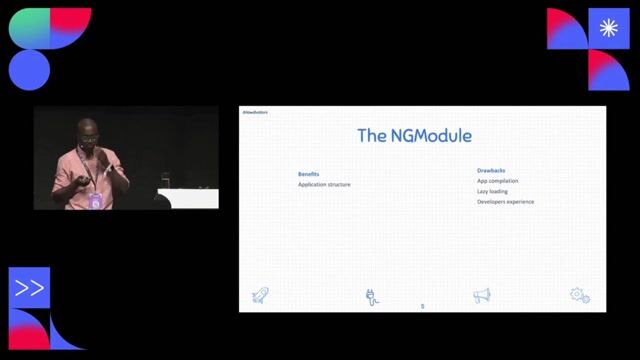
Structural advantages and architectural drawbacks of Angular modules

Although rigid module boundaries successfully partition domains, they historically introduce cascading load delays and unnecessarily steep learning curves.

#3 about 2 min

Isolating dependencies with single component Angular modules

The SCAM pattern isolates exact element functionality to bypass monolithic grouping constraints within legacy dependency structures.

#4 about 5 min

Implementing standalone APIs in modern Angular architectures

Transitioning modern components entirely outside of legacy boundaries removes complex overhead and exposes individual dependencies clearly.

#5 about 2 min

Routing directly to lazily loaded standalone components

Directly linking route paths to individual features optimizes loading waterfalls by removing intermediate module loading constraints.

#6 about 2 min

Bootstrapping an application without root Angular modules

The bootstrap configuration method injects global routing capabilities and network dependencies entirely outside of rigid legacy file conventions.

#7 about 2 min

Migrating an existing codebase to standalone components

Terminal schematic commands efficiently extract foundational element dependencies and automatically execute large-scale domain codebase refactors.

#8 about 3 min

Architecting domain folder structures without Angular modules

Domain folder grouping and index barrel exports enable highly scalable logical structures independent of native framework module rules.

#9 about 7 min

Answers to community questions on application design

Alternative strategies for early network preloading and isolated functionality testing accommodate structural configurations migrating away from legacy approaches.

Matching moments

8:34 min

Exploring Angular component patterns and upcoming framework updates

Benedikt Starzengruber · LIVE

2:54 min

Fundamental architecture and modules in Angular applications

Indu Chaube · LIVE

3:24 min

Introduction to building reusable Angular components

Valentine Awe · WWC 2022

3:46 min

The rise of modern component-based frameworks and modular architecture

Sasha Shynkevich · LIVE

1:13 min

Core principles of the Angular framework

Jessica Janiuk · JS Congress

1:15 min

Overview of the Angular application framework

Indu Chaube · LIVE

Upcoming sessions on this topic

Open session

World Congress 2026 North America

Architecting AI in Angular: WebMCP, A2UI, and the Agent Experience

Ankita Sood

Sr. Principal Engineer @ Secureworks | Angular GDE

Ankita Sood
Open session

World Congress 2026 North America

Beyond Vibe Coding: An AI Builder’s Guide to Migrating 10k+ React Components

Shubham Chaurasia

Senior Software Engineer @ Meta

Shubham Chaurasia
Open session

World Congress 2026 North America

MicroAgents: The Microservices of the Agentic Era

Ashish Shubham

Runs the show bussiness at ThoughtSpot

Ashish Shubham
Open session

World Congress 2026 North America

One Repo, One Strategy: Scalable Full-Stack Testing in a Monorepo World

Bartosz Leczycki, Paweł Matynia

Bartosz Leczycki
Paweł Matynia
Open session

World Congress 2026 North America

It’s Alive! Taming the MLOps Franken-Stack: Write, Run, and Serve with Michelangelo

Paul Zimmerman, Eric Wang

Paul Zimmerman
Eric Wang
Open session

World Congress 2026 North America

When Humans Stop Writing Code: Rethinking Languages, Compilers, and Responsibility

Simon Auer

Organizer of flutter vienna meetup and CEO of marqably

Simon Auer