


JavaScript Congress Nov 25, 2021

How Your Bundle Size Affects The Climate

Roy Derks

Unoptimized JavaScript does more than throttle CPU performance. It actively generates a massive carbon footprint. Discover how shrinking your bundle size makes applications fast and climate-friendly.

Pause
Mute Enter Fullscreen
#1 about 5 min

The energy consumption of internet growth and data centers

Growing website payload sizes and high-profile data center expansions drastically impact global energy consumption grids.

#2 about 7 min

How internet consumption patterns and screen time have evolved

Increased daily screen time and resource-heavy commercial behaviors functionally multiply global data transmission volumes.

#3 about 3 min

The environmental impact of excessively large JavaScript bundles

Monolithic web dependencies require massive script downloads that bottleneck device rendering capabilities and power consumption.

#4 about 4 min

How average website payload sizes have grown over time

The structural complexity, byte weights, and media footprint of popular websites have grown exponentially over ten years.

#5 about 6 min

The shift toward JavaScript frameworks for web development

The widespread adoption of client-side application frameworks directly increases overall application layer complexity and related hardware energy requirements.

#6 about 2 min

Optimizing websites for high performance and energy efficiency

Implementing content delivery mechanisms and caching protocols makes software stacks demonstrably more sustainable to operate.

#7 about 3 min

Calculating the carbon footprint and energy impact of websites

Dedicated web carbon calculators mathematically estimate the compute intensity and planetary cost of serving unoptimized web pages.

#8 about 9 min

Comparing the planetary impact of large and minimal websites

There is a vast greenhouse emissions gap between heavily clustered client applications and clean, minimal HTML-only prototypes.

#9 about 10 min

Reducing environmental impact with static site generators and Jamstack

Jamstack application principles and static site generators dramatically shrink final delivery payloads by resolving component trees statically during compilation.

#10 about 3 min

Implementing network asset compression using gzip and Brotli

Compressing standard server responses via established text algorithms successfully minimizes outbound component bandwidth usage over HTTP channels.

#11 about 3 min

Reducing resource waste with code splitting and dynamic imports

Isolating component logic into dynamically fetched modules prevents connecting clients from processing completely unused application sectors upfront.

#12 about 2 min

Selecting green hosting providers and sustainable data center infrastructure

Choosing production operations providers that run facilities exclusively on renewable energy immediately scales back indirect digital emissions.

Matching moments

4:18 min

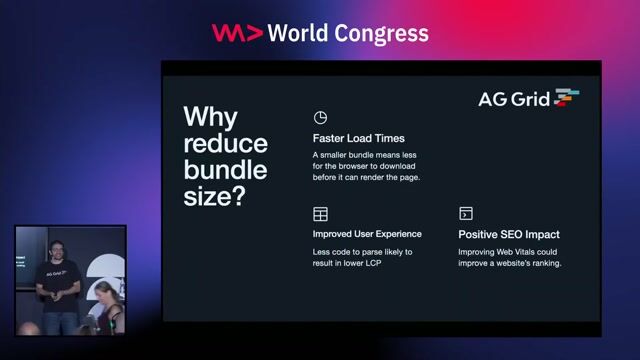
Reducing JavaScript bundle sizes for multiplied carbon savings

Lorenzo Pieri · LIVE

2:13 min

The intersection of web performance and sustainability

Ines Akrap Ines Akrap · WWC 2023

1:38 min

Reducing network payload for large digital website portfolios

Aydin Mir Mohammadi Aydin Mir Mohammadi · WWC Europe 2026

2:55 min

Built-in performance benefits of the Jamstack architecture

Tamas Piros Tamas Piros · WWC 2021

2:54 min

Reducing JavaScript bundle sizes with build tools

Shem Magnezi Shem Magnezi · WWC 2025

4:05 min

Internet traffic growth and website carbon footprint

Lorenzo Pieri · LIVE

Upcoming sessions on this topic

Open session

World Congress 2026 North America

Fast by Design: A Masterclass in High-Performance Web Engineering

Aaron Grogg

Senior web developer, committed to improving the user experience by improving web performance

Aaron Grogg
Open session

World Congress 2026 North America

How to generate business value through performance optimizations

Nikolai Sidiropulo

Software Engineer at Meta

Nikolai Sidiropulo
Open session

World Congress 2026 North America

public void saveMoney(AI): The Developer's Guide to Unit Economics

Hrushikesh Pokala

Senior Software Engineer Lead at Equifax

Hrushikesh Pokala
Open session

World Congress 2026 North America

Offloading IoT State: Solving the Memory Crisis on Legacy Hardware

Pravin Nagare

Senior Software Engineer, Roku

Pravin Nagare
Open session

World Congress 2026 North America

Beyond Vibe Coding: An AI Builder’s Guide to Migrating 10k+ React Components

Shubham Chaurasia

Senior Software Engineer @ Meta

Shubham Chaurasia
Open session

World Congress 2026 North America

Headroom: A Context Optimization Layer for LLM Applications

Tejas Chopra

Senior Software Engineer at Netflix

Tejas Chopra