





BB
Benedikt Bischof
WeAreDevelopers LIVE
•
Dec 7, 2021
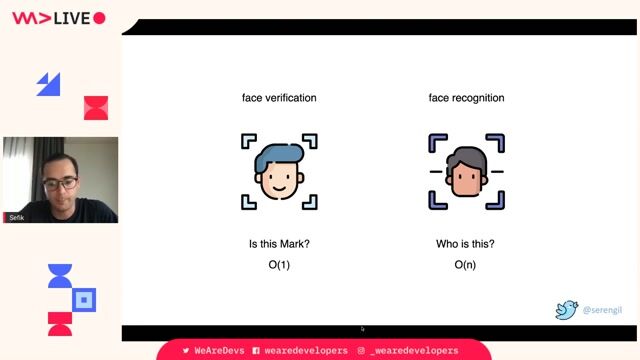
Unboxing the DeepFace
Sefik Serengil
- Discuss this with your agent
- Open in Claude
- Open in ChatGPT
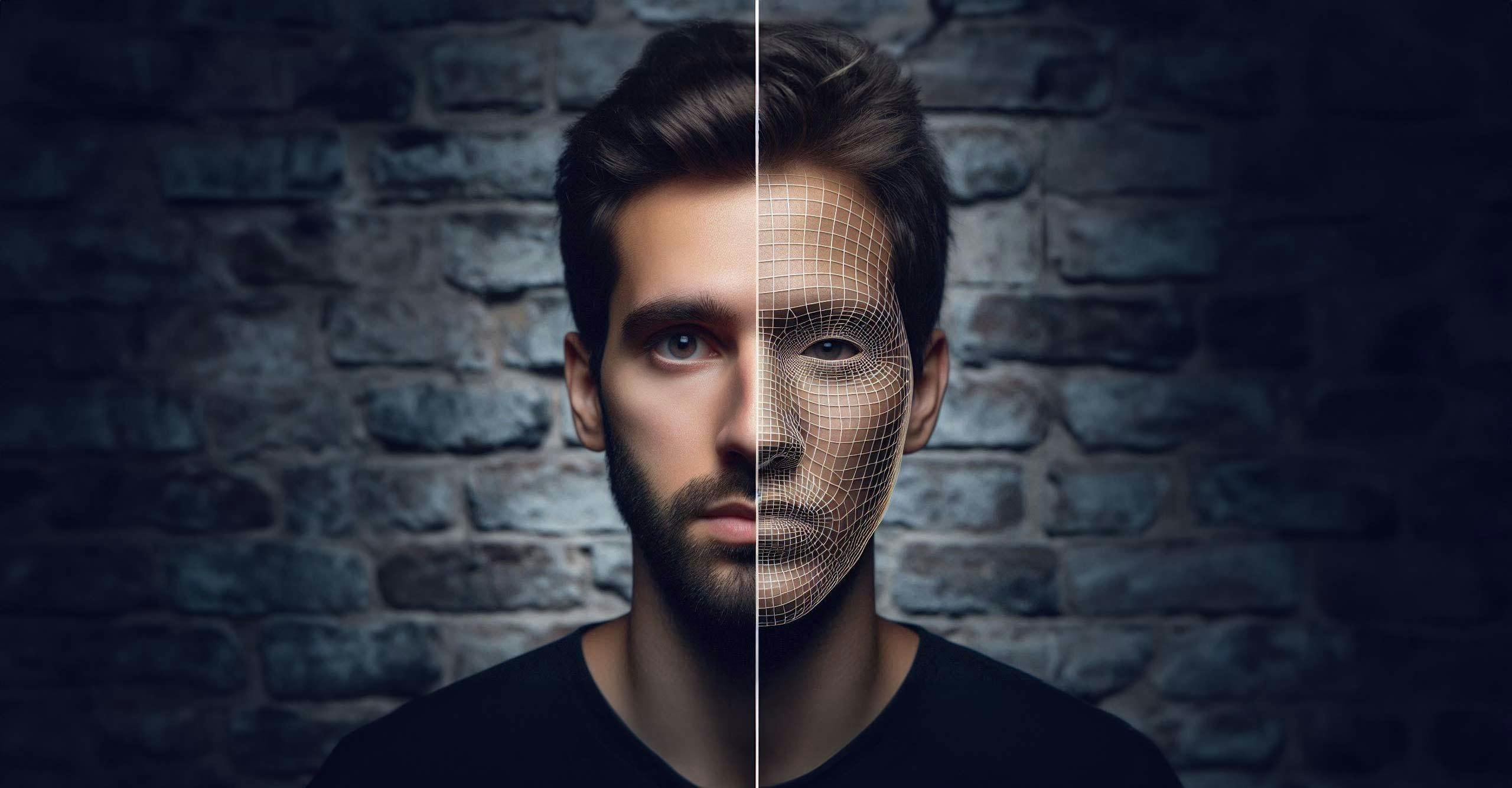
Standardizing eye alignment horizontally improves facial recognition accuracy by over 1%. Learn how the DeepFace framework abstracts complex computer vision pipelines into just a few lines of Python.
Matching moments
5:25 min
Technical pipeline for real-time video deepfakes
 Martin Förtsch +1 · World Congress 2024
3:09 min
Defining true deepfakes generated by trained neural networks
Thomas Endres +2 · World Congress 2021
2:30 min
Implementing the deepfake inference workflow for face generation
Thomas Endres +2 · World Congress 2021
3:36 min
Differentiating traditional video fakes from neural network models
Thomas Endres +2 · World Congress 2021
3:32 min
Implementing automated object and face recognition for images
Arto Liukkonen · LIVE
3:59 min
Preparing video datasets and extracting faces with FaceNet
Thomas Endres +2 · World Congress 2021
More from WeAreDevelopers LIVE
Related videos
Related articles
.gif)
DC
Daniel Cranney
DC
Daniel Cranney

OL
Or Levi

From learning to earning
Jobs that call for the skills explored in this talk.
about 1 month ago
•
Verified
Model Implementation Engineer

Sciforium
San Francisco, United States
Expert
$165k–220k
Python
about 1 month ago
•
Verified
Lead Software Engineer, Model Serving Platform
Sciforium
San Francisco, United States
Expert
$230k–300k
Python
16 days ago
Principal Software Engineer, AI Inference Runtime

ARM
Seattle, WA, United States
Expert
$262k
Compilers
Low Latency
Concurrency
about 1 month ago
•
Verified
Senior AI Serving Engineer, Backend
Sciforium
San Francisco, United States
Expert
$190k–250k
Rust
Python
about 1 month ago
•
Verified
Software Engineer, Fullstack
Sciforium
San Francisco, United States
Expert
$165k–210k
Python
about 1 month ago
•
Verified
ML Engineer
Sciforium
San Francisco, United States
Expert
$165k–210k
Python