




WeAreDevelopers LIVE Apr 6, 2022

Retooling and refactoring - an investment in people.

Andrew Holway

Cloud migrations frequently stall because complex abstractions paralyze developers. Fix this by treating foundational platform refactoring as a direct, hands-on investment in your engineering team's continuous education.

Pause
Mute Enter Fullscreen
#1 about 2 min

Applying instructional design to technical knowledge acquisition

Using structured instructional design transforms the acquisition of difficult technical paradigms into deliberate, trackable learning outcomes.

#2 about 5 min

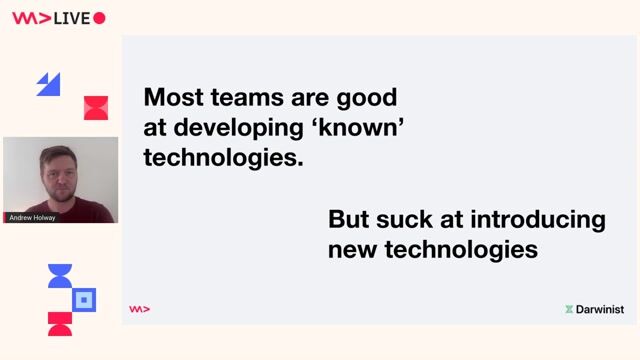
Why agile frameworks fail at new technology adoption

Relying on short research spikes places undue pressure on solo engineers and fails to surface optimal architectural patterns.

#3 about 4 min

Limitations of traditional training and external technical consultants

Traditional abstract IT training ignores the forgetting curve, while outsourcing externalizes tacit tool-using knowledge.

#4 about 2 min

Case study on adopting Kubernetes and Golang effectively

Providing a clear, simple deployment pattern cleanly unblocks legacy migration efforts into modern Kubernetes clusters.

#5 about 2 min

Automating infrastructure to eliminate traditional DevOps roles

Leveraging Kubernetes effectively allows developers to own their deployment lifecycles without handing off work to dedicated DevOps engineers.

#6 about 2 min

Simplifying cloud infrastructure by avoiding complex configuration tools

Dropping heavy orchestration tools like Terraform or Helm for native CLIs directly reduces unneeded declarative abstraction layers.

#7 about 3 min

Separating platform provisioning from application development concerns

Isolating deployment complexity strictly inside Kubernetes allows application developers to independently own schemas and CI/CD pipelines.

#8 about 3 min

Comparing cloud providers and their learning curves

Why simpler default setups in Google Cloud Platform reduce corporate dependencies on specialized platform engineers compared to AWS.

#9 about 6 min

Building internal capabilities through structured organizational skill sprints

Delivering on-the-job educational outcomes ensures teams deeply assimilate new architectural patterns without building permanent vendor dependence.

#10 about 3 min

Insights on transitioning from supercomputing to technical education

How an early career building high-performance computing systems organically shaped a shift towards structured software engineering education.

#11 about 3 min

Refactoring a complex legacy monolith into microservices

How sequentially adopting Kubernetes, modernizing Elasticsearch, and transitioning to Golang solved deep architectural debt for a legacy application.

#12 about 7 min

Convincing organizations to actively invest in engineering skills

Aligning technical learning paths directly with business goals secures corporate funding and structured time for holistic developer growth.

#13 about 4 min

Accelerating productivity and technology adoption in new teams

Pre-defining broad architectural compliance guidelines reduces initial team storming and heavily accelerates project time-to-first-value.

#14 about 3 min

Identifying and advocating for new technical skill requirements

Drafting clear educational roadmaps enables individual developers to effectively pitch large-scale stack migrations directly to executive leadership.

#15 about 4 min

Critical infrastructure and performance skills for modern developers

Mastering CI/CD, database indexing, and SQL query optimization ensures software engineers can efficiently architect and deploy robust codebases.

#16 about 3 min

Evaluating the future of container orchestration and virtualization

A fundamental shift in containerization technology is strictly required before any meaningful new alternative to Kubernetes can emerge.

#17 about 2 min

Leveraging instructional design to improve technical knowledge transfer

Applying formal instructional design principles is ultimately essential for cultivating diverse engineering teams and rapidly onboarding junior developers.

Matching moments

1:57 min

Rethinking corporate training platforms for technical teams

Piet Van Dongen · LIVE

2:24 min

Using failed adoption to drive necessary architectural improvements

Sonja Nesic Sonja Nesic · WWC Europe 2026

4:30 min

Transitioning from software engineering into a DevOps trajectory

Davide Imola Davide Imola · LIVE

4:42 min

Fostering team collaboration through common infrastructure abstractions

Chad Carlson · WWC 2021

3:50 min

Introduction to cloud native infrastructure and platform engineering

Christian Strack · LIVE

1:43 min

Summarizing the organizational benefits of platform engineering

Christian Strack · LIVE

Upcoming sessions on this topic

Open session

World Congress 2026 North America

Culture Doesn't Scale Itself: Leading Engineering Teams Through Hypergrowth and the AI Transition

Thanos Baskous

VP of Engineering and Co-founder of Cogent Security

Thanos Baskous
Open session

World Congress 2026 North America

The Broken Rung: How AI is Rebuilding Software Development from the Ground Up

Tomislav Tipurić

Chief Technology Officer, Nephos

Tomislav Tipurić
Open session

World Congress 2026 North America

Agentic Drift: keeping pace with your agents

John Coghlan

Senior Director, Developer Advocacy at GitLab

John Coghlan
Open session

World Congress 2026 North America

Boring Failover: Predictable Region Recovery Across 5,000 Microservices

Sahil Sabharwal, Garvit Kataria

Sahil Sabharwal
Garvit Kataria
Open session

World Congress 2026 North America

When Humans Stop Writing Code: Rethinking Languages, Compilers, and Responsibility

Simon Auer

Organizer of flutter vienna meetup and CEO of marqably

Simon Auer
Open session

World Congress 2026 North America

From Static Rules to Reasoning Platforms: Scaling Intelligent Canary Delivery in 2026

Daniel Oh

Senior Principal Developer Advocate

Daniel Oh