


WeAreDevelopers LIVE Jun 12, 2020

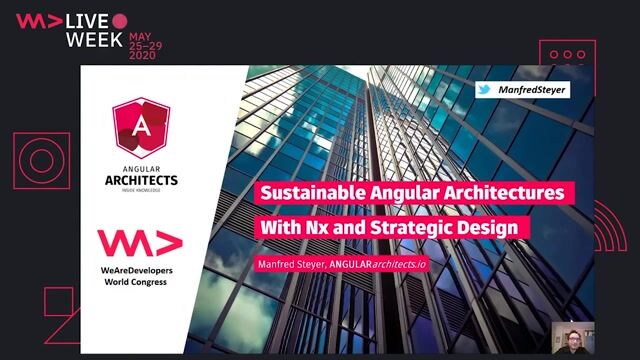
Sustainable Angular Architectures with Nx and Strategic Design

Manfred Steyer

Manfred Steyer reveals how to eliminate the dreaded frontend big ball of mud. Combine Domain-Driven Design with Nx workspaces to build sustainable, strictly bounded Angular architectures.

Pause
Mute Enter Fullscreen
#1 about 5 min

Building long-term Angular architectures with domain-driven design

Creating sustainable enterprise applications requires balancing design methodologies like domain-driven design with an experienced team logic.

#2 about 4 min

Applying strategic domain-driven design for sub-domains

Decomposing large codebases into isolated sub-domains prevents unintended side effects and tangled architectural logic.

#3 about 6 min

Managing scale and dependencies using mono repositories

Grouping isolated projects under a single workspace eliminates versioning conflicts and simplifies library distribution burdens.

#4 about 2 min

Enhancing Angular workspaces with native Nx capabilities

Adopting an Nx workspace over a standard Angular CLI environment enables advanced visual dependency graphing.

#5 about 5 min

Structuring Nx workspaces with domain and shared libraries

Dividing modules into features, utility components, and domain layers enforces clear application boundaries and code reuse.

#6 about 6 min

Enforcing architectural boundaries and module access restrictions

Implementing explicit boundary access rules avoids deep cyclic dependencies and prevents the shared kernel from mutating into a monolith.

#7 about 5 min

Managing domain logic using infrastructure and facade patterns

Separating domain models from APIs using a facade orchestrates use cases efficiently while paving a path to integrated state management.

#8 about 6 min

Exploring a domain-driven Nx workspace source code

Exposing only specific components via index files maintains strict interface stability while keeping implementation details internal.

#9 about 6 min

Visualizing dependencies and linting architectural module constraints

Adding tags to module configuration parameters powers custom linting rules that block illegal imports directly in continuous integration pipelines.

#10 about 4 min

Accelerating continuous integration builds with affected tools

Utilizing git diff insights enables developers to selectively build and test only the modified slices of an entire monorepo.

#11 about 6 min

Replacing Angular modules with lightweight fine-grained libraries

Decomposing heavy logic into granular libraries yields superior caching boundaries while moving away from traditional Angular module patterns.

Matching moments

2:53 min

Managing enterprise monorepos using Nx tooling features

Florian Rappl · World Congress 2022

7:50 min

Debunking common misconceptions about the Nx ecosystem

Miroslav Jonas · JS Congress

4:42 min

Evaluating the long-term trajectory of the Angular framework

Sani Yusuf · JS Congress

2:54 min

Fundamental architecture and modules in Angular applications

Indu Chaube · LIVE

8:14 min

Restructuring the monolith using domain-driven design

Jens Happe Jens Happe · LIVE

1:22 min

Structuring engineering teams around domain bounded contexts

Tom George · LIVE

Upcoming sessions on this topic

Open session

World Congress 2026 North America

September 24, 2026 · 12:50–13:20

Stage 7

Architecting AI in Angular: WebMCP, A2UI, and the Agent Experience

Ankita Sood

Sr. Principal Engineer @ Secureworks | Angular GDE

Ankita Sood
Open session

World Congress 2026 North America

September 24, 2026 · 14:10–14:40

Stage 9

One Repo, One Strategy: Scalable Full-Stack Testing in a Monorepo World

Bartosz Leczycki, Paweł Matynia

Bartosz Leczycki
Paweł Matynia
Open session

World Congress 2026 North America

September 24, 2026 · 10:20–10:50

Stage 3

Reading the Mind of Your NGINX Fleet: A Hybrid Rule + ML Pipeline for NGINX Config Intelligence

Brandon LEE

AI Architect Lead at F5

Brandon LEE
Open session

World Congress 2026 North America

September 25, 2026 · 12:20–12:50

Stage 9

Designing APIs That Survive AI Agents at Scale

Phani Pendurthi

Mastercard, Principal Software Engineer

Phani Pendurthi
Open session

World Congress 2026 North America

September 23, 2026 · 15:45–17:45

Stage 12

Architecting Multi-Agent Teams: Mastering the Orchestration Patterns of ADK 2

Christina Lin

Developer Relations Engineering Manager

Christina Lin
Open session

World Congress 2026 North America

September 24, 2026 · 16:10–16:40

Stage 4

From Cloud Native to Multi-Cloud Native: Write Once, Deploy Anywhere

Sandeep Pal

Principal Member of Technical Staff at Salesforce

Sandeep Pal