








LM
Luis Minvielle
- Discuss this with your agent
- Open in Claude
- Open in ChatGPT
Does your Java app crumble under sudden traffic spikes? Compare non-reactive RestTemplate with reactive WebFlux side-by-side to see how asynchronous data streams unlock massive system elasticity.
Matching moments
1:31 min
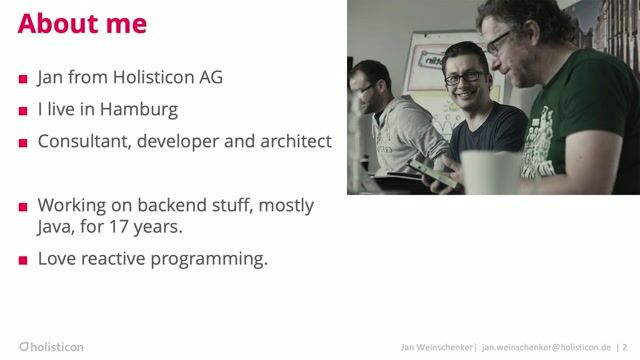
Evaluating the future of reactive programming in Java
 Jan Weinschenker · World Congress 2024
2:03 min
Building scalable applications with reactive programming
Josh Long · World Congress 2022
46 sec
Contrasting Project Loom virtual threads with reactive semantics
Josh Long · World Congress 2022
2:36 min
Shifting to reactive programming paradigms in Java code
Niklas Heidloff · LIVE
2:31 min
Contextual history of reactive programming in Java ecosystems
 Ivan Šarić · Europe 2026 Virtual
1:36 min
Introduction to Project Loom and reactive programming
Jan Weinschenker · World Congress 2024
More from World Congress 2023
Related videos
Related articles
.webp)
AA
Ali Alp

JF
Jonas Fritzsch
main.jpg)
IK
Igor Khokhriakov
CH
Chris Heilmann

From learning to earning
Jobs that call for the skills explored in this talk.
3 months ago
Mid/Senior Full-Stack Engineer (Web-first)

SMG Swiss Marketplace Group
Valbonne, France
Experienced
Remote
Kotlin
Backend
ReactJS
25 days ago
Software Engineer, Java (Opshub)

Bitpanda
Laza, Spain
Remote
MongoDB
Backend
Kubernetes
about 2 months ago
Senior Fullstack AI Engineer (React, Java)

TeamViewer Germany GmbH,
Austin, TX, United States
Expert
ReactJS
Backend
TeamViewer
20 days ago
Sr Architect - Emerging Technologies

Twilio
New York, NY, United States
Expert
$284k
Remote
NoSQL
Twilio
Golang
about 2 months ago
Senior Software Engineer, React (Investing & Trading)
Bitpanda
Laza, Spain
Remote
Next.js
ReactJS
Caching
about 2 months ago
Software Engineer
Twilio
Oakland, CA, United States
Expert
$142k–208k
Remote
Redis
NoSQL
Twilio